
A filter press is an industrial solid-liquid separation machine that uses pressure to remove liquid from slurry while retaining solid particles inside a series of filtration chambers. It is widely used in wastewater treatment, mining, chemical processing, metallurgy, food production, pharmaceuticals, and many other industries where efficient dewatering or product recovery is required.
Although the basic idea is simple, a filter press is much more than a machine that squeezes water out of sludge. Its performance depends on the interaction between filter plates, filter cloth, feed pressure, slurry characteristics, filtration area, chamber depth, operating cycle, and other process conditions.
During operation, slurry is pumped into chambers formed between filter plates. The liquid phase passes through the filter cloth and drainage channels as filtrate, while suspended solids remain inside the chambers and gradually form a filter cake. As the cake becomes thicker, filtration resistance increases and the filtrate flow rate normally decreases.
This pressure-driven filtration process can produce relatively dry filter cakes, recover reusable liquid, reduce sludge volume, and improve downstream material handling.
This guide explains what a filter press is, how it works, its main components, different filter press types, common industrial applications, and the most important factors to consider when choosing a filter press.
What Is a Filter Press?
A filter press is a batch-operated pressure filtration system designed to separate suspended solids from liquids.
The material entering the filter press is normally called slurry. Slurry may contain wastewater sludge, mineral particles, chemical precipitates, metal hydroxides, pigments, food products, pharmaceutical materials, or many other suspended solids.
The filter press separates this slurry into two main products:
- Filter cake: The solid material retained inside the filtration chambers.
- Filtrate: The liquid that passes through the filter cloth and exits the machine.
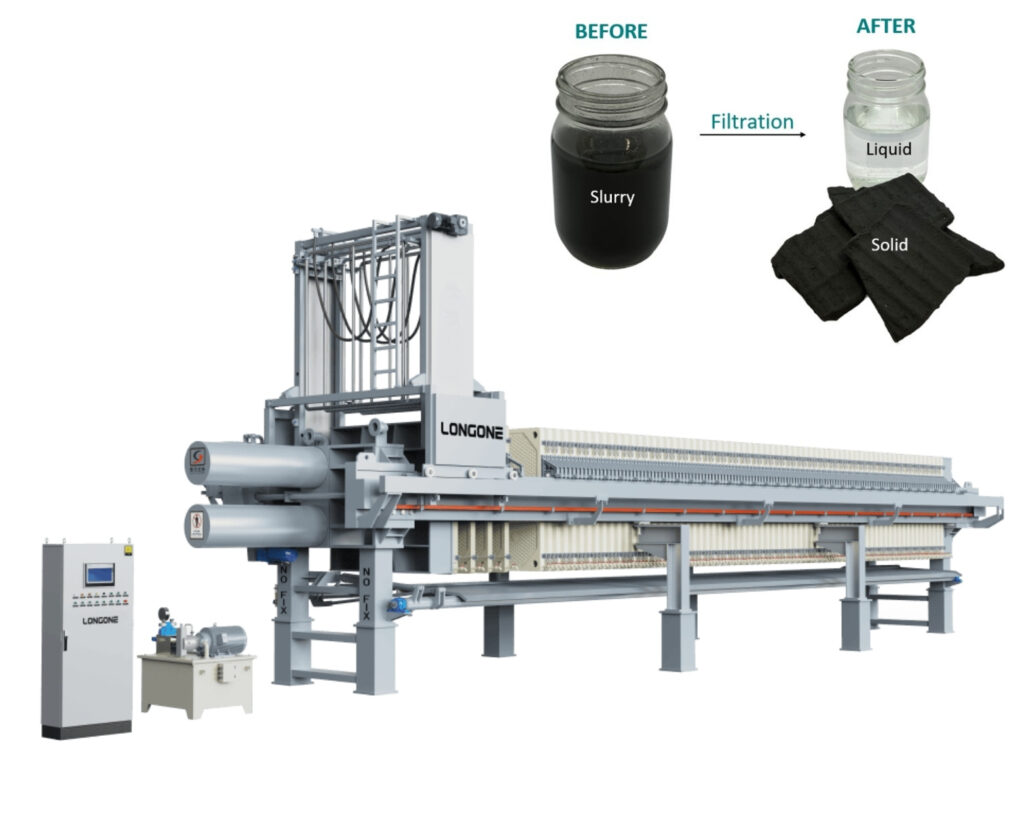
The main difference between a filter press and many other filtration technologies is that a filter press uses relatively high pressure to force liquid through the filtration medium.
As pressure increases and solids accumulate, a dense cake begins to form inside each chamber. This filter cake gradually becomes an additional filtration layer. Small particles that may initially approach the filter cloth are increasingly captured by the growing cake structure.
Because of this process, filtration behavior changes throughout each cycle.
At the beginning of filtration, filtrate flow may be relatively high because the chambers contain little solid material. As the cake grows thicker, resistance to liquid flow increases. Eventually, the chambers become filled and further filtration becomes inefficient.
The press is then opened and the accumulated filter cakes are discharged.
This makes the filter press a batch filtration machine rather than a completely continuous separation system. However, modern automatic filter presses can automate plate opening, cake discharge, filter cloth washing, and other operations, significantly reducing manual labor.
For industrial users, the purpose of a filter press is not simply to separate solids from water. Depending on the process, the primary objective may be to:
- Produce a dry and transportable filter cake
- Recover valuable solids
- Recover valuable filtrate
- Reduce sludge disposal volume
- Reuse process water
- Improve product purity
- Reduce downstream drying costs
- Meet environmental discharge requirements
Understanding the actual filtration objective is therefore the first step in selecting the right filter press.
What Are the Main Parts of a Filter Press?
A filter press contains several important components that work together during each filtration cycle. Their design, material, and condition directly affect filtration efficiency and equipment reliability.
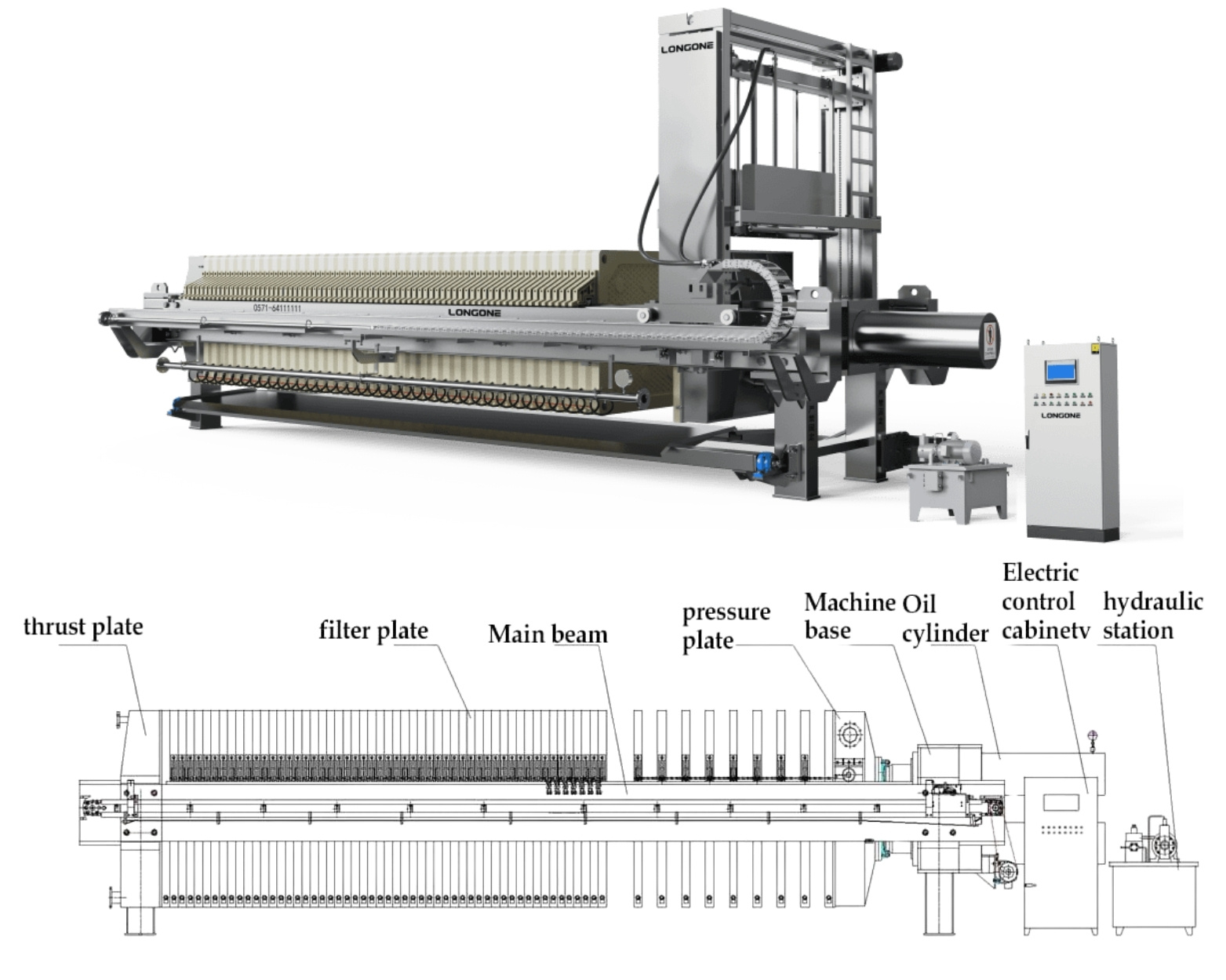
Filter Plates
Placas filtrantes are among the most important components of a filter press.
When the plates are pressed together, recessed areas between adjacent plates form filtration chambers. These chambers receive the slurry and provide the space where filter cake develops.
Filter plates also contain internal drainage channels that allow filtrate to flow away after passing through the filter cloth.
Depending on the application, filter plates may be manufactured from materials such as polypropylene, stainless steel, or other chemically resistant materials.
Plate selection depends on factors including:
- Operating pressure
- Slurry chemistry
- Temperature
- Required filtration area
- Cake thickness
- Mechanical strength
- Resistencia a la corrosión
The plate design has a major influence on filtration capacity and cake formation.
Filter Cloth
Filter cloth is the actual filtration medium that separates solid particles from liquid.
Each filter plate is normally covered with carefully selected filter cloth. When slurry enters the chamber, liquid passes through the pores of the cloth while solid particles are retained.
Different filter cloth materials and weave structures provide different levels of permeability, particle retention, chemical resistance, and cake release performance.
Common filter cloth materials include polypropylene, polyester, nylon, and other synthetic fibers.
Choosing the correct cloth is essential because a cloth that is too open may allow excessive solids to enter the filtrate, while a cloth that is too dense may increase filtration resistance and extend cycle time.
Frame
The frame supports the entire filter plate pack and withstands the high mechanical forces generated during filtration.
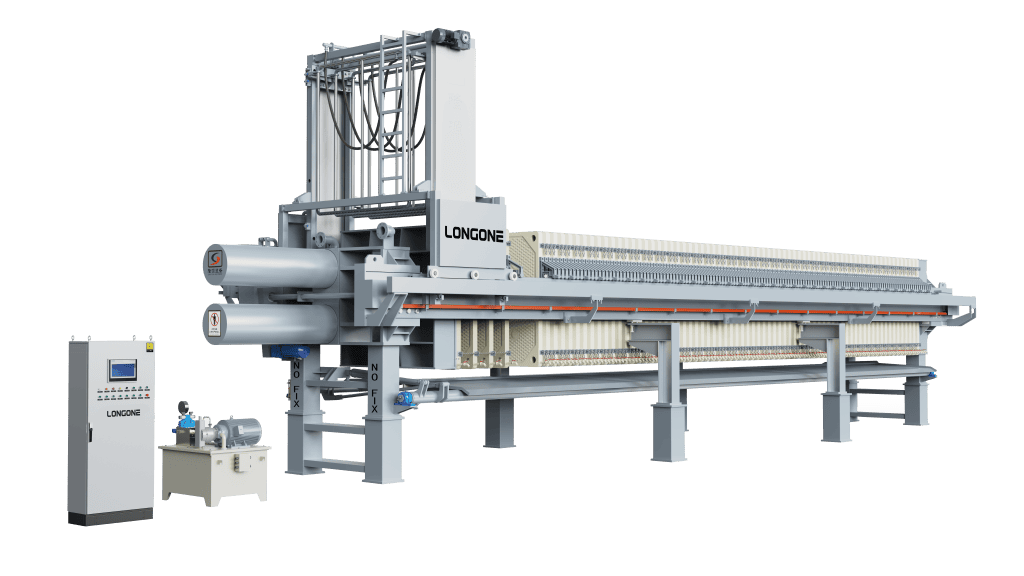
A typical filter press frame includes a fixed head, movable head, side beams, hydraulic closing system, and supporting structure.
Because filtration may occur under significant pressure, frame strength and alignment are critical for safe and stable operation.
Hydraulic Closing System
Before slurry enters the press, the filter plates must be tightly compressed together.
A hydraulic cylinder normally moves the movable head and applies sufficient closing force to prevent the plates from separating during filtration.
The required closing force depends on plate size, filtration pressure, and machine configuration.
Feed Pump
The feed pump transfers slurry into the filter press.
Pump selection is especially important because feed pressure and flow rate change throughout the filtration cycle.
At the beginning of filtration, the system generally requires relatively high flow. As filter cake develops, filtration resistance increases and the required pressure rises.
The pump therefore needs to match the hydraulic characteristics of the filtration process.
Piping, Valves, and Filtrate Collection System
Piping and valves control slurry feeding, filtrate discharge, washing water, compressed air, membrane squeezing media, and other process streams.
The filtrate leaving individual plates is collected and directed to storage, treatment, recycling, or further processing.
For corrosive applications, pipework and valves must also be selected according to the chemical characteristics of the slurry and filtrate.
How Does a Filter Press Work?
Understanding how a filter press works is easier when the complete filtration cycle is divided into several stages.
Plate Closing
Before filtration begins, the hydraulic system closes the plate pack.
The filter plates are pressed tightly together to create sealed filtration chambers. Sufficient closing force must be maintained to withstand the internal slurry pressure.
Slurry Feeding
The feed pump transfers slurry into the filter press through the feed inlet.
The slurry then flows through internal ports and is distributed into the chambers between the filter plates.
During the early stage of filtration, the chambers contain mostly liquid slurry and filtration resistance is relatively low.
Initial Filtration
Pressure forces the liquid phase through the filter cloth.
Suspended solids that are larger than the effective filtration openings are retained on the surface of the cloth, while liquid passes through the cloth and enters the drainage channels inside the filter plates.
The liquid leaves the filter press as filtrate.
Initially, the filtrate may contain very fine particles until a stable cake layer begins to develop.
Filter Cake Formation
As more slurry enters the press, retained solids accumulate on the filter cloth.
This growing layer becomes the filter cake.
An important principle of filter press operation is that the filter cake itself gradually becomes part of the filtration medium.
As cake thickness increases, smaller particles can be captured more effectively. At the same time, however, the cake creates additional resistance to liquid flow.
As a result, filtrate flow generally decreases as the filtration cycle progresses.
Pressure Build-Up
The feed pump continues supplying slurry while filtration resistance increases.
Pressure gradually builds until the chambers are substantially filled with solids or the target filtration conditions are reached.
Operators or automatic control systems may determine cycle completion according to pressure, filtrate flow rate, filtration time, cake condition, or a combination of these factors.
Simply increasing pressure does not always improve productivity. Excessive pressure may compress some types of cake to the point that permeability decreases significantly, causing longer filtration times.
The best operating pressure therefore depends on the slurry characteristics and filtration objective.
Optional Membrane Squeezing
In a membrane filter press, an additional squeezing stage can be performed after the initial cake formation process.
Flexible membrane plates expand using water or compressed air and apply additional pressure directly to the filter cake.
This can remove additional liquid from the cake and reduce final cake moisture.
Membrane squeezing is particularly useful when reducing cake moisture can lower transportation, disposal, or thermal drying costs.
Cake Discharge
Once filtration is complete, the slurry feed stops and internal pressure is released.
The hydraulic closing system retracts, allowing the filter plates to separate.
Filter cakes then fall from between the plates.
In manual filter presses, operators may need to move plates individually. In automatic filter presses, plate shifting devices can open the plates and discharge cakes automatically.
After cake discharge, the filter press closes again and the next filtration cycle begins.
What Are the Different Types of Filter Presses?
Different filtration processes require different filter press configurations.
Understanding the main types can help users select equipment that better matches their production requirements.
Chamber Filter Press
The chamber filter press, also known as a recessed chamber filter press, is one of the most commonly used designs.
Each filter plate contains a recessed area. When two plates are pressed together, these recessed sections create a chamber where filter cake forms.
Chamber filter presses are widely used for:
- Wastewater sludge
- Mining slurry
- Chemical precipitates
- Metal hydroxides
- Industrial process sludge
They provide a relatively simple structure, reliable operation, and good dewatering performance.
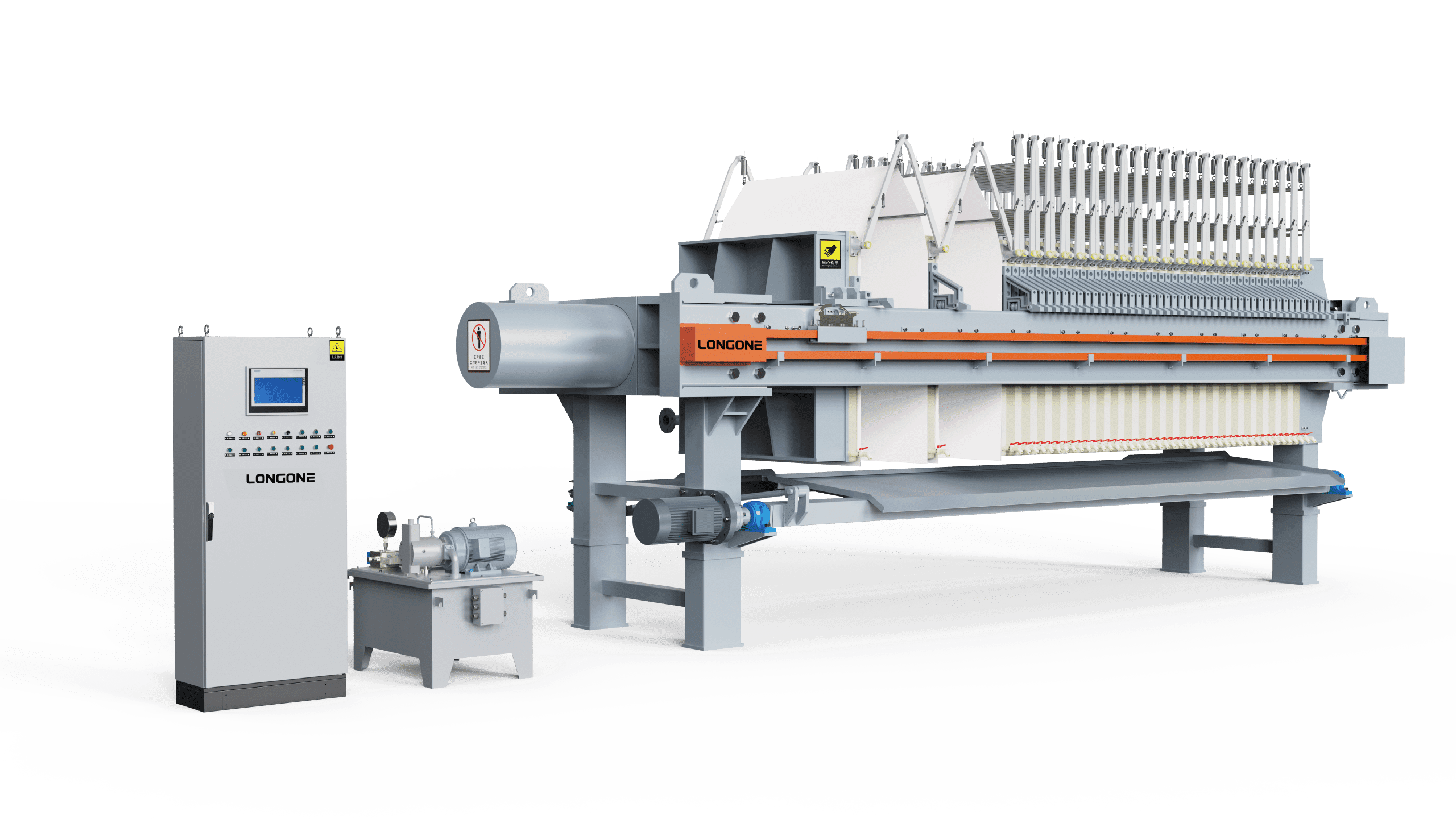
Plate and Frame Filter Press
A traditional plate and frame filter press alternates flat plates and separate frames.
The frames provide the spaces where cake forms, while plates support the filter cloth and provide drainage.
Although recessed chamber presses are now more common in many heavy industrial applications, plate and frame systems can still be useful where process flexibility, cake washing, or specialized filtration requirements are important.
Membrane Filter Press
A membrane filter press incorporates flexible membranes into selected or all filter plates.
After the chambers have been filled, the membranes expand and physically compress the cake.
Potential benefits include:
- Lower cake moisture
- Shorter filtration cycles in some applications
- More consistent cake thickness
- Reduced downstream drying requirements
- Better washing performance in selected processes
The additional equipment cost should be compared with potential savings in sludge disposal, transportation, drying, and overall production efficiency.
Automatic Filter Press
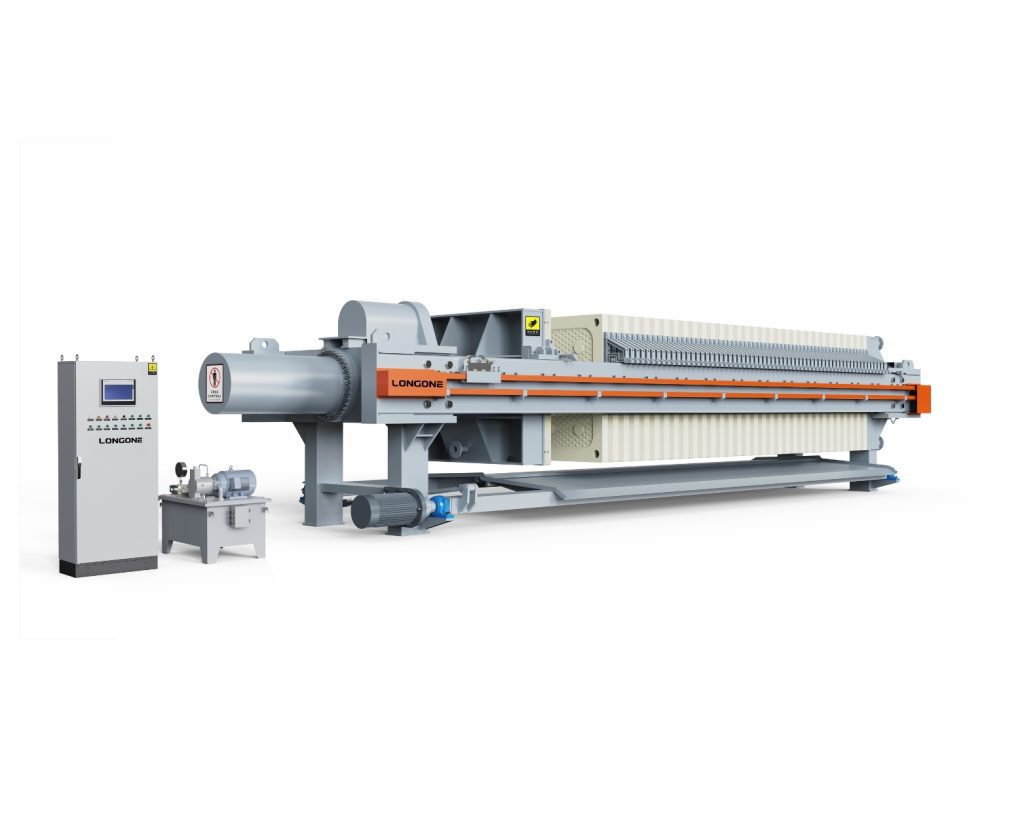
Automatic filter presses reduce manual operation by automating functions such as:
- Hydraulic closing
- Slurry feeding
- Plate opening
- Cake discharge
- Plate shifting
- Filter cloth washing
- Drip tray operation
Automatic systems are especially valuable for larger plants, high-frequency filtration cycles, and facilities that want to reduce labor requirements.
Automation does not change the fundamental filtration principle. Instead, it improves operating consistency, productivity, and safety.
What Is a Filter Press Used For?
Filter presses are used across many industries because pressure filtration can handle a broad range of slurry types.
Tratamiento de aguas residuales
One of the most common applications is sludge dewatering.
Wastewater treatment processes often generate sludge containing large amounts of water. Transporting and disposing of this high-moisture sludge can be expensive.
A filter press removes part of the liquid and produces a more concentrated cake, helping reduce sludge volume and disposal costs.
Mining and Mineral Processing
Mining operations generate large volumes of mineral slurry.
Filter presses may be used for:
- Tailings dewatering
- Concentrate filtration
- Process water recovery
- Valuable mineral recovery
Reducing water content can make mineral products easier to transport while allowing water to be returned to the production process.
Procesamiento químico
Chemical plants frequently handle slurries containing salts, catalysts, pigments, metal hydroxides, crystals, or reaction products.
Filter presses can be used for product recovery, purification, wastewater treatment, and by-product separation.
Because chemical slurries may contain acids, alkalis, solvents, salts, or corrosive substances, material compatibility is particularly important.
Metallurgy and Hydrometallurgy
Metal processing operations may generate slurries containing valuable metals or metal-bearing residues.
Filter presses can help separate solids from leach solutions, recover precipitated metals, and dewater process residues.
Food and Beverage Processing
Filter presses can also be used for selected food processing applications where solids need to be separated from liquid products.
The filter plates, filter cloth, seals, and other contact materials must meet the hygiene and compatibility requirements of the specific process.
Pharmaceutical and Specialty Processing
Pharmaceutical and fine chemical applications may use filter presses for carefully controlled solid-liquid separation.
These processes may require stainless steel structures, specialized filter media, enclosed designs, cake washing systems, or other customized configurations.
The important point is that a filter press does not always exist simply to produce dry waste.
In some processes, the filter cake is the valuable product.
In others, the filtrate is the valuable product.
And in wastewater treatment, reducing the volume of material requiring disposal may be the primary objective.
How Do You Choose the Right Filter Press?
Choosing a filter press should begin with the material being filtered rather than simply selecting a machine according to plate dimensions.
A filter press that performs well with one slurry may operate very differently with another.
Several factors should be evaluated before equipment selection.
Slurry Solids Concentration
The percentage of solids in the feed slurry has a major influence on chamber filling and filtration cycle time.
A slurry with higher solids concentration may fill the chambers relatively quickly, while a very dilute slurry may require substantially more feed volume to produce the same quantity of filter cake.
Particle Size
Particle size distribution affects cake permeability and filtration rate.
Coarser particles often form relatively permeable cakes that allow liquid to pass more easily.
Very fine particles can form dense cakes with high resistance, resulting in slower filtration.
Slurry Viscosity
Higher-viscosity liquids generally flow through the filter cake and cloth more slowly.
Temperature changes can also affect viscosity, which means filtration performance may vary significantly under different operating conditions.
Chemical Compatibility
The pH, chemical composition, solvents, salts, acids, and alkalis present in the slurry must be considered when selecting filter plates, filter cloth, piping, valves, seals, and frame protection.
For highly corrosive applications, corrosion-resistant materials may be necessary to achieve acceptable equipment life.
Required Filtration Capacity
The required amount of slurry processed per hour or per day is essential when determining filtration area and machine size.
However, filtration capacity should not be estimated from slurry volume alone.
Filter cake solids quantity, cake density, cycle time, cake thickness, and operating schedule must also be considered.
Required Cake Moisture
Different applications require different levels of cake dryness.
If the filter cake is simply being discharged nearby, moderate moisture may be acceptable.
If cake must be transported long distances, disposed of by weight, thermally dried, or reused as a product, lower moisture content may provide significant economic benefits.
In these situations, a membrane filter press may be worth considering.
Filter Plate Size and Chamber Depth
Larger plates provide more filtration area, while chamber depth affects the amount of cake that can accumulate during each cycle.
Increasing chamber volume does not automatically guarantee higher productivity because thicker cakes can also increase filtration resistance.
The correct plate and chamber configuration should therefore be based on actual slurry filtration behavior.
Filter Cloth Selection
Filter cloth should be selected according to particle retention, permeability, cake release, chemical resistance, temperature, and cleaning requirements.
A correctly selected filter cloth can improve filtrate clarity, shorten filtration time, reduce cloth blinding, and improve cake discharge.
Presión de funcionamiento
Higher pressure can improve dewatering in many applications, but pressure should not be treated as the only measure of filter press performance.
Cake permeability may decrease as particles become increasingly compressed.
For some materials, operating at unnecessarily high pressure may produce only a small improvement in cake moisture while significantly increasing cycle time and equipment stress.
Cycle Time
Productivity depends on the complete filtration cycle rather than filtration time alone.
A complete cycle may include:
- Plate closing
- Slurry feeding
- Filtration
- Membrane squeezing
- Air blowing
- Cake washing
- Plate opening
- Cake discharge
- Filter cloth cleaning
The best filter press is therefore not necessarily the machine that produces the driest possible cake. It is the system that achieves the required separation result at an economical and repeatable cycle time.
Whenever possible, laboratory filtration testing or pilot testing should be performed using the actual slurry before final equipment sizing.
Conclusion
A filter press is a pressure-driven solid-liquid separation system that uses filter plates and filter cloth to separate slurry into filter cake and filtrate.
Its operating principle is straightforward: slurry enters sealed filtration chambers, liquid passes through the filter cloth, and solids remain behind to gradually form filter cake. As the cake grows, filtration resistance increases until the chambers are filled and the cake is discharged.
However, achieving efficient filtration requires much more than simply applying high pressure.
Slurry solids concentration, particle size, viscosity, chemical composition, operating temperature, filter plate design, filter cloth permeability, chamber depth, filtration area, feed pressure, required cake moisture, and cycle time all influence the final result.
This is why filter press selection should always be based on the actual process conditions and filtration objectives.
For some facilities, the priority is reducing sludge disposal volume. For others, it is recovering valuable solids, obtaining clear filtrate, recycling process water, or producing a low-moisture filter cake.
Selecting the correct filter plates, filter cloth, filtration area, and equipment configuration can significantly improve filtration efficiency and long-term operating reliability.
LONGONE provides filter press equipment, filter plates, filter cloths, and customized solid-liquid separation solutions for wastewater treatment, mining, chemical processing, metallurgy, and other industrial applications. If you are selecting a new filter press or replacing filter plates for an existing system, providing information about your slurry characteristics, processing capacity, operating pressure, and required cake moisture can help determine a more suitable filtration solution.