
If your filter press is leaking around the plates, or the filtrate is coming out with a metallic tint it shouldn’t have, you’re probably not dealing with a maintenance problem. You’re dealing with a materials problem — and it usually shows up faster than anyone expects.
Filter presses in chemical processing, electroplating, hydrometallurgy, and hazardous sludge treatment routinely handle slurries loaded with acids, alkalis, salts, and dissolved heavy metals. A standard carbon-steel press wasn’t built for that environment. A corrosion-resistant filter press was — and understanding what actually makes one “corrosion-resistant,” beyond the marketing language, is what determines whether the equipment lasts three years or ten.
Why Standard Filter Presses Fail in Strongly Corrosive Applications
Carbon steel frames, ordinary filter cloths, and standard plate materials weren’t engineered to sit in prolonged contact with acidic or caustic slurry. Under corrosive conditions, this shows up in a predictable sequence: pitting on exposed metal, cracking or swelling in the filter plates, seal degradation at the plate faces, and eventually leaks at the joints.
The consequences go beyond equipment cost. A pitted frame or degraded plate can shed metal particulate directly into the filtrate, which is a serious problem if that filtrate is a chemical product or feeds back into another process step. Leaks introduce safety risk on the shop floor. And unplanned downtime for plate replacement disrupts production schedules that often can’t absorb the interruption. In industries producing corrosive slurry as a matter of course — plating baths, hydrometallurgical leach liquors, acid pickling lines — this isn’t an edge case. It’s the baseline operating condition, and the equipment needs to be specified for it from the start.
How a Corrosion-Resistant Filter Press Works
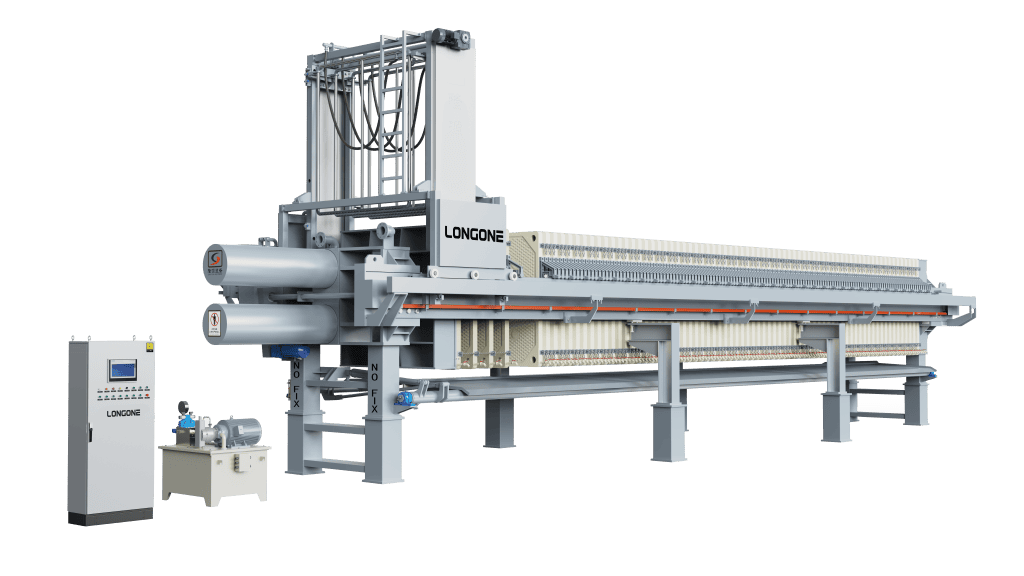
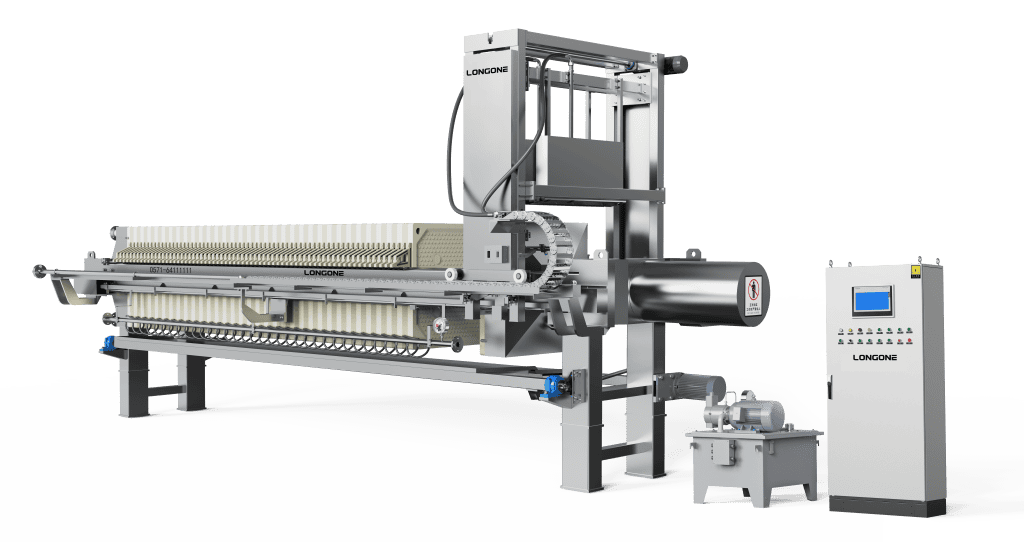
The underlying mechanism is the same as any chamber filter press: a hydraulic system compresses a stack of filter plates into a sealed chamber, a feed pump pushes slurry into that chamber under pressure, liquid passes through the filter cloth as filtrate, and solids build up on the cloth surface as a filter cake. When the cycle finishes, the plates release and the cake drops out by gravity.
What changes in a corrosion-resistant model isn’t the process — it’s what the process happens inside of. Every surface that touches the slurry is upgraded to a material that can tolerate the specific chemistry involved, so the separation mechanics stay identical while the equipment’s working life extends from months to years. For applications needing lower cake moisture, a membrane-plate configuration adds a secondary squeeze stage — using water or compressed air to press the cake further — which is common in hydrometallurgy and hazardous waste dewatering where minimizing residual liquid matters for downstream handling and disposal cost.
Core Materials and Anti-Corrosion Design
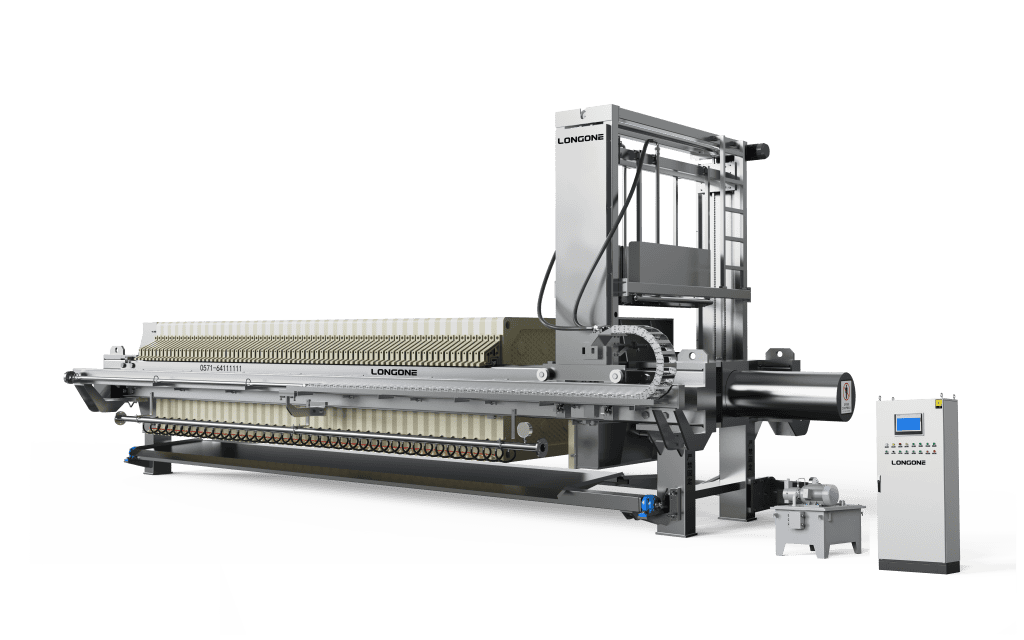
Corrosion resistance isn’t one material choice — it’s a system of choices across every part that contacts slurry, vapor, or splash.
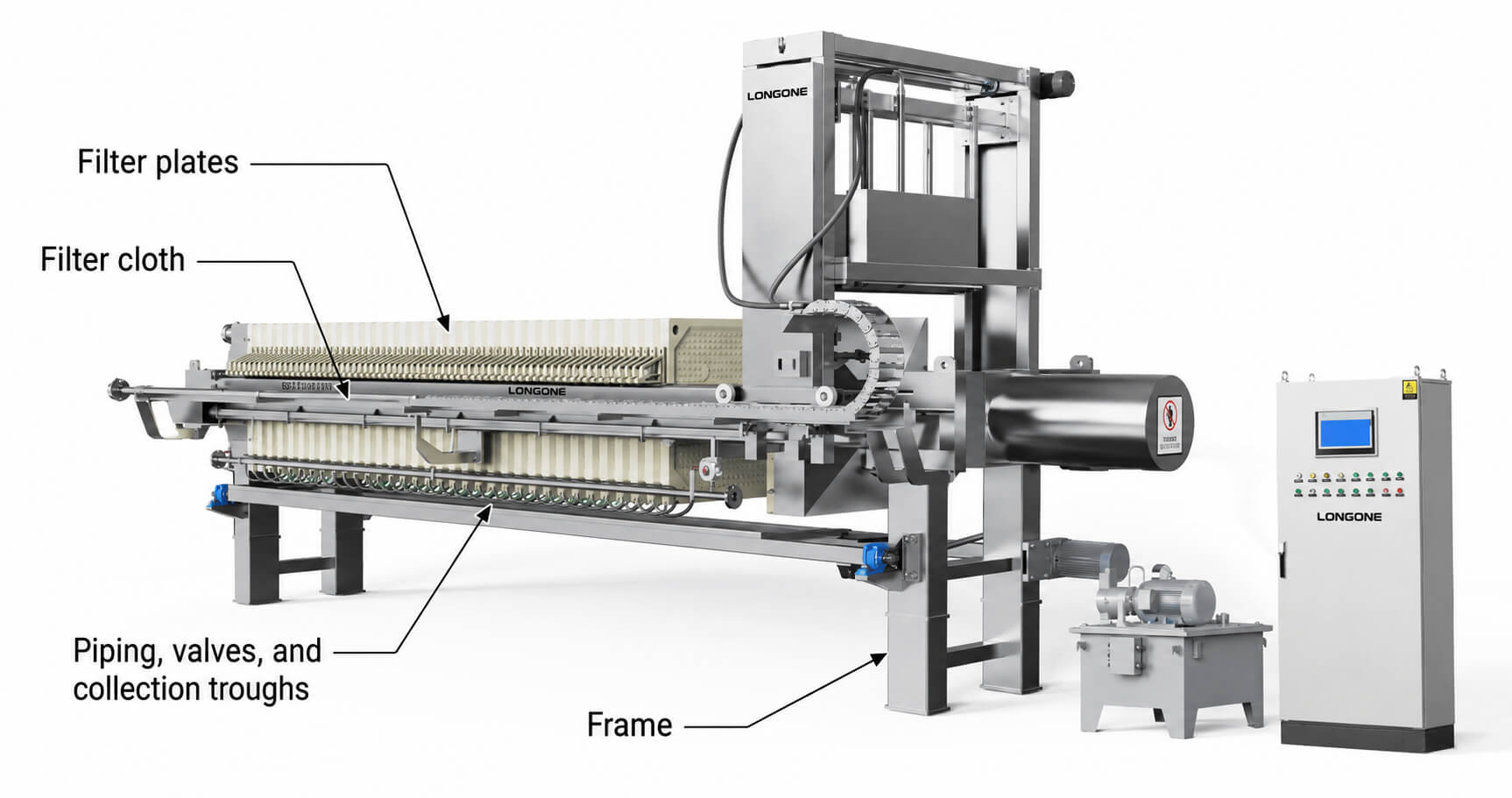
Placas filtrantes: Reinforced polypropylene is the industry-standard baseline, and for good reason. It handles pH 1–14 and temperatures up to roughly 80°C, resists cracking under repeated pressure cycles, and comes in at a fraction of the cost of exotic alloys. That range covers the large majority of acid, alkali, and salt slurries encountered in chemical processing and metal finishing. Outside that range — strongly oxidizing concentrated acids, or sustained high-temperature operation — standard PP plates are the wrong choice, and this is where a lot of equipment failures trace back to under-specifying the plate material rather than any manufacturing defect.
Filter cloth: Acid- and alkali-resistant polypropylene (PP) cloth is matched to the plate material to prevent the filter media itself from becoming the weak point. A degraded cloth means particle bleed-through and reduced cake integrity, even if every other component is holding up fine.
Frame: The frame doesn’t sit in direct contact with the slurry, but corrosive vapor and filtrate splash in the work area still attack exposed metal over time. Frames are typically protected with stainless steel cladding, rotational-molded coatings, or specialized anti-corrosion paint systems. For facilities with consistently high humidity or aggressive off-gassing, a fully stainless-steel frame removes this as a long-term concern entirely.
Piping, valves, and collection troughs: These are frequently overlooked, but they see just as much chemical exposure as the plates. PP or stainless-steel construction across all wetted auxiliary components closes off what would otherwise become the failure point that undermines an otherwise well-specified press.
Key Advantages Over Carbon Steel Filter Presses
The case for a corrosion-resistant press comes down to four measurable outcomes rather than a general durability claim.
| Factor | Carbon Steel Filter Press | Corrosion-Resistant Filter Press (PP Plates + Coated/SS Frame) |
|---|---|---|
| Typical service life in corrosive slurry | Months before pitting/leaks | Multiple years with proper maintenance |
| Filtrate purity | Risk of metal particulate contamination | No metallic contamination from wetted parts |
| Leak/safety risk | Higher — seal and plate failure over time | Substantially reduced |
| Best-fit pH range | Near-neutral only | pH 1–14 (standard PP), wider with custom materials |
| Relative upfront cost | Lower | Moderate — offset by lower replacement/downtime cost |
Beyond the table, the operational impact matters just as much. Consistent filtrate purity protects product quality and batch yield in chemical and metal-salt production, where a contaminated filtrate can mean a failed spec on an entire run. Reduced leak risk lowers the chance of a corrosive-liquid safety incident on the floor. And for facilities under environmental compliance pressure, stable dewatering performance supports filtrate recycling and sludge volume reduction — both of which are increasingly tied to permit requirements rather than being optional efficiency gains.
How to Select the Right Corrosion-Resistant Filter Press
Selection should start from four process parameters, not from a plate material preference:
- Slurry pH and specific chemistry. Not all “acidic” slurries behave the same — a dilute organic acid and a concentrated oxidizing mineral acid call for different plate specifications even at similar pH readings.
- Operating temperature. Standard PP plates top out around 80°C; higher sustained temperatures require different plate chemistry or a custom material solution.
- Solids concentration. This drives filter area, chamber volume, and expected cycle time.
- Whether cake washing is required. If downstream processing needs a cleaner, lower-residual-liquid cake, a membrane-plate configuration is usually the right call over a standard chamber press.
For slurries with unusual or mixed chemical composition, a small-scale soak or bench test against candidate plate materials is worth doing before committing to a full-scale order — it’s a low-cost way to confirm compatibility rather than discovering a mismatch after the equipment is running. Strongly oxidizing acids or unusually high-temperature processes generally shouldn’t default to standard polypropylene plates; that’s a case for a manufacturer conversation about custom materials rather than an off-the-shelf spec. Filter area and automation level (manual, hydraulic-automatic, or fully programmed plate-pulling) should then be sized against daily throughput and the plant’s existing automation standards.
Maintenance Practices That Extend Service Life
Even correctly specified equipment underperforms without a basic maintenance routine:
- Rinse after every batch. Flush plates, cloth, and material flow channels with clean water to prevent corrosive residue from crystallizing and attacking components between runs.
- Inspect coatings and seals regularly. Check anti-corrosion coating integrity, plate surface condition, and sealing faces for residue buildup or early pitting.
- Protect idle equipment. If a press sits unused for extended periods, keep it clean and dry rather than leaving residual slurry in contact with any surface.
None of this is complicated, but it’s frequently skipped under production pressure — and it’s usually the gap between a press that lasts three years and one that lasts eight.
Conclusion
Corrosion resistance in a filter press isn’t a single spec — it’s the sum of plate material, cloth compatibility, frame protection, and auxiliary component construction, all matched to the actual slurry chemistry rather than a generic “acid-resistant” label. Get that matching right at the selection stage, pair it with basic post-batch maintenance, and a corrosion-resistant press will run for years in conditions that would take a standard carbon-steel unit out of service within months. Get it wrong — usually by defaulting to standard PP plates outside their pH or temperature range — and the equipment fails regardless of how well everything else was specified. The four parameters that matter most (pH, temperature, solids concentration, and cake-washing requirements) are worth confirming before an order is placed, not after installation.
Preguntas frecuentes
What pH range can a standard corrosion-resistant filter press handle?
Reinforced polypropylene plates, the industry-standard material, typically handle pH 1–14 at temperatures up to around 80°C. Outside that temperature or for strongly oxidizing acids, a custom plate material is usually needed.
Is a corrosion-resistant filter press more expensive than a standard one?
The upfront cost is typically moderate to higher than a basic carbon-steel unit, but it’s usually offset within one to two years through avoided plate replacement, reduced downtime, and elimination of filtrate contamination losses.
Can a corrosion-resistant filter press handle high-temperature acidic slurry?
Standard PP plates are rated to roughly 80°C. For sustained higher-temperature operation, a custom plate material specified for the exact chemistry and temperature is required rather than a standard configuration.
Do I need a membrane filter press instead of a standard chamber press?
If your process needs lower cake moisture — common in hydrometallurgy, hazardous sludge disposal, or cases where dry cake reduces downstream handling cost — a membrane configuration with a secondary pressing stage is worth the added cost. For most general chemical dewatering, a standard chamber press is sufficient.