
When a filter press plate cracks mid-cycle, the cost is rarely just the plate. Slurry leaks onto the floor, the cake discharge stops, the line goes down, and someone has to explain to the plant manager why a component that looked identical to the last batch failed in weeks instead of years.
Most of these failures trace back to two decisions: which plate material was chosen, and how well that material was manufactured. Today, polypropylene filter plates account for the large majority of new filter press installations worldwide, from mining concentrators to municipal sludge dewatering. This guide explains why PP earned that position, where its limits are, and how buyers can specify plates that last.
What Are Polypropylene Filter Plates and How Do They Work
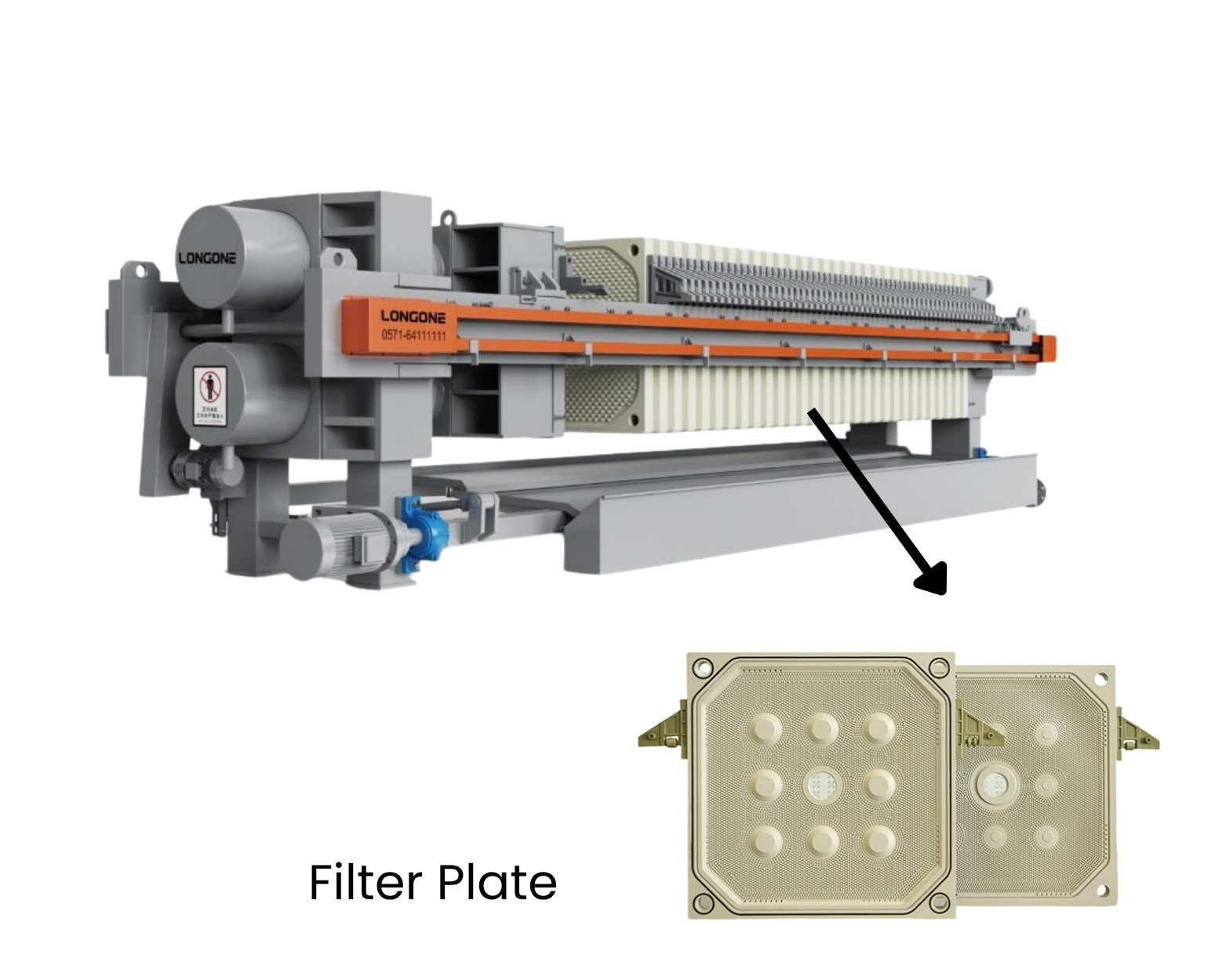
A filter plate is the core structural element of a plate-and-frame or recessed chamber filter press. Plates are clamped together in a row, and filter cloth is fitted over each face. When the plates close, they form sealed chambers. Slurry is pumped into these chambers, the cloth retains the solids, and clear filtrate passes through the cloth, flows along the drainage surface of the plate and exits through the discharge ports. What remains inside the chamber is the filter cake.
Because the plate must hold pressure, support the cloth, guide the filtrate and seal reliably against its neighbor, its material and geometry directly determine the performance of the entire press.
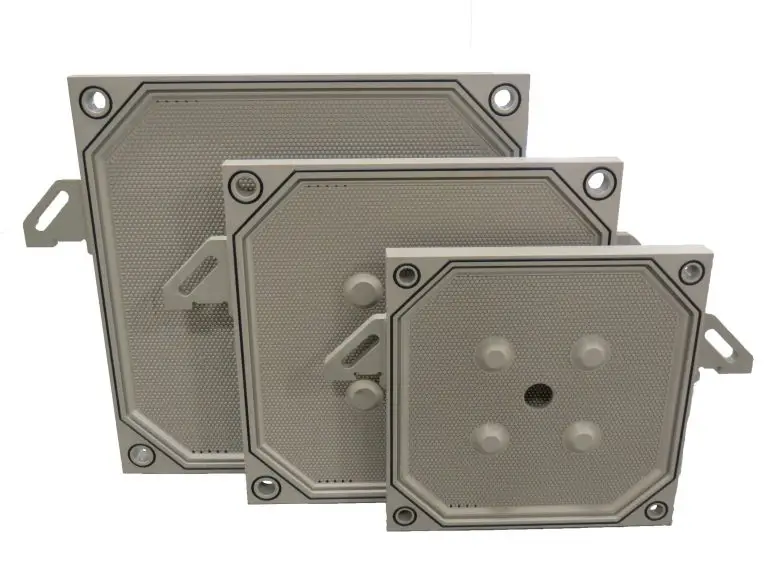
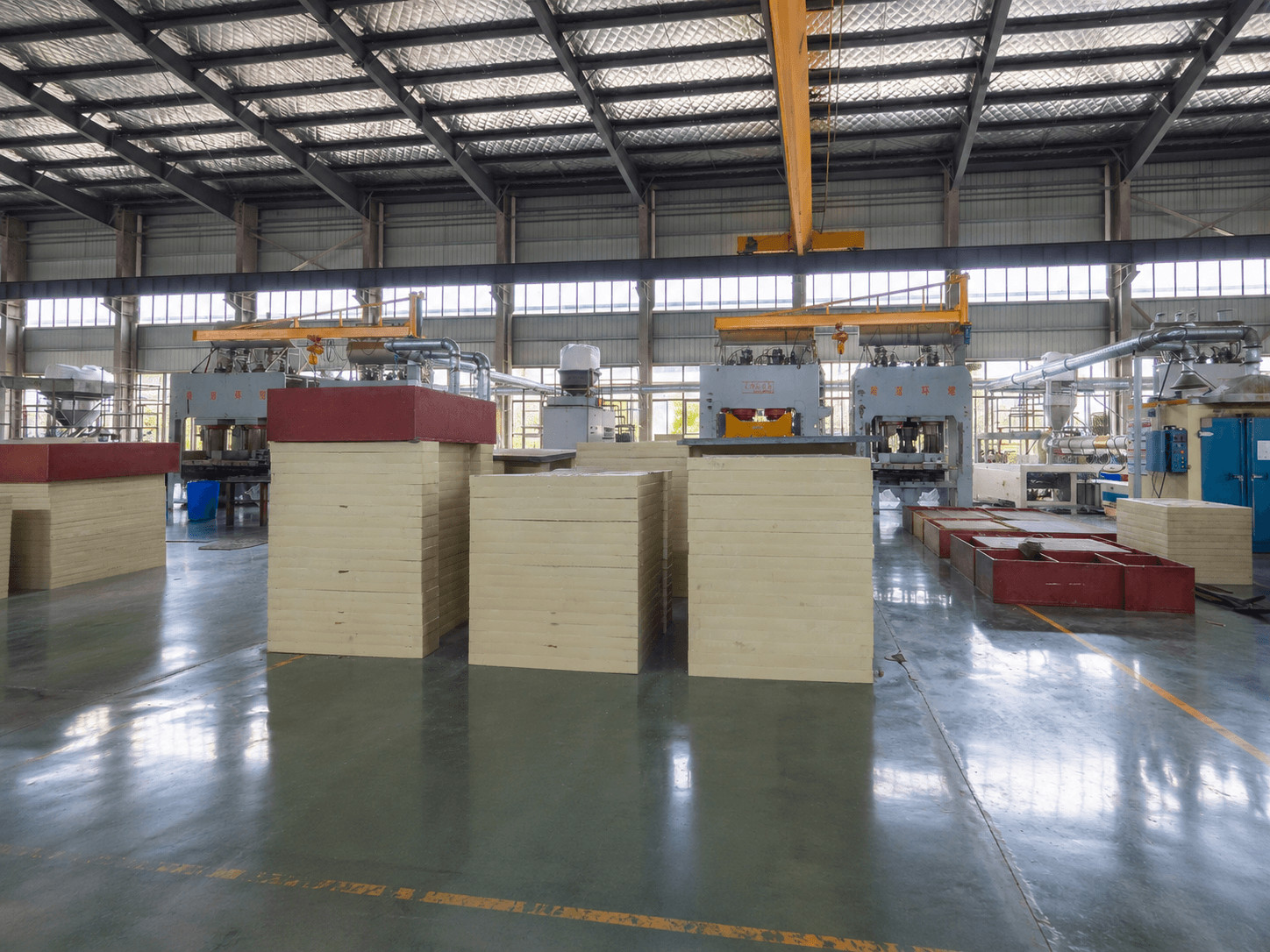
Polypropylene (PP) filter plates are made by injection molding thermoplastic resin into large steel molds. The process produces a one-piece plate with integrated feed eye, drainage grooves, support ribs and sealing surfaces. Injection molding allows consistent dimensions across thousands of plates, which matters because even small variations in flatness or edge thickness can cause leakage when 60 or 100 plates are pressed together.
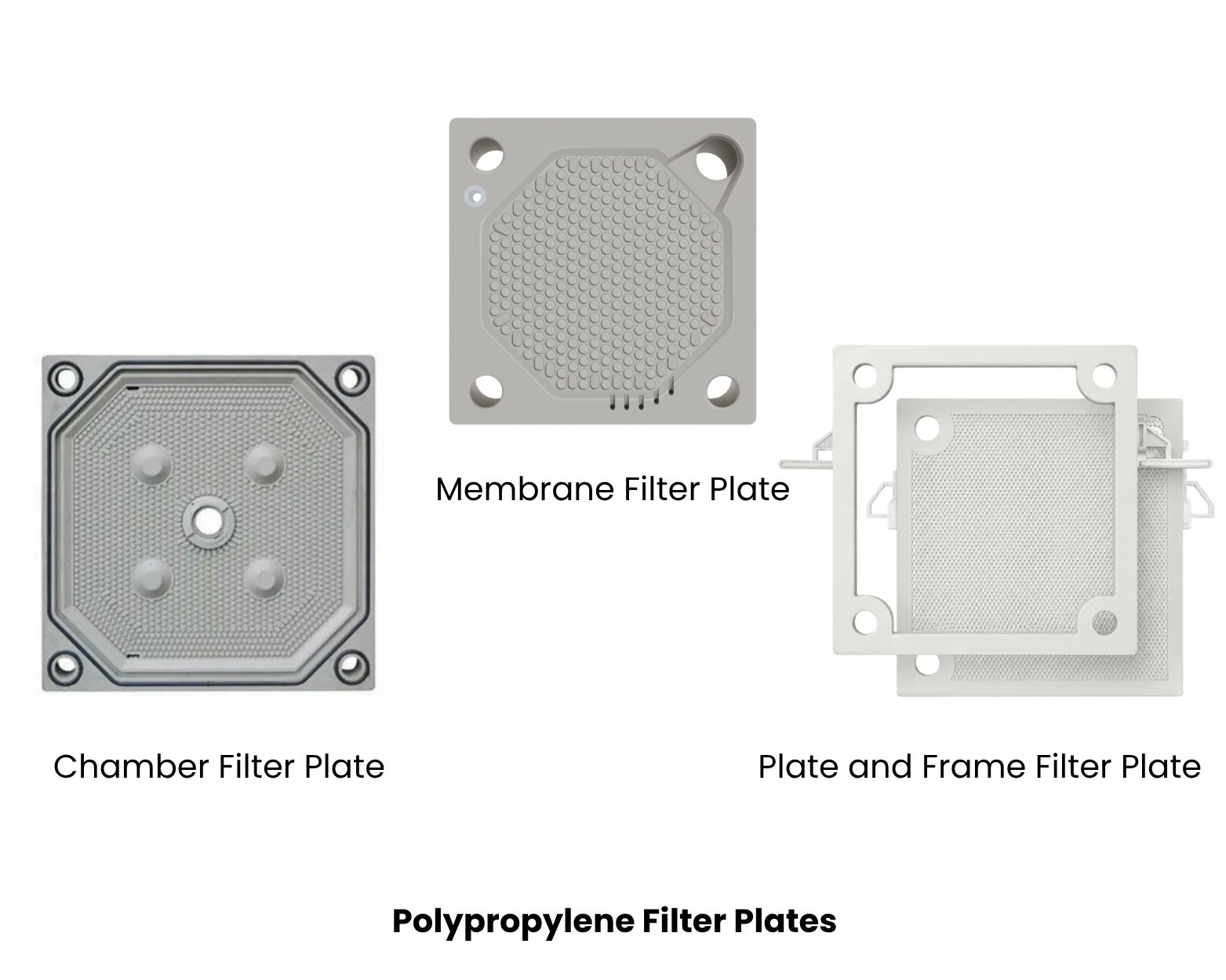
Common PP plate formats include:
- Recessed chamber plates, where a recess on each face forms the chamber with the adjacent plate.
- Membrane plates, which add a flexible diaphragm that inflates to squeeze the cake for lower moisture content.
- Plate-and-frame plates, used with separate frames to form the chamber.
Sizes typically range from small laboratory units to large industrial plates of 1,500 mm to 2,000 mm square.
Why PP Became the Industry Standard: Chemical Resistance, Weight and Cost
Polypropylene did not become dominant because it is the strongest material available. It became dominant because it offers the best balance of properties for the widest range of filtration duties.
Broad chemical resistance
Filter presses handle aggressive streams: acidic mine tailings, alkaline chemical slurries, brines, fertilizer suspensions and industrial wastewater. PP is chemically inert to most dilute and concentrated acids, alkalis and salt solutions. It does not rust, does not pit and does not shed metal ions into the filtrate. For food, pharmaceutical and fine chemical processes, that also means lower contamination risk.
Strong oxidizing agents, some chlorinated solvents and certain aromatic hydrocarbons can attack PP, so chemistry should always be checked. But for the majority of water-based industrial slurries, PP performs reliably.
Light weight
PP has a density of roughly 0.9 g/cm³, far below cast iron or stainless steel. A large PP plate may weigh a fraction of an equivalent metal plate. This has practical consequences:
- Plate shifters and hydraulic systems work under lower load.
- Manual handling during maintenance is safer and faster.
- Press frames, side bars and foundations face less cumulative weight.
- Shipping costs are lower for export orders.
Cost and lifecycle value
Injection-molded PP plates cost significantly less than machined or cast metal plates, and they need no protective coatings. When produced from quality virgin resin and properly reinforced, they deliver service lives that commonly run for several years of continuous duty, depending on slurry, temperature and pressure.
The purchase price is only part of the equation. The more useful measure is cost per filtration cycle, which includes downtime, replacement labor and the effect of leakage on cake quality. On that basis, a well-made PP plate is hard to beat.
Polypropylene vs Cast Iron, Stainless Steel and Rubber Filter Plates
Understanding where PP fits requires comparing it honestly with the alternatives.
| Property | Polypropylene (PP) | Cast Iron | Stainless Steel | Rubber-Lined Steel |
|---|---|---|---|---|
| Chemical resistance | Excellent for most acids, alkalis, salts | Poor; corrodes without coating | Good, but chlorides can cause pitting | Good, depends on rubber type |
| Weight | Very light | Very heavy | Heavy | Very heavy |
| Typical max temperature | About 80°C standard; higher for reinforced grades | Above 200°C | Above 200°C | Depends on rubber, often up to 80-100°C |
| Typical pressure range | 0.6-1.6 MPa (grade and design dependent) | High | High | High |
| Relative cost | Low | Medium | High | High |
| Maintenance | Low | Coating repair, rust control | Low to medium | Lining inspection and repair |
| Best suited for | General industrial, mining, chemical, wastewater, food | Non-corrosive, high-temperature or high-pressure duties | Hygienic, high-temperature or corrosive-with-heat duties | Abrasive and corrosive slurries where PP is unsuitable |
The pattern is clear. Metal plates justify their weight and cost in narrow situations: high temperatures, very high pressures, or special hygienic and structural requirements. For everything else, PP delivers adequate mechanical performance at a lower total cost, with corrosion problems largely removed from the picture.
Temperature and Pressure Limits: Where PP Plates Perform Best
Every material has boundaries, and PP is no exception. Ignoring them is the most common reason PP plates fail early.
Температура
Standard PP filter plates are generally rated for continuous service at temperatures up to about 80°C. As temperature rises, the polymer softens, its stiffness drops and the plate becomes more likely to deform under pressure. Deformation leads to sealing problems, uneven cloth support and eventually cracking.
For hotter slurries, buyers have several options:
- Reinforced or modified PP, which uses fibers or special formulations to raise heat resistance, often to around 100°C.
- Cooling the feed before it enters the press, where the process allows it.
- Alternative materials such as cast iron or stainless steel when temperatures stay high.
Pressure
Typical PP filter plates are designed for feed pressures of 0.6 MPa, 1.0 MPa or 1.6 MPa, and the correct rating depends on plate thickness, rib layout and resin quality. Higher pressure ratings demand thicker sections and better internal support, not just a different label on the datasheet.
Membrane plates add a second pressure stage. The membrane squeeze may operate at pressures up to 1.6 MPa in many designs, and the plate body must be engineered for repeated pressure cycling, not just static loading.
Why cycling matters
Filter plates do not fail only from a single overpressure event. They fail from fatigue. A plate that runs six to eight cycles per day for years experiences tens of thousands of pressure and release cycles. Resin quality, wall thickness and freedom from internal voids determine how long that plate survives. This is where the difference between well-made and poorly made plates becomes visible.
Reinforced PP, Membrane PP and Recessed PP: Choosing the Right Plate Type
Once PP is chosen as the material, the next decision is plate type.
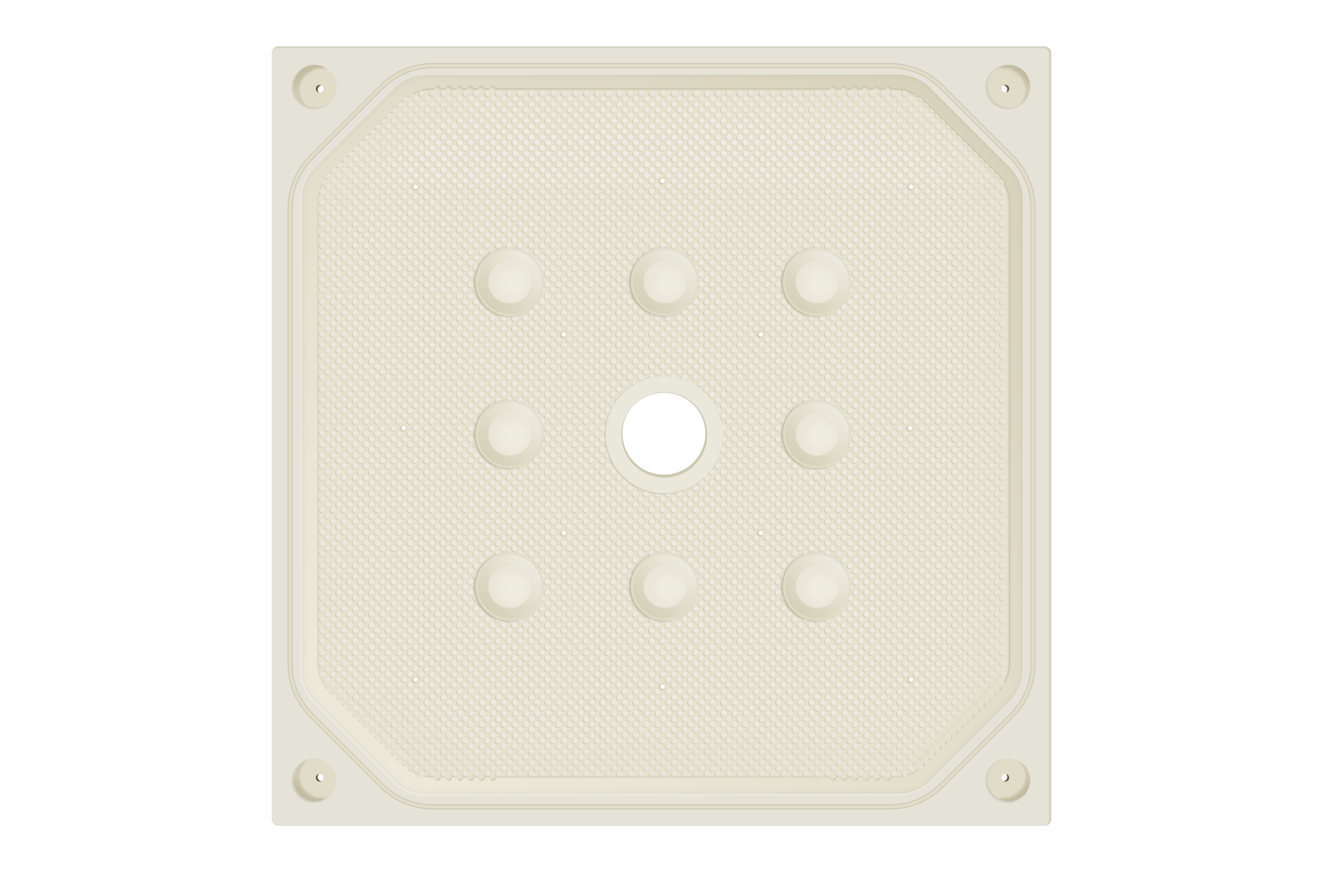
Recessed chamber PP plates
The most common and cost-effective option. They suit general dewatering where cake dryness requirements are moderate. Mining concentrates, ceramic slurries, metal hydroxide sludge and many chemical precipitates run well on recessed plates. Their simple design also makes them easier to maintain and cheaper to replace.
Membrane PP plates
Membrane plates add a flexible PP or elastomer diaphragm. After the fill stage, compressed air or water inflates the membrane and squeezes the cake, often reducing final moisture content significantly compared with a standard recessed plate. They are worth considering when:
- Disposal or transport costs are tied to cake weight.
- Downstream drying costs are high.
- Cake dryness specifications are strict.
- Cycle time reduction is a priority.
The trade-off is a higher plate cost and the need for a membrane squeezing system.
Reinforced and modified PP plates
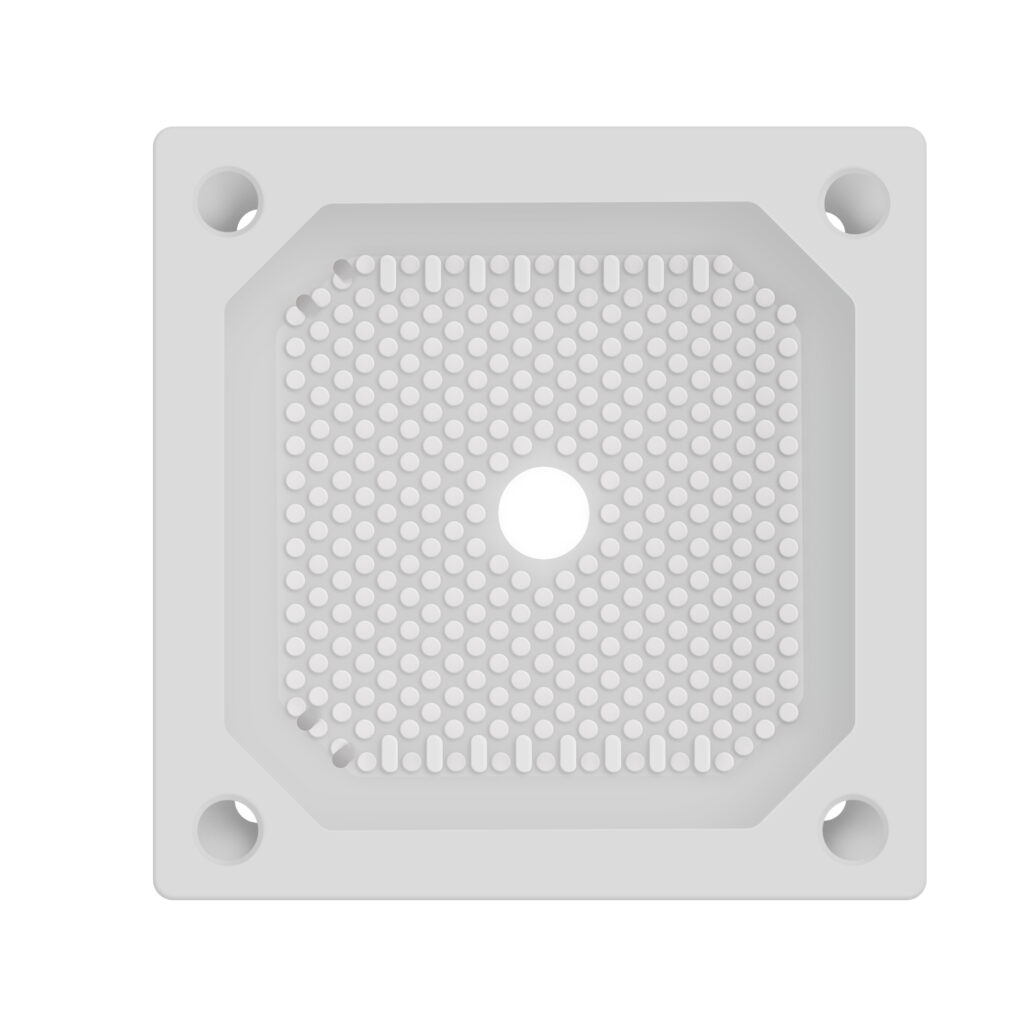
For borderline temperatures or higher pressures, reinforced designs provide extra stiffness and dimensional stability. They are common in demanding chemical, metallurgical and high-solids applications.
Selection by industry
- Mining and minerals: abrasion, fine particles and long duty cycles favor robust recessed or membrane designs with quality resin.
- Chemical processing: compatibility testing is essential; PP handles most inorganic chemistry.
- Municipal and industrial wastewater: membrane plates often pay back through lower sludge volumes.
- Food and beverage: PP’s inertness and resistance to corrosion support clean, consistent filtrate.
How to Specify, Inspect and Extend the Life of PP Filter Plates
Two plates can look identical and perform very differently. The following checklist helps procurement and engineering teams avoid costly surprises.
What to specify before ordering
- Slurry data: pH, temperature, solids concentration, particle size, and any solvents or oxidizers present.
- Рабочее давление: feed pressure and, for membrane plates, squeeze pressure.
- Plate size and feed configuration: square dimensions, center feed or corner feed, and compatibility with your existing press.
- Resin grade: ask whether plates are made from virgin PP or contain recycled or heavily filled material.
- Plate thickness and rib design: especially important at 1.0 MPa and above.
- Cloth and sealing details: cloth fixing method, gasket or sealing-surface design.
What to inspect on delivery
- Flatness and sealing surfaces, with no warping or visible sink marks.
- Uniform color and consistent surface finish, which indicates stable molding conditions.
- Feed eye and discharge port dimensions matching drawings.
- No cracks, flash or contamination from the molding process.
How to extend plate life in service
- Keep operating temperature and pressure within rated limits.
- Avoid sudden pressure spikes from pump start-up or valve closure.
- Clean sealing surfaces and cloths regularly so solids do not build up and force plates apart unevenly.
- Replace damaged cloth promptly, since worn cloth allows solids to scour the plate surface.
- Store spare plates flat, away from direct sunlight and heat sources.
A consistent maintenance routine often extends service life more than any other single factor.
Choosing PP Filter Plates With Confidence
Polypropylene became the industry standard because it solves the problems that matter most in daily filtration: corrosion, weight, cost and dependable sealing. It is not the answer to every duty, but for the broad middle of industrial dewatering, it is the sensible starting point.
The real difference between one PP plate and another lies in resin quality, structural design and manufacturing control. When comparing options for polypropylene filter plates, look beyond the price per piece and consider the slurry, pressure, temperature and expected service life together.
If you are evaluating plates for a new press or planning a replacement, our engineering team is happy to review your slurry data and operating conditions and suggest a suitable plate type and specification. Simply share your process details, and we can help you narrow the options.
FAQ
What temperature can polypropylene filter plates withstand?
Standard PP filter plates are generally suitable for continuous operation up to about 80°C. Reinforced or modified PP grades can extend this range, often to around 100°C, depending on the formulation and plate design. For consistently higher temperatures, metal plates are usually more appropriate.
Are PP filter plates better than cast iron plates?
For most applications involving corrosive or wet chemical slurries, yes. PP resists corrosion, weighs far less and typically costs less. Cast iron remains suitable for high-temperature or specialty duties where plastic cannot perform, but it requires protection against rust and is much heavier to handle.
How long do polypropylene filter plates last?
Service life depends on slurry chemistry, temperature, pressure cycling and resin quality. Plates made from quality virgin PP and operated within their ratings can run for many years. Plates made from low-grade or recycled material may fail much sooner, especially under repeated high-pressure cycles.
Can PP filter plates handle acidic slurry?
Yes. PP has excellent resistance to most acids and alkalis, which is one of the main reasons it is used in mining, metallurgy and chemical processing. Strong oxidizing acids and certain solvents should be checked against a chemical compatibility chart before selection.
How do I choose the right size of PP filter plate?
Plate size is determined by the required filtration capacity, available press frame and site space. Common industrial sizes range from 500 mm to 2,000 mm square. If you are replacing plates in an existing press, the dimensions, feed position and thickness must match your current equipment.