
When a new formulation or process is still under development, running trials on a full-size industrial press is rarely practical. It consumes too much material, takes too much time, and makes comparison testing expensive. A laboratory filter press solves this problem. It lets R&D teams test a small slurry sample under conditions that closely reflect real industrial filtration, and it produces the data needed to size and select production equipment with confidence.
This guide explains what a laboratory filter press is, how the chamber and membrane types differ, how a typical test runs, which parameters you can measure, and, importantly, how to treat lab results when scaling up.
What Is a Laboratory Filter Press and Why Test Before Scaling Up?
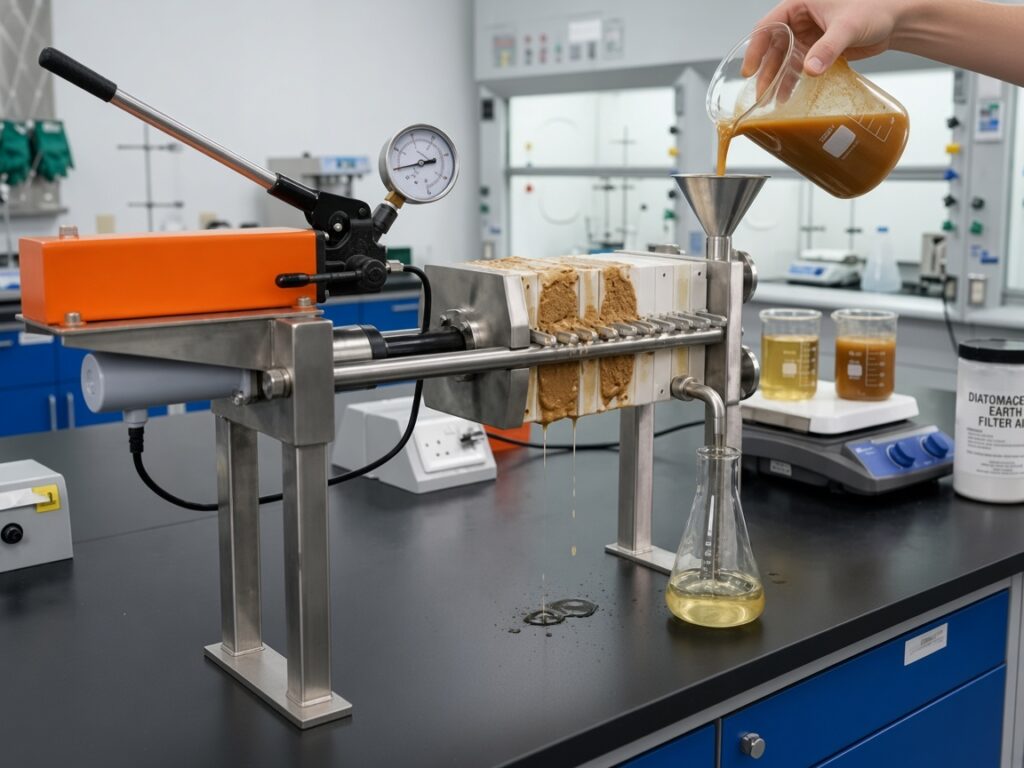
А laboratory filter press (also called a lab filter press or test filter press) is a compact solid-liquid separation machine designed for small-batch trials. It follows the same working principle as an industrial filter press, but with a much smaller filtration area and lower material throughput.
In chemical, pharmaceutical and mineral processing, the filtration behavior of a slurry depends on many variables: particle size, solids concentration, temperature, viscosity and the filter cloth used. These factors are difficult to predict from theory alone. A test filter press turns guesswork into measurable data.
The main reasons to test before scaling up include:
- Lower risk. You validate the process before committing to a large equipment investment.
- Lower material cost. Small sample volumes are enough for each trial.
- Faster development. Multiple test conditions can be compared in a short time.
- Better equipment selection. Measured results support more accurate industrial model sizing.
For this reason, the laboratory filter press is a core piece of equipment in R&D centers, university research teams and third-party testing laboratories.
Chamber vs. Membrane Laboratory Filter Press: Which Fits Your Trials?
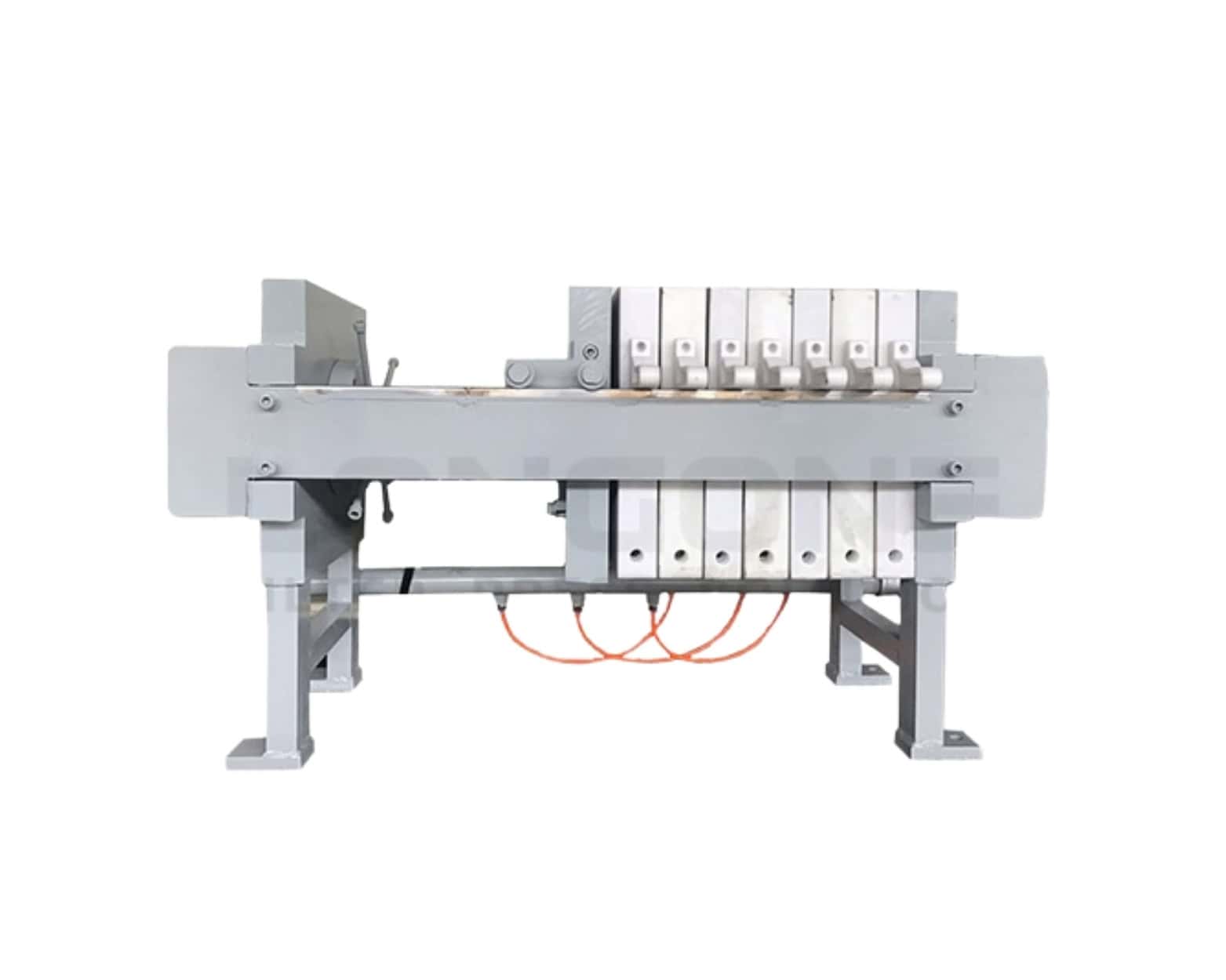
Laboratory filter presses are generally available in two main configurations: the standard chamber type and the membrane (diaphragm) type. The right choice depends on what your trial needs to show.
А chamber laboratory filter press performs conventional filtration. The slurry is pumped into the filter chambers, the liquid passes through the filter cloth, and the solids build up as a filter cake. It is straightforward, easy to operate, and well suited to basic filtration performance tests.
А membrane laboratory filter press adds a second step. After the feed filtration is complete, compressed air or water is introduced behind the membrane, which squeezes the cake further. This additional pressing can reduce cake moisture beyond what standard chamber filtration achieves, which makes it valuable for high-precision dewatering tests.
| Feature | Chamber Type | Membrane Type |
|---|---|---|
| Filtration principle | Feed pressure filtration | Feed filtration plus membrane squeeze |
| Secondary pressing | Not available | Compressed air or water |
| Cake moisture testing | Baseline dewatering result | Evaluates additional moisture reduction |
| Structure | Simpler | Includes membrane chamber and pressing medium line |
| Best suited for | General filtration trials, cloth and parameter screening | High-precision dewatering and comparison with standard filtration |
| Typical question answered | “How does my slurry filter?” | “How dry can my cake become with pressing?” |
If you are not sure which one you need, a useful approach is to run the same slurry on both types. The comparison shows directly how much benefit a pressing step adds to your specific material.
How a Laboratory Filter Press Works: Key Components and Test Procedure
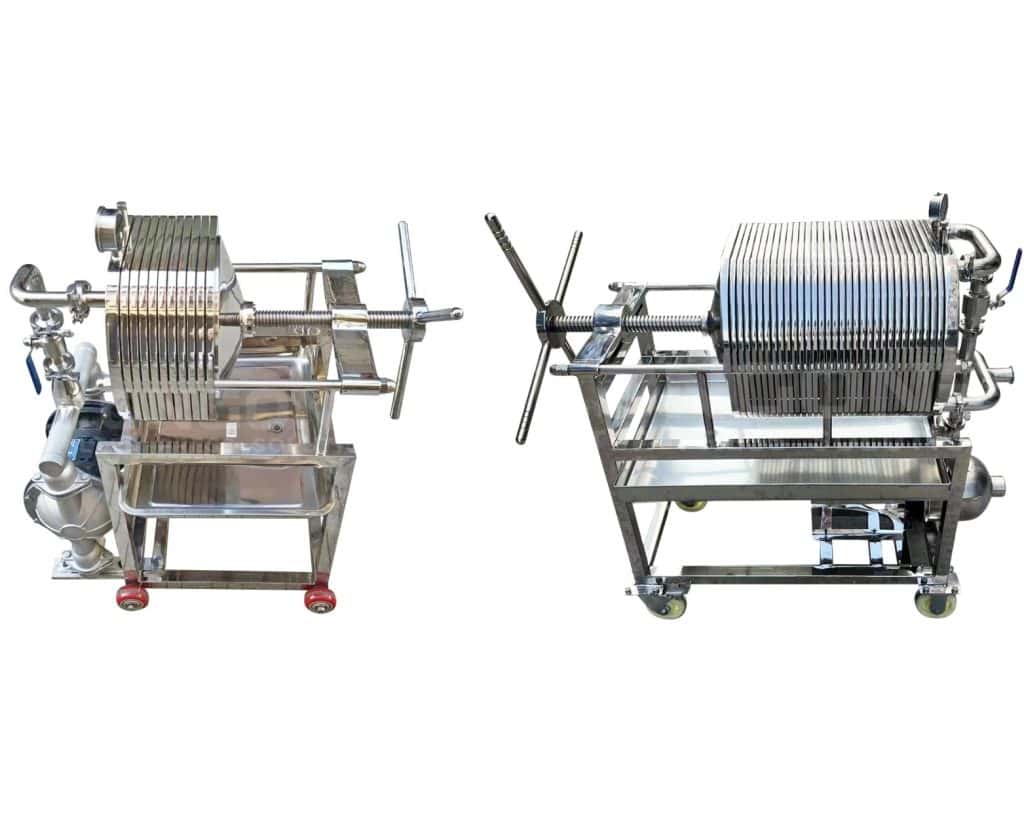
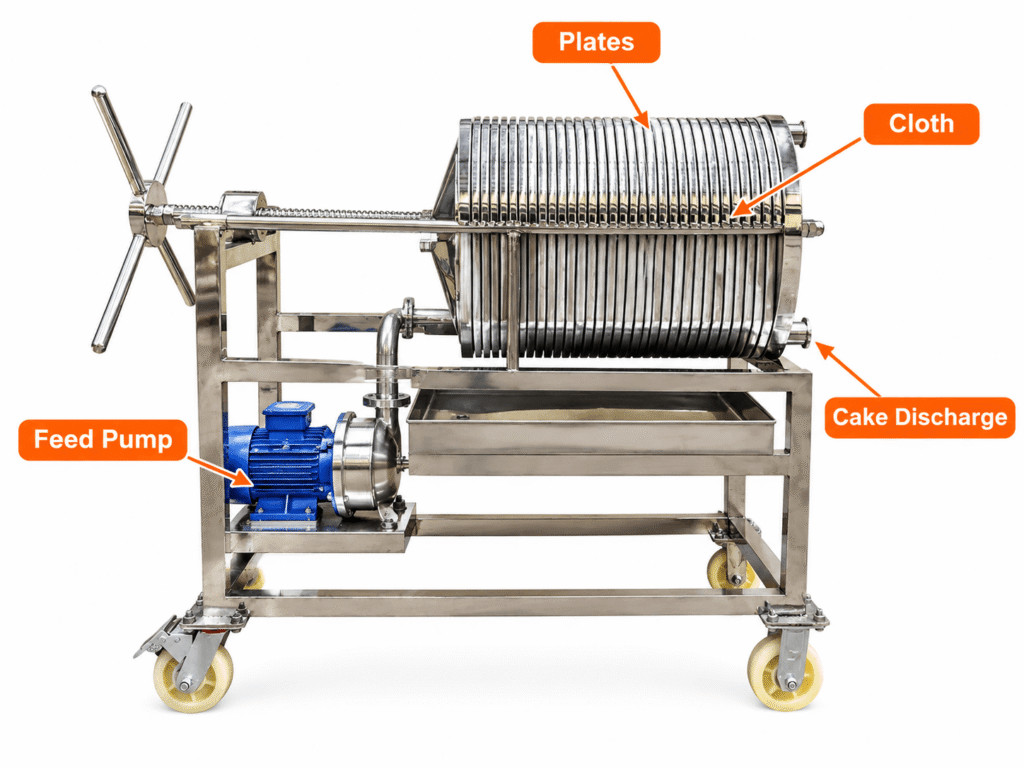
Despite its small size, a lab filter press keeps the essential structure of an industrial unit. The main components include:
- Frame: supports the plates and the clamping mechanism.
- Filter plates: form the filtration chambers.
- Clamping device: holds the plates tightly together during filtration.
- Filter cloth: retains the solids while allowing the liquid to pass.
- Feed piping: delivers the slurry into the chambers.
A membrane laboratory filter press also includes membrane chambers and a pipeline for the pressing medium, either compressed air or water.
A typical test follows a simple sequence:
- Prepare the slurry at the concentration and temperature you want to evaluate.
- Clamp the plates to the required pressure.
- Pump the slurry into the filter chambers.
- Collect the filtrate as the liquid passes through the cloth, while the solids form a cake.
- Apply membrane pressing (membrane type only) to squeeze the cake further.
- Release the clamping mechanism and remove the filter cake.
- Record the results, including filtration time, cake condition and filtrate quality.
Because each run uses only a small amount of material and consumables, you can repeat the process many times with different settings. This is what makes a lab filter press so efficient for process screening.
Key Process Parameters You Can Measure: Filtration Time, Cake Moisture and Cake Thickness
The real value of a laboratory filter press is the data it generates. The most important parameters include:
Filtration time and filtration rate. How quickly the slurry filters tells you how long a production cycle is likely to be. Slow filtration may suggest the need for a different filter cloth, a pre-treatment step or a change in feed concentration.
Cake moisture content. This is often the most commercially important result. Lower moisture means lower handling and transportation cost, and in some processes it determines whether downstream drying is needed. With a membrane laboratory filter press, you can compare moisture before and after the pressing step.
Cake thickness and formation. Cake thickness affects both filtration efficiency and cake release. Testing helps you understand how the cake forms and whether it discharges cleanly from the cloth.
Filtrate clarity. The quality of the filtrate shows whether the chosen cloth is retaining fine particles effectively.
Effect of operating conditions. Because the equipment allows adjustment of clamping pressure, filter cloth type, and, on membrane models, pressing pressure and time, you can see how each variable influences the final result. You can also test the same material at different temperatures and concentrations.
Recording these values systematically builds a clear performance profile of your slurry, which is the foundation for any later equipment selection.
Applications in Fine Chemicals, Non-Metallic Minerals and Biopharma R&D
Laboratory filter presses are used wherever a new solid-liquid separation process needs to be developed or verified. Typical fields include:
Fine chemicals. Reaction products, intermediates and pigments often have very different filtration characteristics from batch to batch. A test filter press helps engineers compare conditions and confirm that a process is repeatable.
Non-metallic mineral processing. Fine mineral slurries can be challenging to dewater. Lab trials help determine whether standard filtration is sufficient or whether membrane pressing is needed to reach the target moisture level.
Biopharmaceutical and pharmaceutical R&D. Development stages often involve small, valuable samples. The low material consumption of a lab filter press makes it a practical way to evaluate separation performance without wasting product.
Universities and testing laboratories. Research teams and third-party labs use these machines for method development, material studies and customer sample testing.
In all of these settings, the goal is the same: to collect reliable filtration data early, before large investments are made.
From Lab Data to Industrial Filter Press Sizing: Managing Scale-Up Effects
This is the most important point for any buyer or process engineer to understand: laboratory results cannot be copied directly to industrial production.
A lab-scale test reflects small-scale conditions. When the process moves to a full-size filter press, a scale-up effect appears. Differences in feed consistency, cake thickness, plate size, cycle time and real site conditions can all influence the final performance. Treating lab numbers as exact production guarantees can lead to undersized equipment or unrealistic expectations.
A sound scale-up approach usually includes:
- Using lab data as a reference, not a final specification. The results show trends and relative performance between options.
- Correcting for actual site conditions. Feed variation and operating practice should be taken into account.
- Reviewing the data with an experienced supplier. Interpretation matters as much as the measurement itself.
- Selecting the industrial model based on the corrected data. Filtration area, chamber configuration and whether a membrane plate is required should all follow from the validated results.
LONGONE supports users through this transition. In addition to supplying laboratory filter presses in both chamber and membrane configurations, LONGONE offers free working-condition data analysis and helps match test results to a suitable industrial filter press model. The aim is to close the gap between small-scale R&D and industrial production, so that the equipment you finally purchase is based on evidence rather than assumption.
Talk to LONGONE About Your Filtration Trials
If you are planning a filtration test program or need help choosing between a chamber and a membrane laboratory filter press, the LONGONE team is happy to discuss your material and your goals. Contact us to arrange a trial consultation, and we will help you turn your lab results into a practical path toward industrial production.
FAQ
What is a laboratory filter press used for?
It is used for small-scale solid-liquid separation tests. Engineers use it to evaluate filtration time, cake moisture, cake thickness and filtrate quality before selecting or designing an industrial filter press.
What is the difference between a chamber and a membrane laboratory filter press?
A chamber type performs standard feed filtration only. A membrane type adds a secondary squeeze using compressed air or water, which can further reduce cake moisture and helps evaluate high-precision dewatering performance.
Can I use different filter cloths on a lab filter press?
Yes. Filter cloths can be changed, and clamping pressure can be adjusted, so you can compare how different materials and settings affect filtration results.
Can lab test results be applied directly to a full-size filter press?
No. Lab data is a valuable reference, but a scale-up effect exists. Results should be corrected against real production conditions before an industrial model is selected.
Which industries use laboratory filter presses?
They are widely used in fine chemicals, non-metallic mineral processing and biopharmaceutical R&D, as well as in university research and third-party testing laboratories.
Does LONGONE help with industrial equipment selection after testing?
Yes. LONGONE provides free working-condition data analysis and supports industrial filter press selection based on your test results.