
A filter press crew opens the plates, and one cloth has worn through around the feed eye again. Another line down the hall takes twice as long to change cloths as planned. Both problems often trace back to the same decision made years earlier: where the slurry enters the filter plate.
Feed position looks like a minor line in a specification sheet. In practice, it shapes how the filter cloth is fitted, how the cake forms and releases, and how much maintenance the plates demand over their service life. This guide explains the two main designs, center feed and corner feed, and gives you a practical way to decide which one fits your operation.
What Are Center Feed and Corner Feed Filter Plates?
Every filter press works the same way at a basic level. Slurry is pumped in, solids are held back by the filter cloth, and clear filtrate leaves through the plate drainage system. The feed channel is the path the slurry takes to reach the filtration chambers, and its location is what separates the two designs.
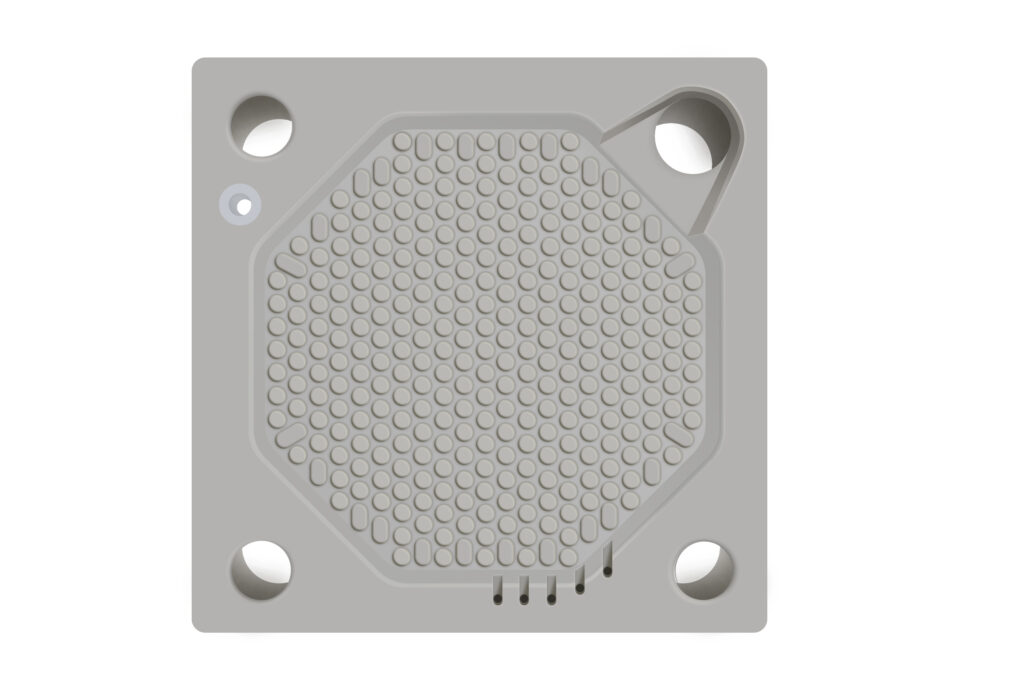
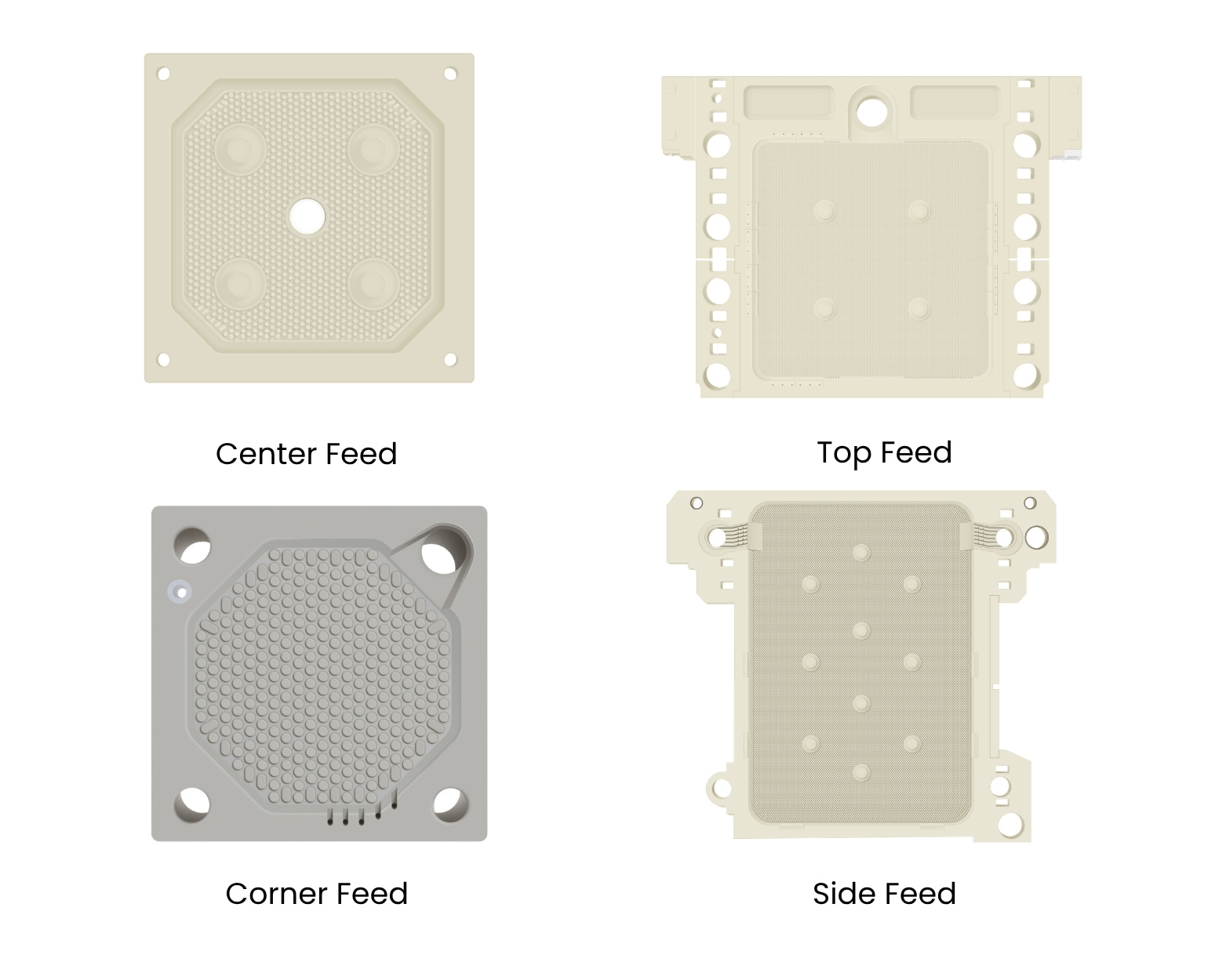
Center feed filter plates have the feed port in the middle of the plate. When the plates are closed, the aligned center holes form a continuous channel running the length of the plate stack. Slurry travels down this channel and flows into each chamber from the middle.
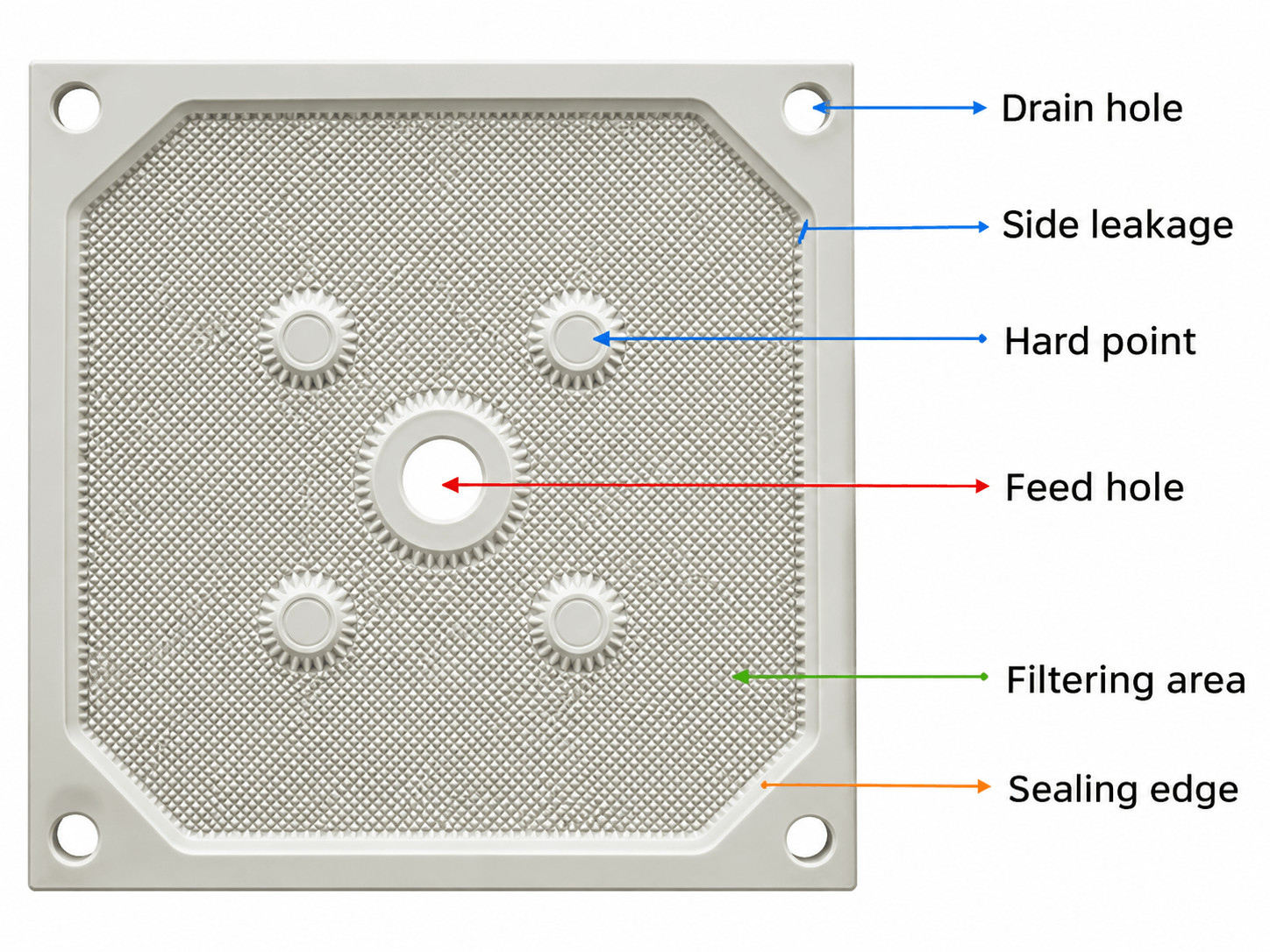
Corner feed filter plates have the feed port in a corner of the plate, usually at the top. The aligned corner holes form the feed channel, and slurry enters each chamber from that corner. The other corners are typically used for filtrate discharge, washing or air-blowing connections, depending on the press configuration.
Neither design is outdated or inherently superior. Both are widely used in recessed chamber, membrane and plate-and-frame configurations. The right one depends on how your plant actually operates.
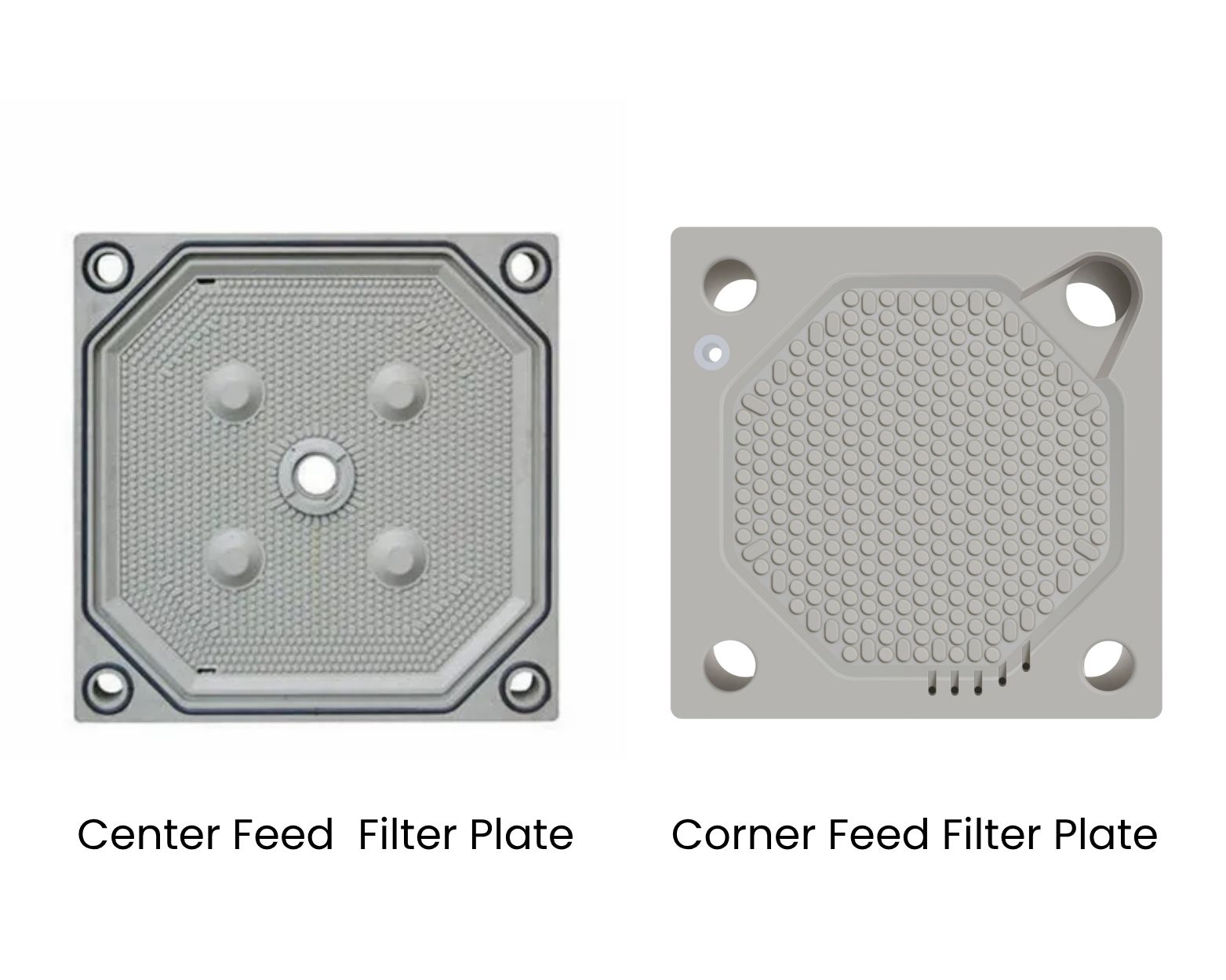
How Slurry Flows and Cakes Form in Each Design
Center feed: radial distribution
With center feed, slurry enters the chamber at its geometric center and spreads outward toward the edges. Because the flow starts from the middle, the cake tends to build up in a fairly symmetrical pattern. The finished cake has a hole in the center where the feed channel passed through, so cakes are ring-shaped rather than solid slabs.
This symmetry is a real advantage for many slurries. Even distribution helps chambers fill consistently, which supports uniform cake thickness and predictable cycle times.
Corner feed: directional distribution
With corner feed, slurry enters at one corner and must travel across the chamber to fill it. The resulting cake is a continuous slab without a central hole, though the feed corner is usually visible as a notch or thicker area.
Corner feed relies more on the slurry properties and feed pressure to fill the chamber evenly. When the pump curve, solids content and plate design are well matched, cake formation is consistent. When they are not, thickness can vary from the feed corner to the far side of the plate.
A useful way to think about it: center feed builds evenness into the geometry, while corner feed depends more on operating conditions to achieve it.
Center Feed vs Corner Feed: Key Differences in Cloth, Cake Release and Maintenance
The differences that matter most on the plant floor are not about filtration theory. They are about cloth, cake and maintenance time.
Filter cloth fitting
Center feed plates need a filter cloth with a center hole, often reinforced or fitted with a feed eye or neck so the cloth seals around the port. This is the design’s main weak point. The cloth area around the center hole sees the highest flow velocity of the whole chamber, so it is where abrasion, blinding and leakage tend to start.
Corner feed plates do not need a center opening in the cloth. Cloth layouts are generally simpler, which reduces one common leakage path and can make cloth replacement faster. The cloth still has to be matched to the plate’s port arrangement, so specifying the right cloth for the right plate remains important.
Cake formation and release
Center feed cakes are ring-shaped and, on cakes that stick, the material around the feed hole can hold the cake to the cloth. Corner feed cakes are solid slabs that often release as a single piece, although a cake that is too thick at the feed corner can behave differently from the rest of the plate.
Cake release depends heavily on the slurry, the cloth and the filtration pressure, so neither design guarantees easier discharge. What the feed position changes is where the cake is most likely to stick or tear.
Maintenance and wear points
| Factor | Center Feed | Corner Feed |
|---|---|---|
| Feed port location | Middle of the plate | One corner of the plate |
| Filter cloth | Requires a center hole and feed eye | Simpler cloth layout, no center feed opening |
| Cake shape | Ring-shaped, with a central hole | Solid slab with a feed-corner notch |
| Flow pattern | Radial, symmetrical fill | Directional fill from the corner |
| Main wear point | Cloth around the center feed eye | Feed corner area and port seals |
| Cloth change effort | Higher, due to center hole fitting | Generally lower |
| Common plate sizes | Very common on small and mid-size plates | Common on larger plates |
| Typical fit | Consistent slurries, even cake priority | Abrasive slurries, frequent cloth changes |
Table is a general guide. Actual performance depends on plate structure, cloth selection, slurry properties and operating pressure.
Which Slurries and Applications Suit Each Feed Type?
When center feed makes sense
Center feed is a strong choice when the slurry is fairly consistent, the solids are not highly abrasive, and even cake thickness is a priority. Many general-purpose applications, including a wide range of chemical, food-processing and light industrial duties, run well on center feed plates. Plants that value predictable cycle times and uniform cakes often prefer the symmetry it provides.
It is also the familiar configuration in many older presses, which can simplify spare-part planning if your fleet already uses it.
When corner feed makes sense
Corner feed tends to suit operations where cloth handling is a real cost. That includes abrasive slurries, such as some mining and mineral-processing streams, where the center feed eye would be under constant attack. It also suits plants that change cloths frequently, since a simpler cloth layout saves labor and downtime.
Because it avoids the central opening, corner feed is also a practical choice for larger plates, where feeding an entire large chamber from one central point can become more demanding.
What neither design fixes
Feed position does not compensate for a mismatched cloth, an undersized pump or a slurry that was never conditioned properly. If filtrate is cloudy, cakes are wet, or cycle times keep drifting, check cloth permeability, feed pressure, flocculation and pre-treatment before blaming the plate design.
Plate Size, Pressure and Membrane Plate Considerations
Размер пластины
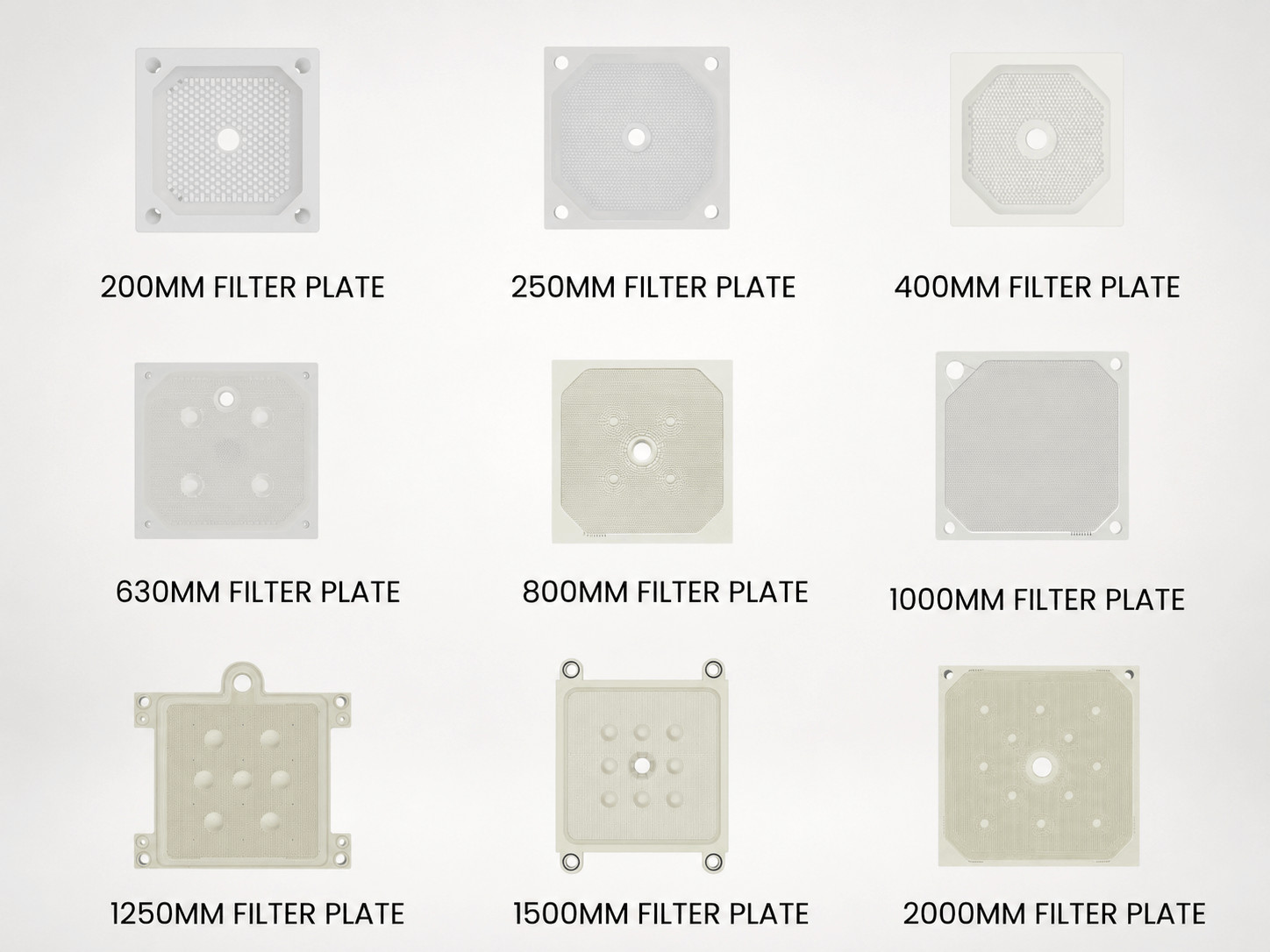
Filter plate size influences how much the feed design matters. On smaller plates, a single center port can fill the chamber quickly and evenly. As plates get larger, the distance the slurry must travel grows, and feed layout becomes a bigger part of the design conversation. This is one reason corner feed is common on larger plates, though many large plates are also built in other configurations to suit the press.
Structural design matters here too. The port position, the drainage surface and the plate reinforcement all have to work together, which is why feed style should be decided as part of the plate design, not added afterward.
Рабочее давление
Higher operating pressure puts more stress on port seals, cloth edges and the plate body. Whichever feed style you choose, the plate material, thickness and sealing surface should be specified for the pressure your process actually uses, including any peaks during feed.
Membrane plates
Membrane filter plates add a squeeze stage, where an inflatable diaphragm compresses the cake after filling to reduce moisture. Both center feed and corner feed membrane plates exist. The feed choice affects how the chamber fills, while the membrane affects how the cake is pressed afterward. If your goal is drier cake, evaluate the membrane design and squeeze pressure alongside the feed style, and decide the two together.
How to Choose the Right Feed Design for Your Filter Press
Rather than asking which design is better, ask which failure you least want to live with. This checklist helps turn that into a decision.
- Slurry abrasiveness. Highly abrasive solids attack the cloth around a center feed eye first. If abrasion is severe, a design without a center opening deserves serious consideration.
- Solids content and particle behavior. Slurries that fill the chamber readily suit either design. Sticky or fast-blinding materials call for careful attention to cloth and feed pressure.
- Plate size. Larger plates put more weight on the feed layout and structural design.
- Cloth change frequency. If cloths are replaced often, the labor difference between the two layouts adds up quickly.
- Acceptable downtime. Plants running tight production schedules usually value faster cloth changes more than a marginal gain in cake symmetry.
- Existing equipment. If you are replacing plates on a running press, the frame, feed connections and plate stack usually dictate what can be fitted. Confirm compatibility before selecting a new design.
- Moisture target. If you need drier cake, discuss membrane options at the same time as feed style.
Bring the following details to any supplier conversation: slurry type and solids content, particle size range, operating pressure, plate size, cycle time, and how often you currently change cloths. With this information, a manufacturer can recommend a configuration based on your process rather than a catalog default.
If you are comparing options for a new press or a plate replacement project, our team can review your operating conditions and suggest a suitable plate configuration. You are welcome to reach out with your application details.
Заключение
Center feed and corner feed filter plates both do the same basic job, but they solve different problems. Center feed gives symmetrical chamber filling and a familiar, proven layout. Corner feed removes the center hole from the filter cloth, which often means simpler cloth changes and one less wear point, and it is a common choice on larger plates.
The practical takeaway is to decide based on your own operation rather than on a general “better or worse” ranking. Look at how abrasive your slurry is, how large your plates are, how often you change cloths, and how much downtime your production schedule can absorb. Then check that the feed design fits your existing press frame and feed connection.
If you are planning a new filter press or replacing worn plates, send us your slurry type, operating pressure, plate size and current cloth change routine. LONGONE can review these details and suggest a plate configuration that fits your process.
FAQ
Is center feed better than corner feed?
Neither is universally better. Center feed offers symmetrical chamber filling, while corner feed typically offers a simpler cloth layout and easier cloth changes. The better choice depends on your slurry, plate size and maintenance priorities.
Can I switch from center feed to corner feed plates on the same filter press?
Usually not by simply swapping plates. Feed position is tied to the plate stack, the feed connection at the head of the press and often the frame design. Changing it typically requires checking or modifying several components, so confirm compatibility with the manufacturer first.
Which feed type is easier to maintain?
Corner feed is generally easier for cloth replacement because the cloth does not need a center feed opening. Center feed requires more careful cloth fitting and closer inspection of the area around the feed eye.
Do membrane filter plates use center feed or corner feed?
Both are available. The feed style determines how the chamber fills, and the membrane determines how the cake is squeezed afterward. The two choices should be made together, based on your moisture target and slurry.
How does feed position affect filter cloth life?
Feed position determines where the highest flow velocity and stress concentrate on the cloth. In center feed plates, the area around the feed eye typically wears first. In corner feed plates, wear is more likely near the feed corner. Proper cloth selection and correct feed pressure matter as much as the plate design itself.