
Specifying a filter press for a corrosive or hygienic application is harder than it looks. The phrase “stainless steel filter press” appears in every catalogue, yet the actual bill of materials varies enormously from one supplier to the next. Buyers who skip the details often pay for stainless components they don’t need — or miss the ones they do.
A stainless steel filter press is a solid-liquid separation machine in which the structural frame, feed manifold, piping, and filtrate collection trays are fabricated from stainless steel — typically 304 or 316L — to resist corrosion, contamination, and hygiene risks. The filter plates and cloth are usually reinforced polypropylene, which handles pH 1–14 and temperatures up to roughly 80 °C at a substantially lower cost than stainless alternatives. Corrosion resistance is a system property, not a single-material property.
Understanding which components actually need to be stainless — and which don’t — changes both the purchase price and the long-term performance of the machine. The sections below work through the engineering logic, the best-fit industries, and the selection criteria that experienced plant engineers use before signing a purchase order.
What Is a Stainless Steel Filter Press and How Does It Work?
Procurement teams frequently receive quotations for the same nominal machine at very different price points. Without understanding how the equipment works, it is almost impossible to compare those quotations fairly.
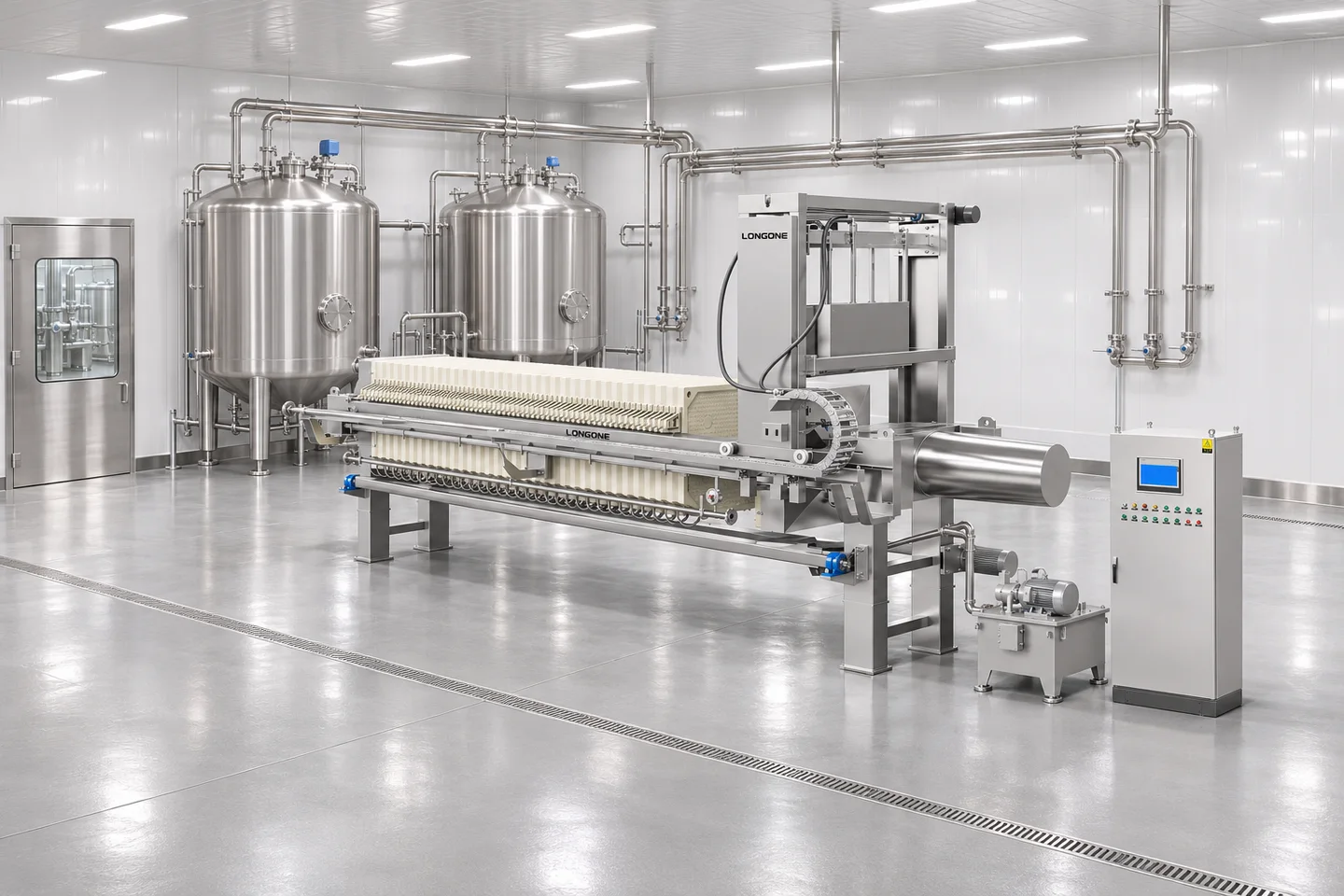
A filter press separates solids from liquids by pumping a slurry under pressure through a series of filter cloths stretched across filter plates. Solids accumulate as a cake between the plates, while clarified filtrate drains away. The cycle ends when the press is opened and the cake is discharged. In a stainless steel filter press, the parts most exposed to atmospheric corrosion — frame, piping, manifolds — are built in stainless, while the fluid-contact internals are typically engineered polymers.

The Core Components
A fully configured machine includes:
- Frame and sidebars — the structural skeleton that holds the plate stack under hydraulic pressure
- Filter plates — the press elements that form individual chambers; most commonly reinforced polypropylene (RPP)
- Filter cloths — the porous media that retains solids and passes filtrate
- Feed manifold and piping — the internal conduit through which slurry enters the chambers
- Hydraulic closing system — applies and maintains the clamping force during filtration
- Filtrate collection trays and discharge chutes — collect liquid exiting the plates
How Pressure Drives Separation
Feed pumps push slurry into the closed plate stack at pressures typically ranging from 0.6 MPa to 1.6 MPa for standard applications, and up to 6.0 MPa for high-pressure dewatering. Higher pressure shortens cycle time and produces drier cake. The filter cloth rating, plate chamber depth, and feed pump characteristics must all be matched to the target cake dryness and throughput.
Why Material Choice Matters Here
Different components see very different chemical exposure. The frame sits in ambient workshop air — which may carry acid mist, humidity, or chloride. Piping and manifolds carry hot, potentially aggressive slurry. Filter plates are immersed in the process liquid for every cycle. Each exposure environment calls for a different material solution. Treating the machine as a single-material system almost always results in either over-specification or premature failure somewhere in the assembly.

Why Choose a Stainless Steel Filter Press? Key Advantages Over Standard Models?
Engineers who have watched a carbon steel frame rust through within two years in a battery recycling plant understand the problem immediately. Others are still discovering it.
A stainless steel filter press extends service life and maintains product purity in environments where carbon steel corrodes rapidly and where contamination from iron oxides is unacceptable. The investment premium is justified by reduced maintenance downtime, compliance with hygiene standards, and the avoidance of product contamination in sensitive processes.

Comparison: Stainless Steel vs. Carbon Steel vs. Full-PP Filter Press
| Feature | Stainless Steel Frame + PP Plates | Carbon Steel Frame + PP Plates | Full Polypropylene (PP) Press |
|---|---|---|---|
| Frame corrosion resistance | Excellent | Poor in humid/acid environments | Very good |
| Maximum operating pressure | Up to 6.0 MPa | Up to 6.0 MPa | Typically ≤ 1.6 MPa |
| Hygienic compliance (FDA/GMP) | Yes (316L) | No | Conditional |
| Resistance to acid mist / splash | Excellent | Poor | Good |
| Filter plate material | RPP or stainless | RPP | RPP |
| Capital cost | Medium–High | Low–Medium | Low |
| Typical service life (corrosive env.) | 15–20 years | 3–7 years | 10–15 years |
| Best fit industries | Food, pharma, fine chemicals | General mining, ceramics | Light chemical, wastewater |
Key Advantages in Detail
- Contamination control. Stainless steel does not shed iron oxides into the filtrate. This matters critically in pharmaceutical, food-grade, and electronic-materials applications.
- Structural integrity under pressure. Full-PP frames are not rated for high-pressure operation. A stainless frame handles the clamping forces and operating pressures required by demanding dewatering duties.
- Surface cleanability. Smooth 2B or electropolished 316L surfaces support CIP (clean-in-place) protocols and comply with GMP standards.
- Resistance to workshop atmosphere. Even if the slurry itself is benign, acid mist and high humidity in the surrounding environment attack carbon steel rapidly.
Which Parts Should Be Stainless Steel: Frame, Plates, Piping and Cloth?
One of the most persistent misunderstandings we encounter is the assumption that “stainless steel filter press” means every wetted and structural part is stainless. That assumption significantly inflates cost without always improving performance.
The components that most benefit from stainless steel are the structural frame, sidebars, feed manifold, internal piping, valves, and filtrate collection trays. For most corrosive slurries — including those with pH 1–14 — reinforced polypropylene filter plates and polypropylene filter cloths deliver equal or better chemical resistance at a fraction of the cost of stainless plates.

Breaking Down Component-Level Decisions
Structural Frame and Sidebars
The frame never contacts the slurry directly, but it lives in the workshop atmosphere. Acid mist, water vapour, and spillage attack carbon steel continuously. Grade 304 stainless is adequate for most food and chemical environments. Grade 316L (with 2–3% molybdenum) is the correct choice where chloride levels are elevated — coastal plants, chlor-alkali environments, or seawater-based processes.
Feed Manifold and Internal Piping
These components carry hot, pressurised slurry. This is where the process chemistry strikes hardest. 316L is typically specified here for pharmaceutical and fine chemical applications. For strongly oxidising acids, buyers should consider whether PTFE lining or Hastelloy C-276 is more appropriate — a qualified process engineer should validate the material for unusual media.
Filter Plates
Reinforced polypropylene (RPP) plates resist the full pH spectrum (1–14), handle temperatures up to approximately 80 °C, and are chemically inert to most organic solvents and inorganic acids. They are also substantially lighter than stainless plates, reducing fatigue stress on the frame and simplifying manual or automated plate shifting. Stainless steel filter plates are specified only in a narrow set of cases: very high-temperature slurries (above 90 °C), abrasive duties where polymer plates wear too quickly, or applications requiring metal-detectable components.
Filter Cloths
Standard filter cloths are woven polypropylene or polyester. For high-temperature or strongly acidic duties, PTFE-coated cloths or monofilament woven fabrics are available. Metal-wire filter cloths (stainless 316L mesh) are used in specialised cake-discharge applications or where cloth integrity must be verified by metal detection.
Valves and Instrumentation
All process valves, pressure gauges, and sampling points should match the frame material specification. A stainless frame fitted with carbon steel valves will simply fail at the valve connections first.
Where Stainless Steel Filter Presses Perform Best: Food, Pharma, Chemical and Fine Chemicals?
Not every application justifies the investment in stainless steel construction. Knowing where it genuinely earns its place helps buyers avoid both over-spending and under-specifying.
A stainless steel filter press is most justified where product purity regulations are strict, where the workshop environment is chemically aggressive, or where the filtrate or cake is destined for human consumption or pharmaceutical use.
Industry-by-Industry Fit
- Food and beverage. Wine clarification, fruit juice processing, edible oil filtration, and sugar refining all require FDA/EC 1935-compliant contact surfaces and CIP capability. Electropolished 316L is the standard specification.
- Pharmaceutical and fine chemicals. GMP compliance, batch traceability, and zero metal contamination make 316L mandatory for contact surfaces. Passivation records and material certificates (EN 10204 3.1) are typically required at procurement.
- Specialty chemicals and dyes. Processes running chlorinated solvents, strong acids, or mixed organic media corrode carbon steel quickly. The frame and manifold upgrade pays back within the first maintenance cycle.
- Battery materials and lithium processing. Lithium carbonate and cobalt slurries are mildly to moderately corrosive. More importantly, iron contamination from a corroding frame destroys product quality. Stainless frames are standard in this sector.
- Mining and hydrometallurgy. Acid mine drainage and leach liquors are extremely corrosive. RPP plates combined with a stainless or rubber-lined frame is the typical engineering solution.
How to Choose a Stainless Steel Filter Press?
The selection process is straightforward when buyers bring the right data to the conversation. The common mistake is leading with equipment size before defining process chemistry.
Define your process conditions first, then derive the material specification. Working backwards from a catalogue item almost always results in a mismatch — either over-priced stainless components where polypropylene would suffice, or under-specified steel in a genuinely corrosive duty.

Selection Checklist for Procurement and Engineering Teams
- pH range — full operating range, not just nominal pH
- Temperature — maximum slurry temperature at the feed inlet
- Chloride content — determines 304 vs. 316L vs. duplex stainless
- Solids concentration and particle size — affects plate chamber depth and cloth selection
- Filtrate purity requirements — drives contact-surface material and surface finish spec
- Wash requirements — counter-current washing cycles increase liquid contact time on all wetted parts
- Throughput and cycle time targets — sets filtration area and chamber volume
- Regulatory compliance — FDA, GMP, ATEX, or local pressure vessel codes
Our recommendation from manufacturing experience: For media with complex chemistry — mixed solvents, variable pH, or unknown trace components — run a simple immersion coupon test. Place samples of candidate materials (304, 316L, RPP) in the actual process liquid for 72–168 hours before finalising the material specification. This costs almost nothing and prevents expensive surprises after installation.
Maintenance and Cost of Ownership: Getting the Most from a Stainless Steel Filter Press?
Capital cost is only part of the financial picture. A filter press that corrodes in year three, or requires frequent cloth replacement due to chemical degradation, costs far more over its operating life than a well-matched configuration specified correctly from the start.
A stainless steel filter press with correctly specified components typically delivers a 15–20 year service life in corrosive environments, compared to 3–7 years for carbon steel equivalents. The maintenance advantage is concentrated in the frame and piping, while ongoing consumable cost is driven primarily by filter cloth replacement intervals.
Routine Maintenance Items
- Filter cloth inspection and replacement — the highest-frequency consumable; replacement interval depends on abrasion, chemical exposure, and blinding. Typical intervals range from 3 months to 2 years.
- Plate inspection — RPP plates should be inspected for cracking, warping, or feed-port erosion annually. Stainless plates require inspection for crevice corrosion at gasket seating surfaces.
- Hydraulic system service — cylinder seals and hydraulic fluid should be checked on the manufacturer’s recommended schedule, typically every 12 months.
- Manifold and valve integrity — pressure-test piping connections annually; check valve seats for pitting on chloride-rich duties.
- Frame surface inspection — passivated 316L requires minimal attention, but inspect welds for crevice corrosion if chlorides are present in the workshop atmosphere.
Total Cost of Ownership Perspective
| Cost Category | Stainless Frame + RPP Plates | Carbon Steel Frame + RPP Plates |
|---|---|---|
| Initial capital | Higher by 25–60% | Baseline |
| Frame refurbishment at year 5 | Minimal | Likely repainting or structural repair |
| Frame replacement over 15 years | Unlikely | Probable (1–2 cycles) |
| Plate replacement frequency | Same | Same |
| Production downtime from corrosion | Very low | Moderate to high |
| Total 15-year cost (corrosive env.) | Lower | Higher |
The numbers above are directional. Actual figures depend on the specific corrosive duty, local labour costs, and the cost of lost production during unplanned downtime. Buyers should request a lifecycle cost analysis from their supplier when the operating environment is genuinely aggressive.
Frequently Asked Questions
What does “stainless steel filter press” actually mean?
The term refers to a filter press where the structural frame, manifold, and piping are fabricated from stainless steel — typically 304 or 316L. It does not necessarily mean every component is stainless. Filter plates and cloths are usually reinforced polypropylene, which offers broad chemical resistance at lower cost.
Is 304 or 316L stainless steel better for a filter press?
Grade 316L is the correct choice when chloride content is significant — including seawater, chlorinated process streams, or coastal environments. For general food, chemical, and pharmaceutical duties without elevated chlorides, 304 performs well and costs less. Confirm the specific chloride level in your process before specifying either grade.
Can a stainless steel filter press handle strong acids?
The stainless frame resists acid mist and splash effectively. However, the filter plates — usually reinforced polypropylene — provide the primary chemical resistance to strong acids inside the press chambers. RPP handles pH 1–14 reliably. For strongly oxidising acids such as concentrated nitric or chromic acid, material compatibility should be verified by a qualified process engineer.
How long does a stainless steel filter press last?
In a corrosive industrial environment, a properly specified stainless steel filter press with RPP plates typically operates for 15–20 years with routine maintenance. Carbon steel equivalents in the same environment commonly require structural repair or replacement within 3–7 years.
What is the typical price premium for stainless steel construction?
A stainless steel frame and manifold (304 or 316L) typically adds 25–60% to the capital cost of a comparable carbon steel machine, depending on size and configuration. The premium is recovered through reduced maintenance costs and longer service life in genuinely corrosive or hygienic applications.
Conclusion
A stainless steel filter press is the right tool for corrosive, hygienic, and contamination-sensitive applications — but only when specified correctly. The core insight from manufacturing experience is this: corrosion resistance in a filter press is a system property. The frame, plates, cloth, piping, and valves each face different chemical exposures, and each deserves a material choice matched to that exposure. Reinforced polypropylene plates and cloths handle the majority of aggressive slurries at a fraction of the cost of stainless alternatives. Stainless steel earns its place on the structural frame, manifold, and piping — the components that live in the workshop atmosphere and carry pressurised process fluid.
If you are evaluating a stainless steel filter press for your plant, start with your process data: pH range, temperature, chloride content, solids loading, and filtrate purity requirements. We are happy to review your operating conditions and recommend a configuration — feel free to share your process parameters and we will offer a no-obligation assessment.