
Choosing solid-liquid separation methods without first defining your target cake moisture and slurry particle size is one of the most expensive mistakes a process engineer can make. The wrong choice doesn’t just hurt efficiency — it inflates downstream transport costs, increases thermal drying load, and reduces product or metal recovery. The right choice starts with the slurry, not the equipment catalog.
Solid-liquid separation is the process of mechanically dividing a suspension into a solid phase (cake or sludge) and a liquid phase (filtrate or overflow). The best method depends on particle size distribution, required cake dryness, throughput, and downstream processing needs. For fine, sticky, or compressible solids where low cake moisture is critical, pressure filtration — specifically the filter press — is typically the most economical final dewatering step.
Understanding why each method works for some applications and fails in others is what separates a sound procurement decision from an expensive retrofit. The sections below walk through the full selection framework — from method comparison to equipment specification.
What Is Solid-Liquid Separation and Why Method Selection Matters?
Most plant managers already know what solid-liquid separation is. The harder question is: why do so many facilities end up with equipment that underperforms their process targets?
Solid-liquid separation is any mechanical or physical process that removes suspended solids from a liquid carrier. Method selection matters because each technique operates within a defined particle size range and delivers a specific range of cake dryness — and mismatching these to your slurry characteristics drives up operating costs across the entire downstream process chain.
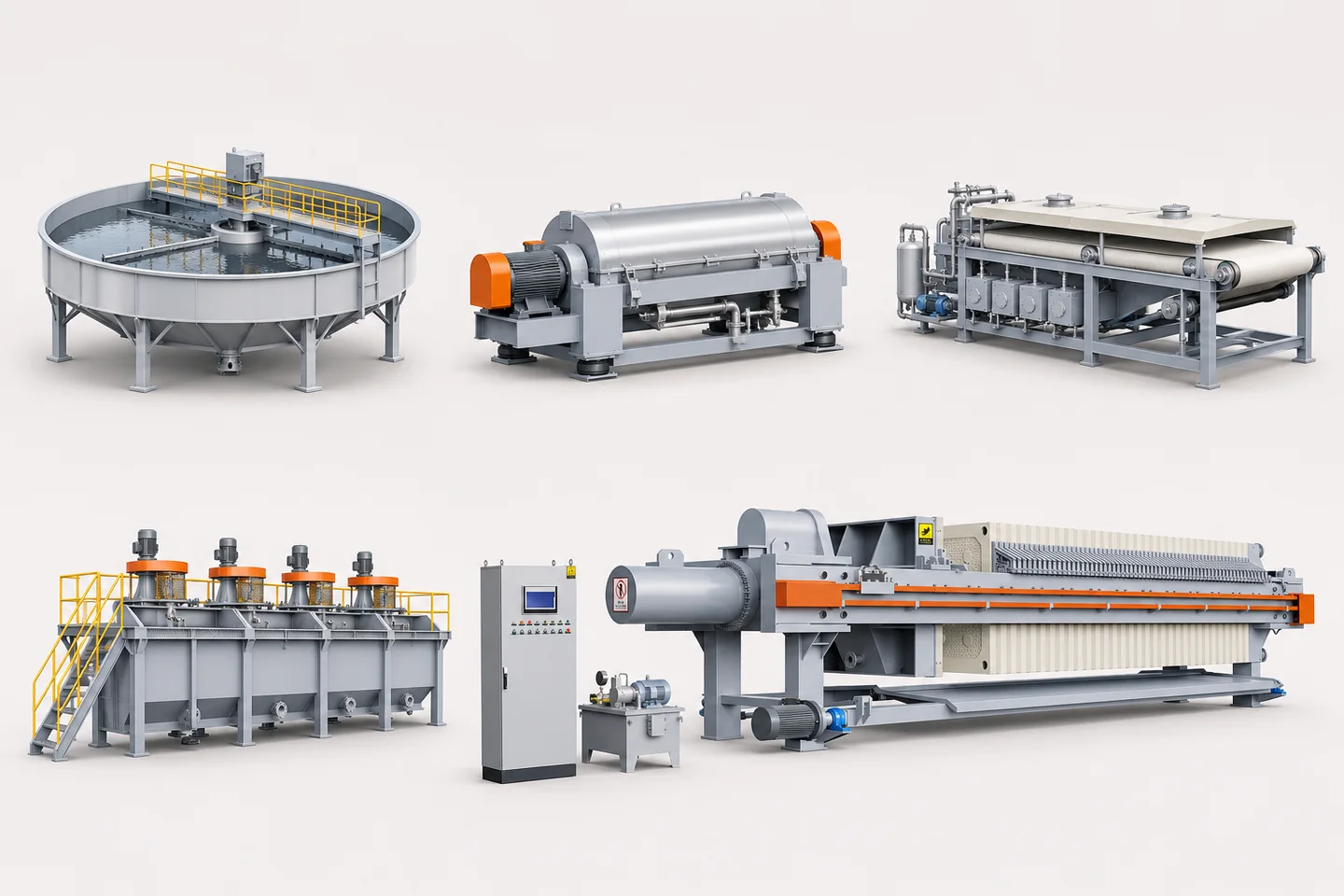
The decision is rarely about finding “the best method.” It is about finding the right method for your slurry at your required output quality.
The Two Questions That Define Every Separation Decision
Before evaluating any equipment, an engineer should answer two questions:
- What is the target cake moisture content (% by weight)?
- What is the d50 particle size of the slurry solids?
These two parameters eliminate most options immediately. A thickener cannot achieve the same cake dryness as a filter press. A belt press cannot handle ultra-fine colloidal particles efficiently. A centrifuge is excellent for free-draining crystalline solids but struggles with compressible, gelatinous materials.
Why Method Mismatch Is Costly
When the wrong method is selected:
- Cake moisture is too high → higher transport weight, higher landfill costs, higher thermal drying energy.
- Filtrate is too turbid → product loss, environmental permit violations, additional polishing steps.
- Cycle times are too long → bottleneck in the production line, reduced throughput.
- Maintenance complexity is too high → operators avoid the equipment, process deteriorates.
In my experience working with process engineers across mining, chemicals, and wastewater treatment, most rework projects trace back to one root cause: the separation method was chosen before the slurry was fully characterized.
Solid-Liquid Separation Methods Compared: Sedimentation, Centrifugation, Vacuum Filtration, Flotation, and Pressure Filtration?
Each major separation technology has a defined operating window. Knowing those boundaries is the starting point for any honest evaluation.
The five primary solid-liquid separation methods are sedimentation, centrifugation, vacuum filtration, flotation, and pressure filtration. Each method handles a different particle size range, achieves different levels of cake dryness, and suits different operational modes — continuous versus batch, low versus high throughput, coarse versus fine solids.
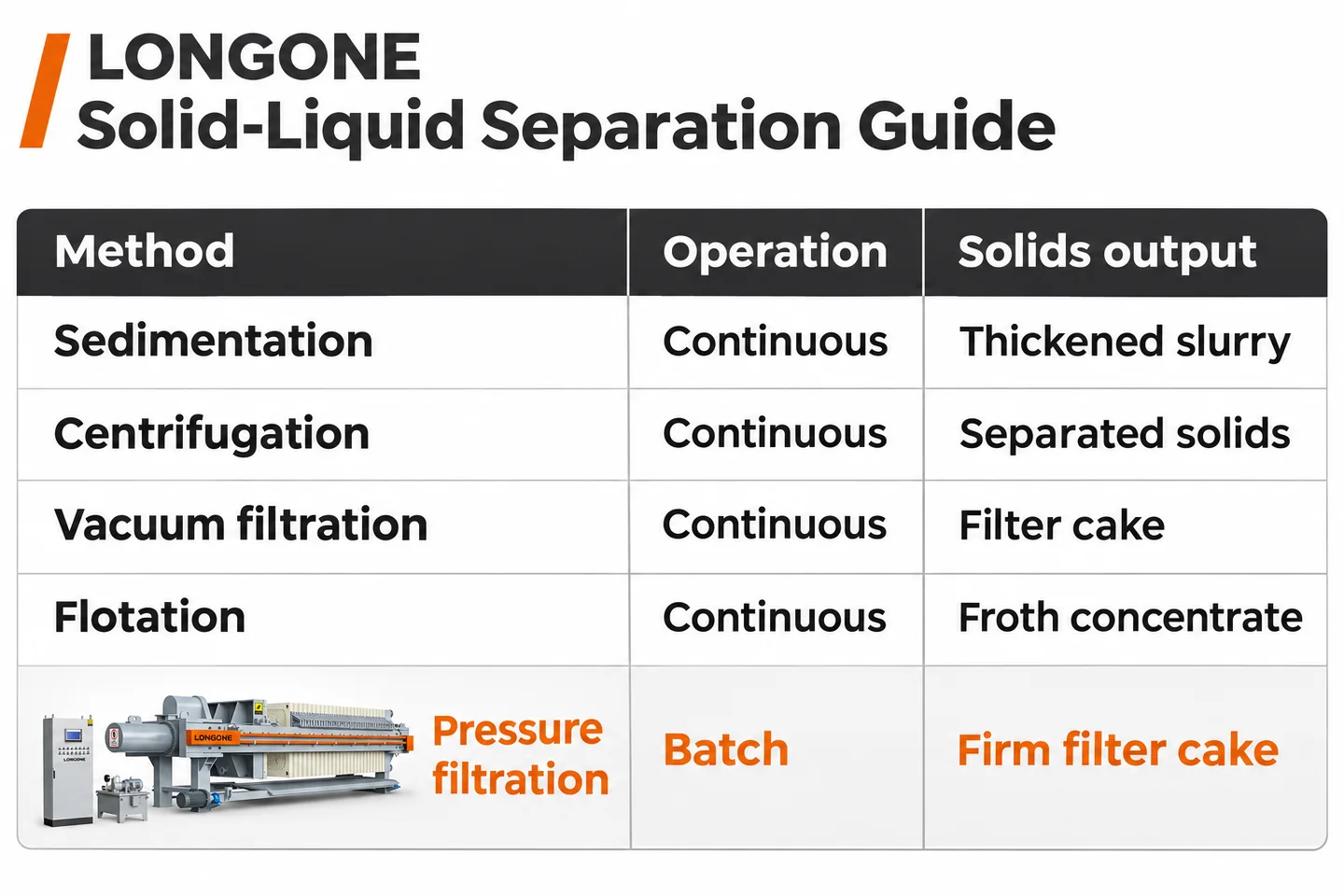
Here is a side-by-side overview of the five main methods:
| Method | Particle Size Range | Cake Dryness | Operation Mode | Relative Footprint | Energy Use | Best Application |
|---|---|---|---|---|---|---|
| Sedimentation / Thickener | >10 µm | Low (high moisture underflow) | Continuous | Large | Low | Pre-concentration, tailings |
| Centrifugation | 1–5,000 µm | Medium–High | Continuous | Medium | High | Coarse, free-draining crystalline solids |
| Vacuum Filtration | >10 µm | Medium | Continuous | Medium–Large | Medium | Free-draining materials, large tonnage |
| Flotation | 10–150 µm | N/A (concentrate slurry) | Continuous | Large | Medium | Mineral beneficiation, selective separation |
| Pressure Filtration (Filter Press) | 0.1–1,000 µm | High (very dry cake) | Batch | Compact | Medium | Fine solids, low moisture requirement, high-value product recovery |
A Closer Look at Each Method
Sedimentation and Thickeners
Sedimentation relies on gravity to settle particles. Thickeners are the industrial-scale implementation — large circular tanks with slow-rotating rakes. They are excellent for pre-concentration of high-volume slurries, reducing water volume before downstream dewatering. However, the underflow is still a wet slurry, not a handleable cake. Sedimentation is almost always a first step, not a final one.
Centrifugation
Centrifuges use rotational force to accelerate sedimentation. They work well for coarse, dense, free-draining solids — think sugar crystals, coarse coal, or pharmaceutical intermediates with well-defined particle shapes. For fine, sticky, or compressible solids, centrifuge performance degrades quickly, and maintenance costs rise. Capital cost is also significantly higher than a filter press of comparable throughput.
Vacuum Filtration
Belt filters and drum filters operate under negative pressure (vacuum). They suit free-draining materials at large continuous throughput — coarse mineral concentrates, paper pulp dewatering, and some wastewater sludges. When solids are fine or the cake is compressible, vacuum alone cannot achieve the pressure differential needed for low cake moisture.
Flotation
Flotation is a selective separation method, not a dewatering method. Air bubbles attach to hydrophobic particles, carrying them to the surface as a froth. It is used in mineral processing to separate valuable minerals from gangue, not to dewater a slurry. It typically feeds back into a thickener or filter press downstream.
Pressure Filtration (Filter Press)
A filter press forces slurry through a filter medium under positive pressure — typically 0.6 to 2.0 MPa for chamber presses, and up to 6.0 MPa for high-pressure membrane presses. The result is a firm, dry, handleable filter cake and a clear filtrate. It handles the widest particle size range of any filtration method and achieves the lowest cake moisture — which is why it is the preferred final dewatering step in most industrial process chains.
How to Choose a Separation Method: Five Selection Criteria?
Engineers often start with the technology rather than the problem. A cleaner approach is to define five criteria first, then match to equipment.
The five criteria for selecting a solid-liquid separation method are: (1) slurry particle size and size distribution, (2) required cake dryness, (3) required filtrate clarity, (4) throughput volume and batch versus continuous operation, and (5) downstream processing requirements. Defining these criteria before evaluating equipment eliminates most mismatches.
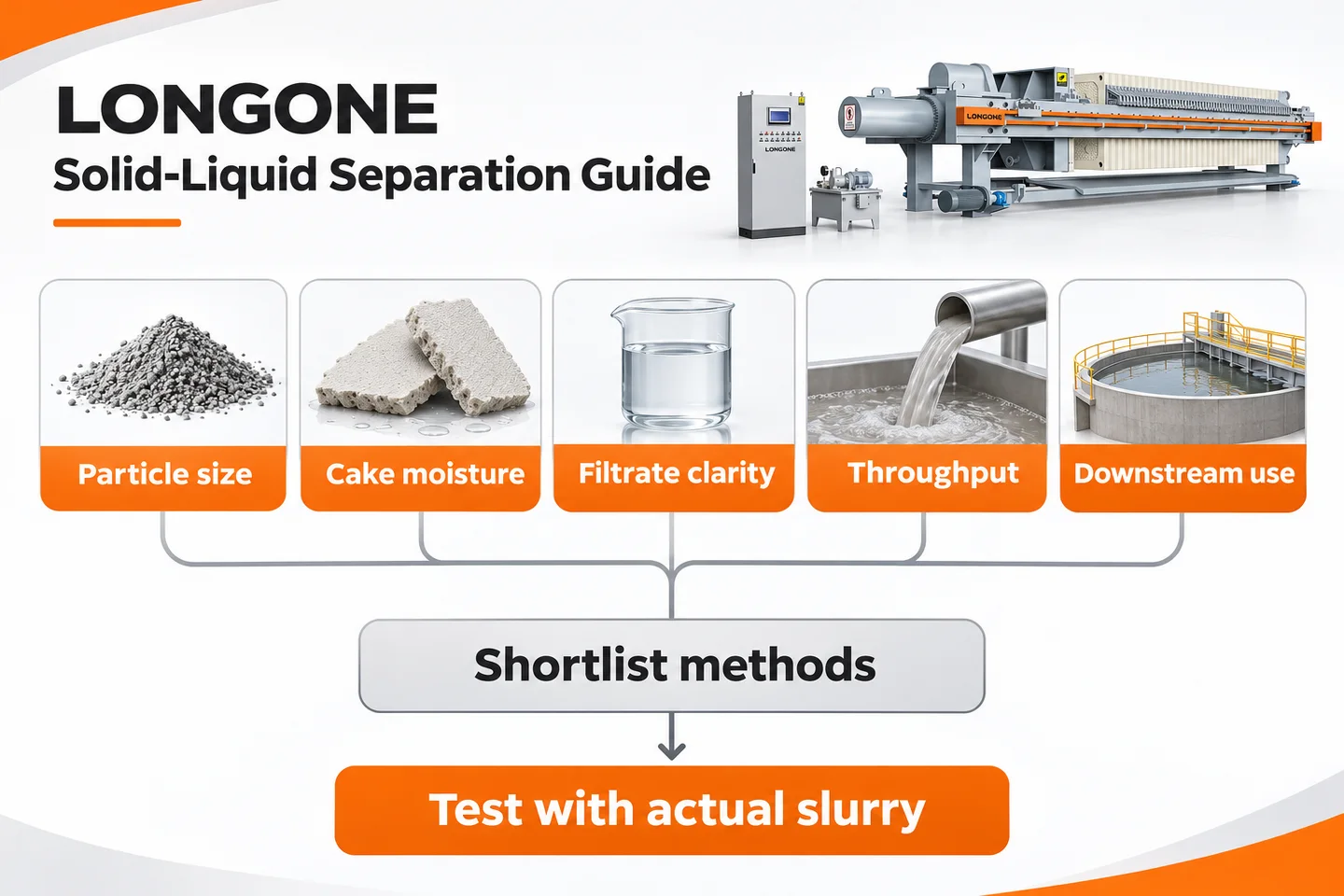
Selection Checklist
Use this checklist before requesting any equipment quotation:
- Particle size characterized? (d10, d50, d90 — laser diffraction or sieve analysis)
- Target cake moisture defined? (expressed as % moisture by weight)
- Filtrate quality requirement defined? (turbidity, suspended solids limit, chemical purity)
- Throughput established? (m³/hour of feed slurry, tonnes/day of dry solids)
- Operation mode confirmed? (batch acceptable, or must be continuous?)
- Downstream use of cake defined? (landfill, thermal drying, product recovery, resale)
- Available footprint measured? (filter presses are compact; belt filters need more floor space)
- Small-scale lab test completed? (always recommended before equipment purchase)
That last point deserves emphasis. A lab-scale filter press test on your actual slurry — not a similar slurry, not a reference case — is the single most reliable way to predict full-scale performance. It costs very little compared to a capital equipment purchase.
Why Filter Press Is the Preferred Choice for Low Cake Moisture and Fine Particles?
Fine particles, sticky solids, and compressible cakes are where most separation methods hit their limits. This is the operating window where the filter press earns its place.
A filter press achieves the lowest cake moisture of any mechanical dewatering method because it applies positive pressure across the filter medium throughout the entire filtration cycle. For fine solids below 50 µm, compressible sludges, and applications where cake dryness directly affects transport cost or product value, pressure filtration closes the economics that other methods cannot.
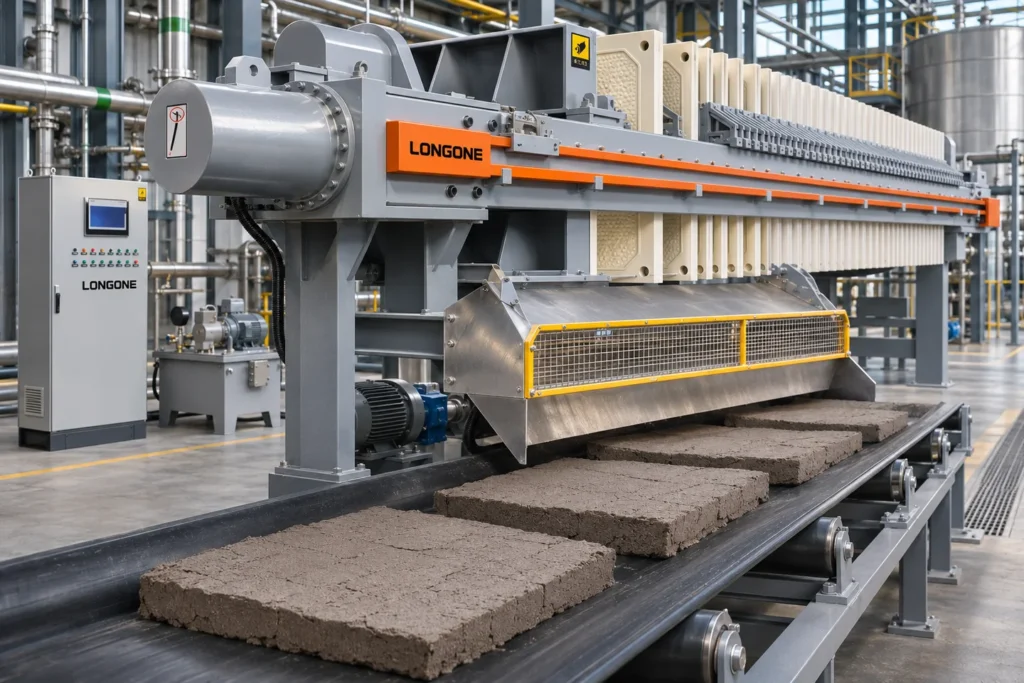
Where Filter Press Economics Close
The filter press is not the cheapest equipment to purchase. It is, however, often the cheapest solution when you account for:
- Transport cost savings — a 15% reduction in cake moisture can halve the weight of material sent to landfill or dryer feed.
- Thermal drying load reduction — drier cake entering a rotary dryer or spray dryer means less fuel consumption per tonne of dry product.
- Metal or product recovery — clearer filtrate means less valuable product lost to the liquid phase.
- Reagent recovery — in chemical and pharmaceutical applications, the ability to wash the cake in-press recovers process chemicals.
The Typical Process Chain
In most real-world applications, the filter press is the second step, not the first:
Thickener (pre-concentration) → Filter Press (final dewatering)
The thickener removes the bulk of the water cheaply and continuously, raising the feed solids concentration. The filter press then takes that thickened underflow and produces a firm, dry cake. Running dilute slurry directly into a filter press without pre-concentration extends cycle times and increases cloth blinding — a common mistake in first installations.
Filter Press Selection Guide: Chamber vs Membrane, Filter Cloth, Plates, and Feed Pump?
Choosing a filter press is not a single decision. It is a set of four interconnected component decisions.
When selecting a filter press, the four critical specification decisions are: (1) chamber press versus membrane press, (2) filter cloth permeability and material, (3) filter plate material and pressure rating, and (4) feed pump type and pressure capability. Each choice affects cake dryness, cycle time, and long-term operating cost.
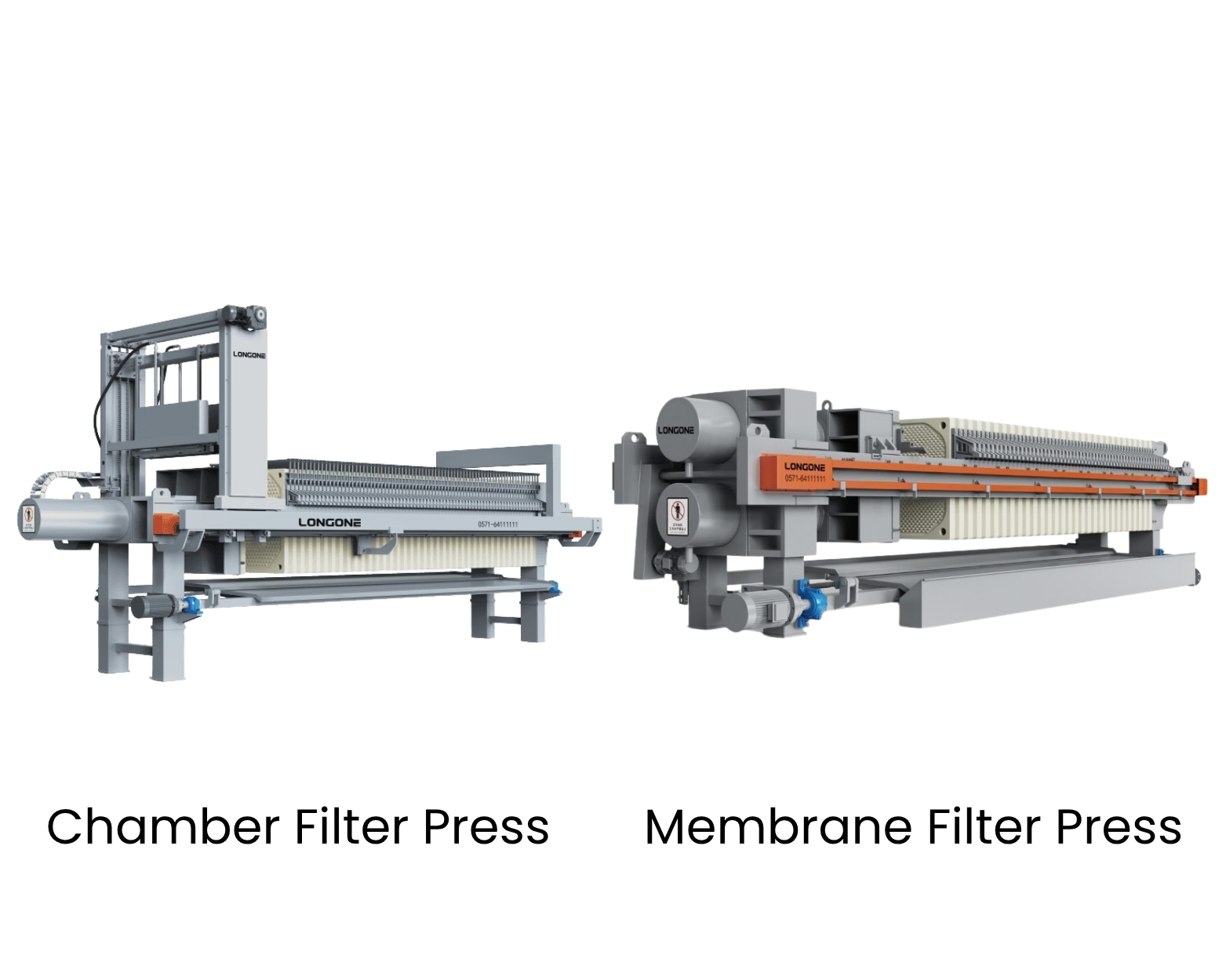
Chamber Press vs Membrane Press
| Feature | Chamber (Recessed Plate) Press | Membrane Press |
|---|---|---|
| Filtration mechanism | Pressure only | Pressure + membrane squeeze |
| Typical cake moisture | Moderate | Lower (10–15% drier vs chamber) |
| Cycle time | Standard | Shorter (squeeze phase compresses cake) |
| Capital cost | Lower | Higher |
| Best for | Less demanding moisture targets, standard slurries | Fine solids, high moisture sensitivity, valuable products |
For most mining tailings and standard industrial sludges, a chamber press is sufficient. When downstream costs are sensitive to cake moisture — thermal drying, expensive transport, high-value product recovery — a membrane press typically pays back the premium in 12–24 months.
Filter Cloth Selection
The filter cloth is the most frequently replaced consumable in a filter press. Key selection parameters:
- Permeability — higher permeability gives faster filtration but poorer filtrate clarity; balance against your clarity requirement.
- Fiber material — polypropylene (most common), polyester, nylon, or PTFE for aggressive chemical environments.
- Weave pattern — monofilament, multifilament, or needle felt, depending on particle size and cake release requirement.
Plate Material and Pressure Rating
Standard plates are polypropylene, suitable for most chemical environments and pressures up to 1.6 MPa. For higher pressures or abrasive slurries, cast iron or stainless steel frames are available. Always verify the plate pressure rating matches your feed pump output — overpressure is the leading cause of plate damage.
Feed Pump Specification
The feed pump drives filtration performance. A progressive cavity pump or diaphragm pump is standard for filter press feed. The pump must:
- Deliver pressure up to the press rated pressure
- Handle abrasive or viscous slurries without excessive wear
- Ramp pressure gradually at cycle start to avoid cloth blinding
Industry Applications: Matching Separation Methods to Mining, Chemical, Wastewater, and Food Processing?
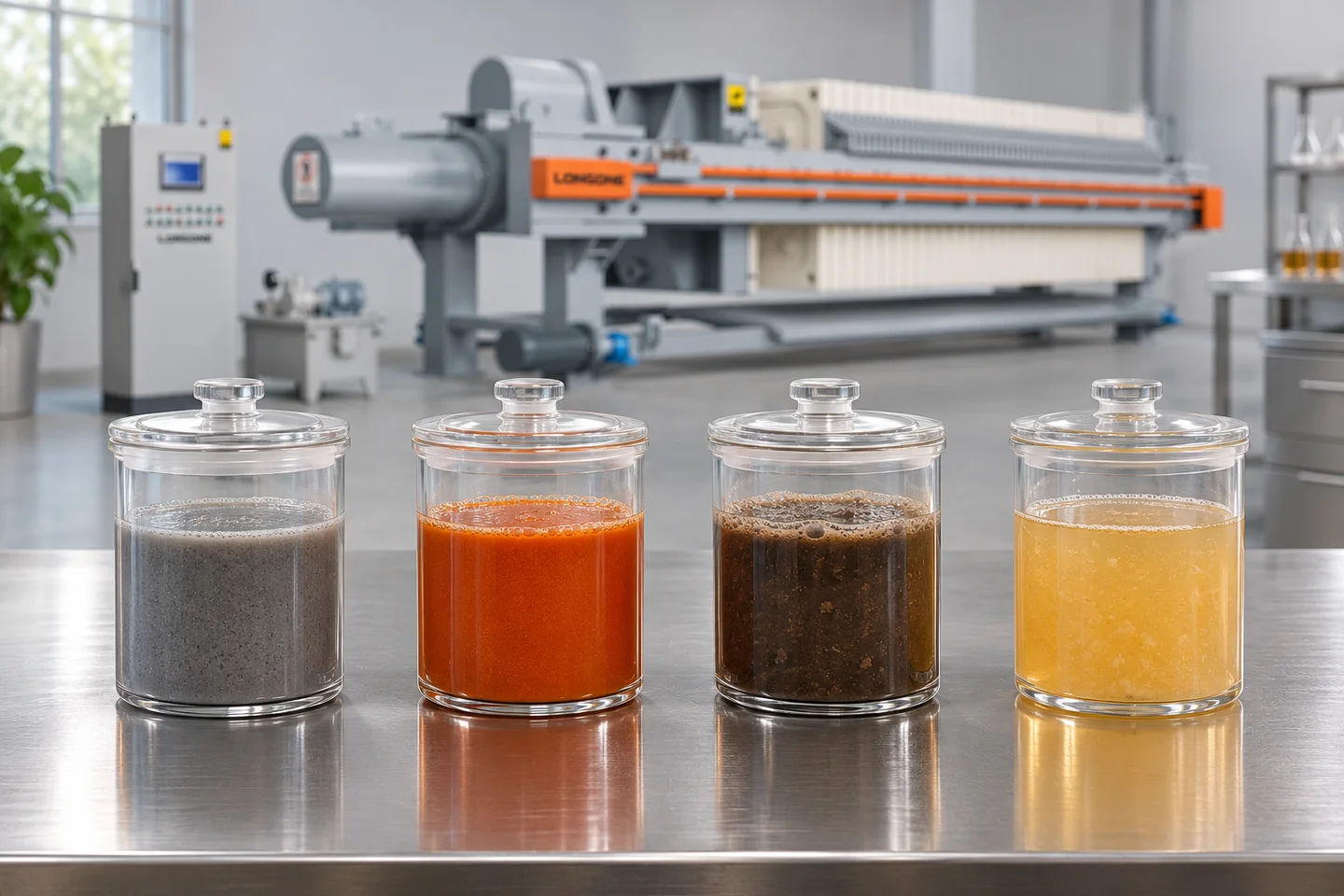
Different industries have different dominant slurry characteristics. Knowing the typical process chain in your industry helps frame the equipment decision.
In mining, chemical processing, wastewater treatment, and food production, the dominant solid-liquid separation methods differ by slurry type and output requirement. Mining and chemical applications typically combine thickening with pressure filtration. Wastewater applications use sedimentation and belt or membrane presses. Food processing demands food-grade materials with wash capability.
Mining and Mineral Processing
Tailings dewatering, concentrate filtration, and leach residue handling all require low cake moisture to minimize water loss to tailings storage and reduce transport cost. The standard chain is thickener → filter press. Plate and cloth material must resist abrasive fine mineral particles.
Chemical and Pharmaceutical Manufacturing
Slurries often contain fine crystalline or amorphous solids in aggressive chemical liquors. Cake washing in-press is frequently required to displace mother liquor and recover product or reagent. Polypropylene or PTFE-lined plates are common. Filtrate clarity is often a product purity specification, not just an environmental requirement.
Municipal and Industrial Wastewater Treatment
Activated sludge and digested sludge are compressible, low-solids-content slurries. Belt filter presses are common for large continuous municipal flows. For industrial wastewater with higher solids loading or stricter moisture targets, recessed plate and membrane presses are preferred. Pre-conditioning with polymers is almost always required.
Food and Beverage Processing
Fruit juice clarification, edible oil filtration, starch dewatering, and beer filtration all use pressure filtration. Equipment must meet food-grade material standards (FDA or EC regulations). Plate and cloth materials, sealing compounds, and cleaning protocols all require food-safe specifications.
Frequently Asked Questions
What is the most effective method for solid-liquid separation?
There is no single most effective method. The best method depends on particle size, required cake dryness, throughput, and downstream requirements. For fine solids and low cake moisture, pressure filtration with a filter press is typically the most effective final dewatering step. For pre-concentration of large volumes, sedimentation and thickeners are more economical.
When should I use a filter press instead of a centrifuge?
Use a filter press when your slurry contains fine, sticky, or compressible solids, when cake moisture must be minimized for transport or drying cost reasons, or when filtrate clarity is critical. Centrifuges are better suited to coarse, free-draining crystalline solids at high continuous throughput where gravity separation alone is insufficient.
What cake moisture can a filter press achieve?
A recessed chamber filter press typically achieves cake moisture in the range of 20–35% by weight, depending on slurry characteristics. A membrane filter press with a squeeze cycle can reduce this further — often by 10–15 percentage points compared to chamber-only filtration. Actual values depend heavily on particle size, solid compressibility, and operating pressure. A lab test on your slurry gives the most reliable estimate.
Do I need a thickener before a filter press?
In most applications, yes. Feeding dilute slurry directly to a filter press extends cycle times, accelerates filter cloth blinding, and increases wear on the feed pump. Pre-concentrating the slurry in a thickener to 40–60% solids by weight before feeding the filter press improves performance and reduces total operating cost. Some low-volume or high-solids applications can feed a filter press directly — verify with a pilot test.
How do I specify the right filter cloth for my filter press?
Start with particle size (d50 of your solids), required filtrate clarity, and the chemical environment (pH, solvents, temperature). Match the fiber material (polypropylene for most applications, PTFE for aggressive chemicals) and weave permeability to those parameters. For compressible or sticky solids, a stiffer monofilament weave aids cake release. When in doubt, test two or three cloth specifications on a lab press before committing to a full-scale order.
Conclusion
Solid-liquid separation method selection comes down to two primary variables — particle size and target cake moisture — evaluated against five practical criteria: slurry characteristics, cake dryness, filtrate quality, throughput, and downstream requirements. Sedimentation handles pre-concentration. Centrifuges and vacuum filters serve specific continuous-process applications. When fine particles, sticky solids, or low-moisture targets define the problem, pressure filtration through a filter press is where the process economics typically close.
Equipment selection matters as much as method selection. Chamber versus membrane, filter cloth permeability, plate pressure rating, and feed pump specification all directly affect cake dryness, cycle time, and operating cost. Before purchasing any filter press, run a lab-scale test on your actual slurry.
If you are evaluating solid-liquid separation options for a new project or an underperforming installation, LONGONE’s engineering team can support slurry testing, process chain review, and equipment specification. Contact us to discuss your application — no sales pressure, just a technical conversation.