
Ordering a filter plate that is a few centimeters off is one of the most expensive small mistakes in solid-liquid separation. The plate does not seat properly, the feed eye does not line up, or the press ends up too small for the slurry volume it was meant to handle. Most of these problems begin with a misunderstanding of filter plate sizes: buyers see a single number, such as 800 or 1000, and assume it tells them everything.
It does not. Plate size is a starting point for decisions about capacity, floor space, handling, and cost. This guide explains the standard filter plate sizes from 500 mm to 2000 mm, what each size typically means in practice, and how to choose or match a size without costly rework.
Why Filter Plate Size Matters: Capacity, Footprint, and Cost
Filter plate size is usually expressed as the outer dimension of a square plate, measured in millimeters. A “1000 mm plate” generally refers to a plate of about 1000 × 1000 mm. That single number influences almost every downstream decision:
- Filtration area. Larger plates offer more filtering surface per plate, so fewer plates are needed to reach a target capacity.
- Press length and footprint. Fewer, larger plates can shorten the frame for the same total area, but each plate takes up more width and height.
- Handling and labor. Bigger plates are heavier and harder to inspect, clean, and replace.
- Equipment requirements. Large plates need stronger frames, higher closing force, and often hydraulic plate shifters and lifting aids.
- Cost per square meter. Larger plates usually reduce cost per unit of filtration area, but the supporting equipment raises the initial investment.
The important point is that size is not the same as performance. Two presses with the same total filtration area can behave differently depending on plate thickness, chamber depth, feed method, and cake characteristics. Size should be read together with plate type, pressure rating, and process conditions.
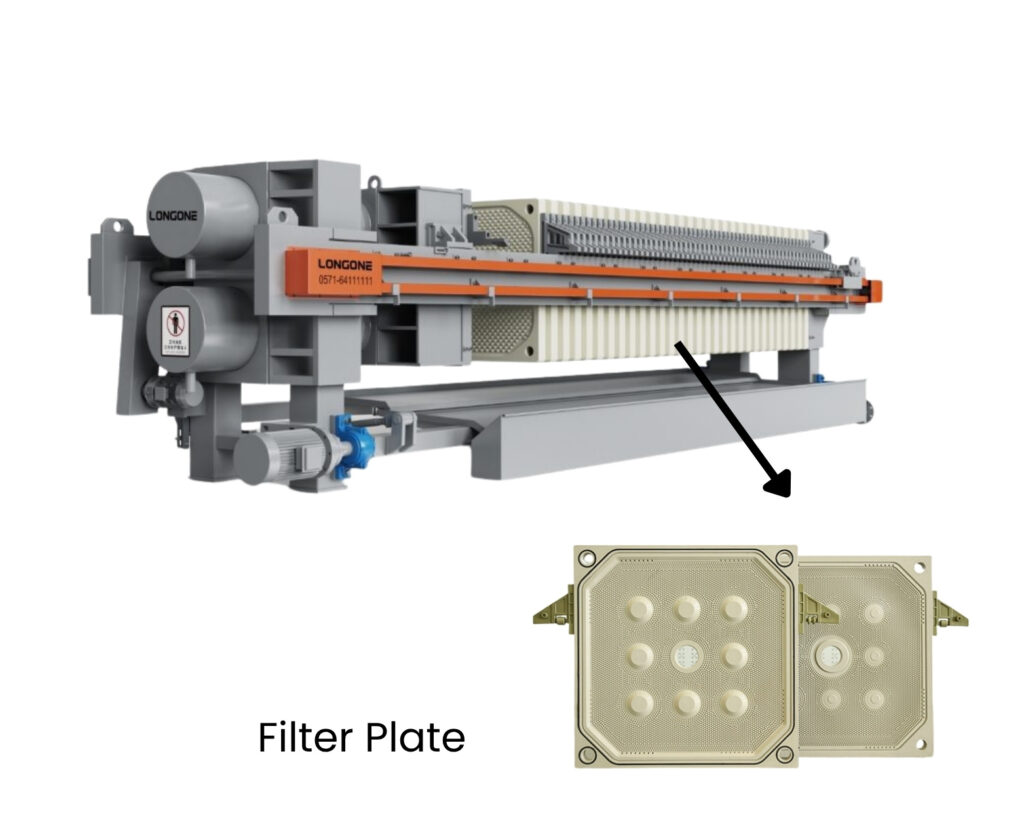
Standard Filter Plate Sizes from 500 mm to 2000 mm
Filter plates are manufactured in a range of standard sizes. The exact catalog varies by supplier, but the ranges below are widely used across mining, chemical processing, wastewater treatment, and food and beverage applications.
| Plate Size (mm) | Approx. Size (inches) | Approx. Filtration Area per Plate* | Typical Use |
|---|---|---|---|
| 500 × 500 | ~19.7 in | ~0.25–0.35 m² | Pilot trials, small batches, fine chemicals |
| 630 × 630 | ~24.8 in | ~0.4–0.6 m² | Small production lines, specialty processes |
| 800 × 800 | ~31.5 in | ~0.8–1.0 m² | General industrial filtration, mid-size batches |
| 1000 × 1000 | ~39.4 in | ~1.3–1.6 m² | Widely used in chemical, mining, and wastewater |
| 1250 × 1250 | ~49.2 in | ~2.0–2.5 m² | Higher-throughput continuous operations |
| 1500 × 1500 | ~59.1 in | ~3.0–3.6 m² | Large mineral and sludge dewatering |
| 2000 × 2000 | ~78.7 in | ~5.5–6.5 m² | Very high-volume, heavy-duty installations |
*Approximate effective filtration area per plate. Actual values depend on chamber design, drainage surface, and plate type, so always confirm against the manufacturer’s specification.
A few practical notes on how these sizes group together:
Small plates (500–800 mm) are easier to handle manually and are well suited to smaller volumes, frequent product changes, or processes where cloth replacement and cake discharge need to stay simple.
Mid-size plates (870–1000 mm) are the workhorse range. They balance capacity with manageable handling and are common in chemical and general industrial plants.
Large plates (1250–2000 mm) are built for high throughput. They cut the number of plates and cloths per unit of capacity, but they demand robust frames, hydraulic systems, and mechanical handling.
Round plates also exist, mainly in smaller diameters, but square plates dominate the standard sizes covered here.
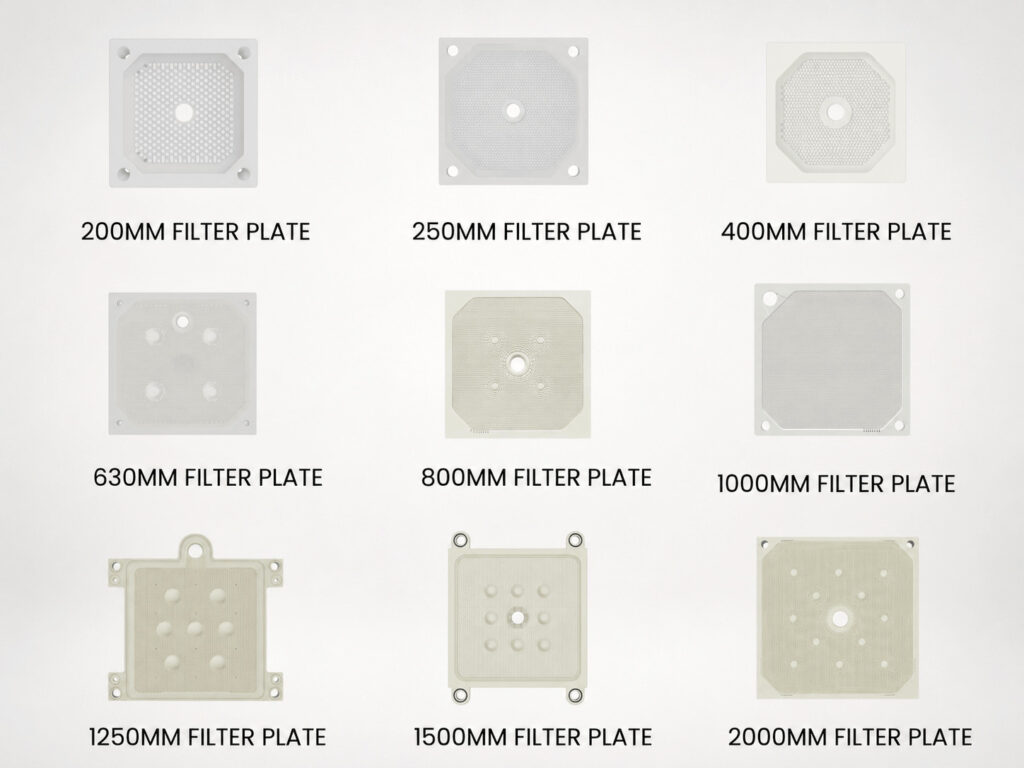
Filtration Area, Chamber Volume, and Cake Capacity by Size
When engineers compare presses, three figures matter more than the plate dimension alone.
Filtration area is the total surface through which liquid passes. It is calculated from the area per plate multiplied by the number of chambers. It governs how quickly a given slurry volume can be processed.
Chamber volume is the internal space between two closed plates. It determines how much cake a single cycle can hold. Chamber volume depends on both plate size and chamber depth, so two plates of the same outer dimension can hold very different cake volumes.
Cake capacity is what you actually need to plan around. If the cake forms faster than the chambers can hold it, or the chamber fills before the cycle target is reached, filtration area on paper does not translate to real throughput.
This is why buying by filtration area alone is a common mistake. A press with a large nominal area but shallow chambers may need frequent discharge cycles, while a press with deeper chambers may run fewer, longer cycles at the same area. The right balance depends on solids concentration, cake compressibility, target moisture content, and the feed pump’s capacity to deliver slurry at the required pressure.
For membrane plates, the picture changes again. The membrane squeezes the cake after initial filling, so final cake volume and dryness depend on both chamber geometry and squeeze pressure. Recessed and membrane plates of the same outer size are therefore not interchangeable in capacity terms.
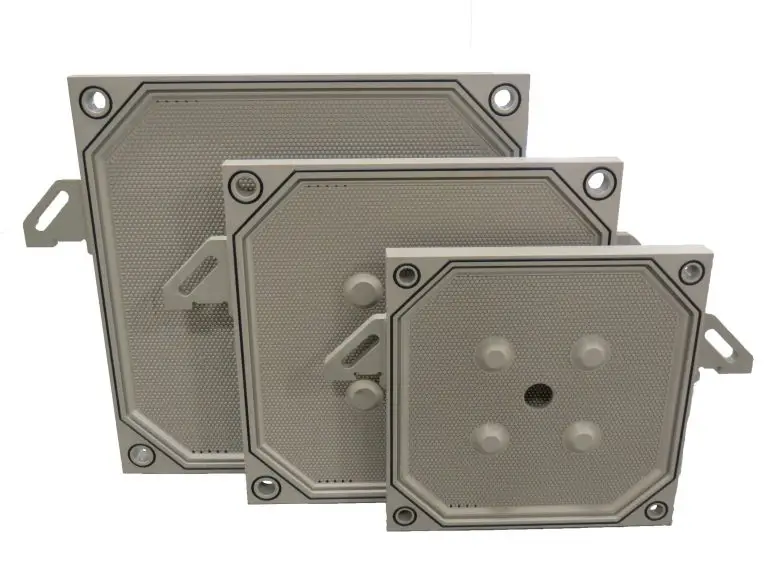
How to Choose the Right Filter Plate Size for Your Application
Selecting a plate size is easier when you work through the decision in a clear order.
1. Start with the process. Define the slurry volume per batch or per hour, solids concentration, particle size, and target cake dryness. These determine the total filtration area and cake volume you need.
2. Consider the site. Check available floor space, ceiling height, crane or hoist capacity, and access for maintenance. A large press may fit on paper but be difficult to service in a tight plant layout.
3. Match handling to your team. Small and mid-size plates can often be handled by two operators. Large plates typically require lifting equipment and automated plate shifting. Factor in cloth changes, plate inspection, and cleaning time.
4. Balance one large press against several smaller ones. One large press offers lower cost per unit of area but creates a single point of failure. Several smaller presses offer flexibility and redundancy but use more space and control hardware.
5. Match size to plate type. Recessed chamber plates and membrane plates are both available across most standard sizes, but pressure ratings and squeeze requirements differ. Choose the size and type together, not in sequence.
As a rule of thumb, smaller plates favor flexibility and simple handling, while larger plates favor throughput and lower cost per square meter. The best choice is usually the smallest plate size that meets your capacity target without pushing the press into an impractical length.
Replacement Plates: Matching Size, Feed Port, and Frame Dimensions
Ordering replacement plates for an existing press is where “nominal size” causes the most trouble. Two plates both labeled 800 mm may not fit the same press. Before ordering, confirm the following:
- Outer dimensions. Measure the actual plate width and height, not only the catalog label.
- Plate thickness. Thickness affects how many plates fit within the frame’s closing stroke.
- Feed eye position and diameter. The center feed hole, and any corner feed or discharge ports, must align exactly with the existing plate stack.
- Handle or lug distance. The support handles must sit correctly on the side rails of the frame.
- Pressure rating. Replacement plates must meet or exceed the press’s operating pressure.
- Plate type. Recessed and membrane plates are not drop-in substitutes for each other in a mixed stack.
The most reliable method is to provide a supplier with a drawing or a physical sample plate, along with the press model and operating conditions. Measuring one plate carefully, including thickness and port locations, avoids most fitment errors. If the original supplier is no longer available, a manufacturer can often reverse-engineer a compatible plate from a sample.
Common Filter Plate Sizing Mistakes and Custom Size FAQs
Common Sizing Mistakes
- Selecting by area alone. Ignoring chamber volume, cake behavior, and feed capacity leads to presses that look right on paper but underperform.
- Ignoring handling. A larger plate saves cost per square meter but can slow down maintenance if the plant lacks lifting capability.
- Assuming nominal size equals compatibility. Plate thickness, port layout, and lug position all matter for replacement orders.
- Forgetting future growth. If volumes are likely to increase, consider a frame that can accept additional plates later.
- Mixing plate types without checking. Different plate types in one stack need matching dimensions and pressure ratings.
Frequently Asked Questions
What is the most common filter plate size?
Plates in the 800 mm to 1000 mm range are among the most widely used, because they balance capacity with manageable handling. The best size still depends on your throughput, cake volume, and plant conditions.
Can I mix different filter plate sizes in one press?
No. All plates in a single press must share the same outer dimensions and port layout so they seal correctly under closing pressure. Plate type mixing, such as recessed plus membrane, is possible in some designs but must follow the press manufacturer’s specification.
Can filter plates be made in custom dimensions?
Yes. Many manufacturers can produce plates to custom dimensions, thicknesses, and port layouts, especially for replacement or retrofit work. Providing a drawing or sample plate helps confirm the design before production.
How do I measure my existing filter plate?
Measure the outer width and height, plate thickness, feed eye diameter and position, and the distance between the support handles. Note the plate material, operating pressure, and whether it is a recessed or membrane plate. A photo of the plate and the press nameplate is also useful.
Does a bigger plate always mean higher capacity?
Not necessarily. Capacity depends on total filtration area, chamber volume, feed pressure, and cake characteristics. A larger plate increases area per plate, but the overall result depends on the number of plates and how the slurry behaves.
Choosing Filter Plate Sizes with Confidence
Filter plate sizes from 500 mm to 2000 mm cover everything from pilot trials to heavy-duty dewatering, but the right size is never just a number on a datasheet. It comes from balancing filtration area, chamber volume, handling capability, and compatibility with your existing equipment.
If you are sizing a new press or matching replacement plates, it helps to have your operating conditions or a plate drawing on hand. LONGONE’s engineering team can review your requirements and help confirm dimensions before you place an order.