
Choosing the wrong filter plate rarely fails on day one. It fails slowly: cake that stays wetter than your disposal budget allows, cycles that run longer than the shift plan, or plates that crack at the feed eye after a few months. By then the price difference between two plate types looks small next to the cost of lost throughput and unplanned downtime.
The recessed chamber filter plates are the most widely used plate in pressure filtration, and for good reason. It is simple, robust and economical. But it is not the right answer for every slurry. This guide explains how a recessed chamber plate works, which design details actually matter, and how to decide whether it fits your duty or whether a membrane plate deserves the extra investment.
What Is a Recessed Chamber Filter Plate and How Does It Form a Filtration Chamber?
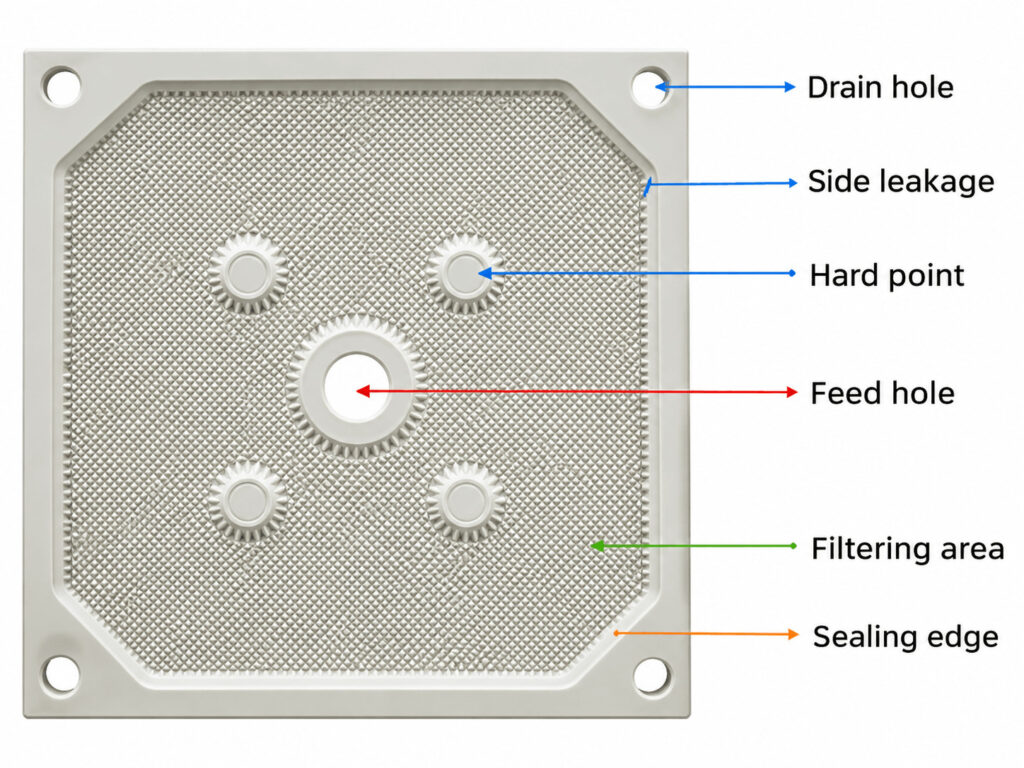
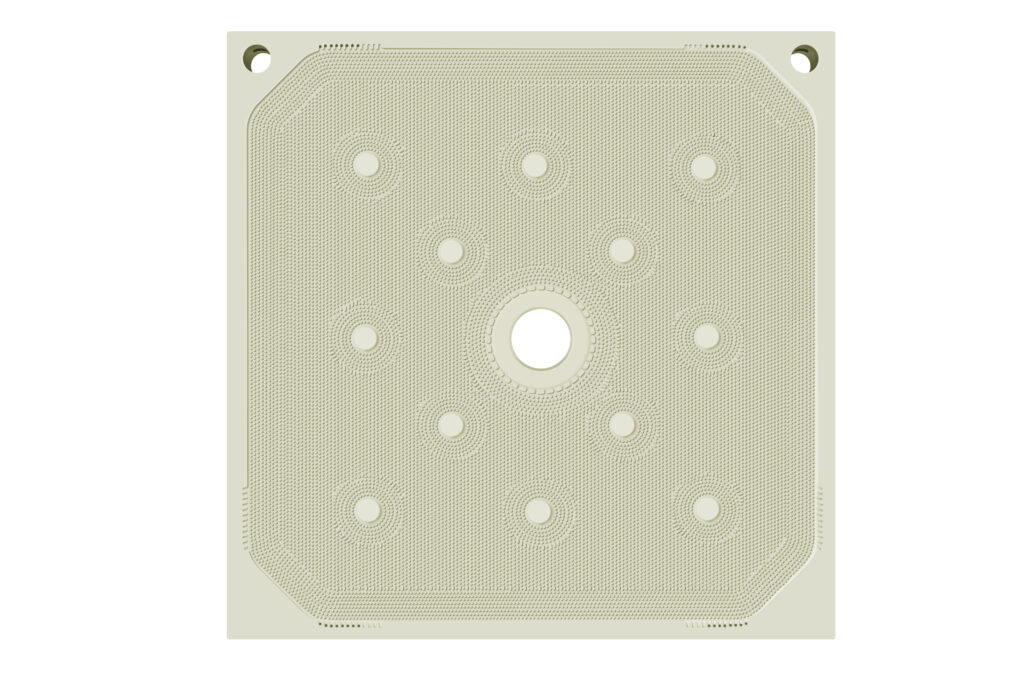
A recessed chamber filter plate is a solid plate with a shallow recess on each face. The raised border around each recess is the sealing edge. When a stack of plates is clamped together in a filter press, the recesses of two neighbouring plates face each other and form a closed chamber. Filter cloth covers each plate face, and this chamber is where the solids are captured and the cake is built.
This is what separates a chamber plate from an older plate-and-frame arrangement. In a plate-and-frame press, a separate frame creates the space between two flat plates. In a recessed chamber design, the chamber is molded or machined into the plate itself, so there are fewer parts to align, seal and maintain.
Most recessed chamber plates for industrial use are made from polypropylene (PP). PP offers good chemical resistance, low weight and enough mechanical strength for typical operating pressures. For harsher duties, such as strongly abrasive slurries or aggressive chemicals, other materials and reinforced constructions are available. The right choice depends on the slurry chemistry, temperature and pressure, which is why these details should be confirmed before ordering.
How Recessed Chamber Filter Plates Work in a Filter Press Cycle
A filter press cycle with recessed chamber plates follows a consistent sequence:
- Closing. A hydraulic cylinder and pump clamp the plate pack together. The sealing edges meet, and the chambers are formed.
- Feeding. Slurry is pumped in through the feed eye, commonly a large center hole running through the plate stack, and fills each chamber.
- Filtration. Pressure drives liquid through the filter cloth. The filtrate travels across the drainage surface on the plate face, exits through the filtrate ports, and flows to the discharge piping. Solids cannot pass through the cloth, so they collect in the chamber as a layer.
- Cake formation and dewatering. As the cake thickens, resistance rises and the filtrate flow slows. The chamber is considered full when the flow falls to a set low level or the feed pressure reaches its target.
- Optional washing or air blow. Some processes wash the cake to recover product or blow air through it to remove more moisture.
- Opening and discharge. The press opens, the plates shift, and the cakes usually drop out of the chambers into a hopper or bin. Sticky cakes may need light manual help.
The important point for buyers is step 4. In a recessed chamber plate, the cake dries only through continued pressure and time. The later part of the cycle, when filtrate flow is already low, is often the longest and the least productive. That characteristic is what defines both the strengths and the limits of this plate type.
Depending on the slurry, filter presses of this kind can produce cakes with a wide range of solids content, from fairly wet to very dry. Particle size, compressibility and chemical conditioning all influence the result, so it is best to treat any single figure as a guide rather than a guarantee.
Key Design Features: Feed Position, Drainage Surface and Sealing Edge
Two plates that look identical on a datasheet can behave very differently in service. These are the design features that make the difference.
Besleme konumu
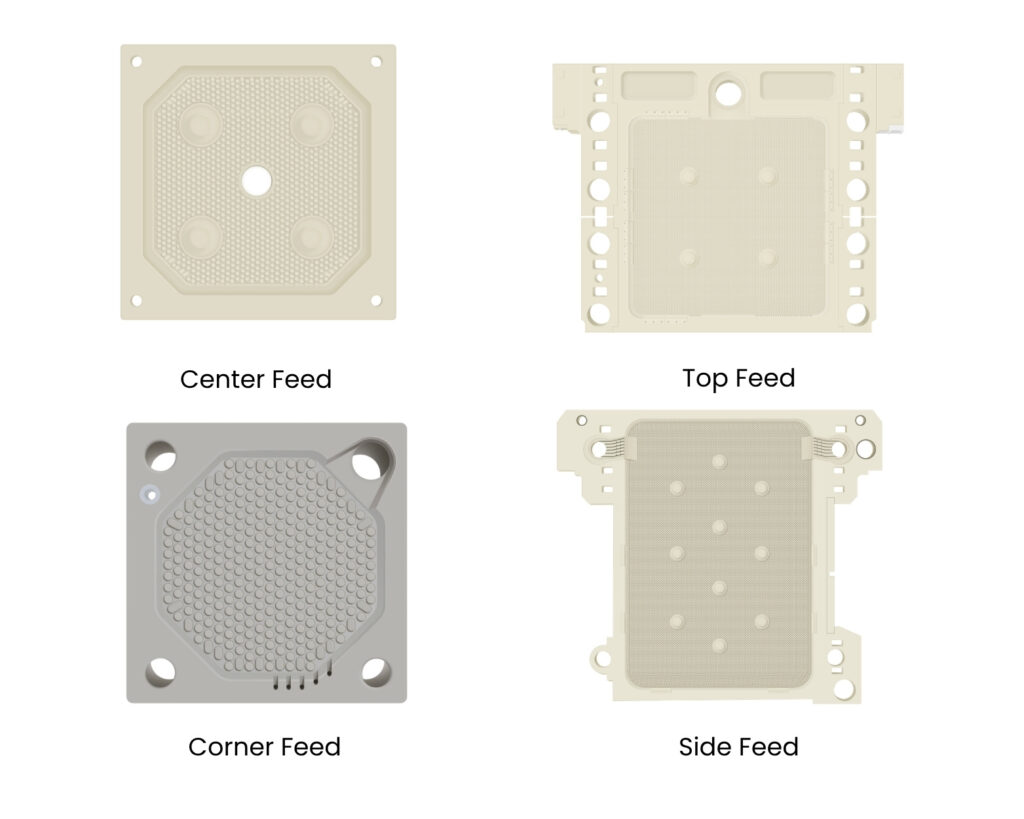
The most common arrangement is a center feed, where slurry enters through a hole in the middle of the plate. This allows the chamber to fill quickly and evenly from the center outward. Even filling means more uniform pressure across the plate and less risk of localized overloading, which is especially important with high-solids feed.
Other arrangements exist, including corner feed, head feed, foot feed and external feed. The right one depends mainly on the press frame and on how the slurry behaves. Some are chosen for retrofit compatibility, others for slurries that tend to settle or block the feed eye.
Drainage surface
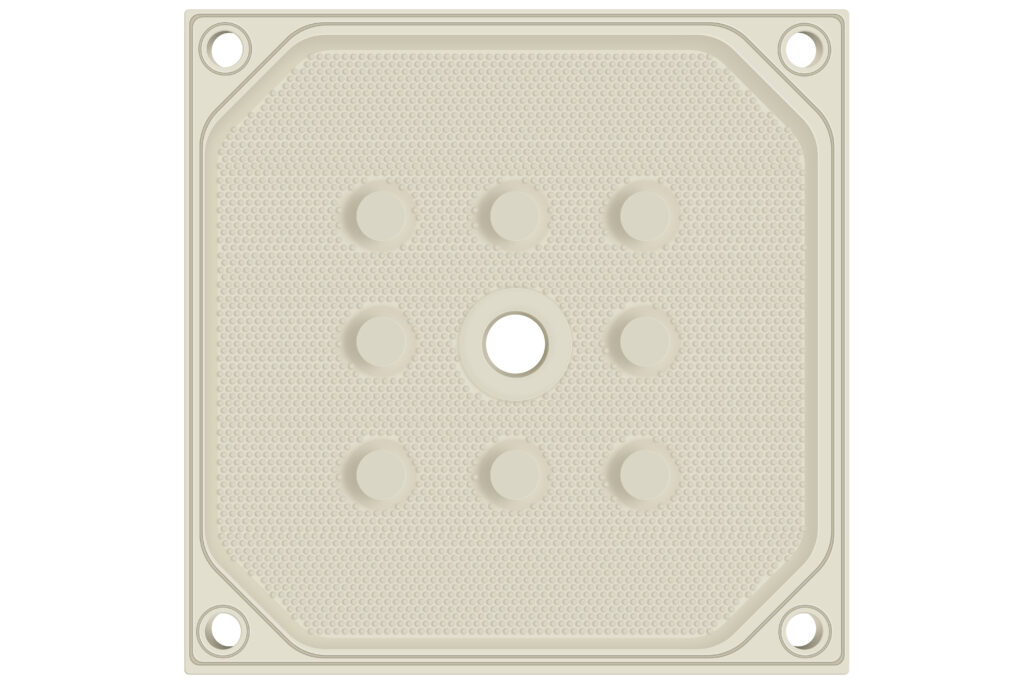
The recessed area is not smooth. It carries a pattern of raised studs or pips that support the filter cloth and leave channels underneath for the filtrate. The height, spacing and shape of these studs affect how freely the filtrate can leave the chamber and how well the cloth is supported under pressure. Poor support can lead to premature cloth wear or blinding, while a well-designed pattern extends cloth life and stabilizes the cycle time.
Some designs use ribbed or grooved drainage patterns instead of studs. Ribbed surfaces are often preferred in higher-pressure duties because they provide more continuous cloth support.
Sealing edge and hard points
The sealing edge must be flat and precisely finished. Even small variations reduce sealing quality and cause leakage, uneven wear or cloth damage. In thicker or higher-pressure plates, additional hard points inside the recess help the plate resist deflection under closing force and feed pressure.
Open vs. closed filtrate discharge
With open (exposed) discharge, the filtrate leaves each plate through a separate outlet at the side or bottom, so an operator can see the flow from every chamber. A torn cloth or a blocked chamber is easy to spot. With closed (enclosed) discharge, the filtrate passes through internal ports and collects in a common manifold. This is cleaner and better suited to hazardous, volatile or high-value filtrates, but it is harder to inspect chamber by chamber.
Gasketed vs. Non-Gasketed Recessed Plates: Which Sealing Option Fits Your Process?
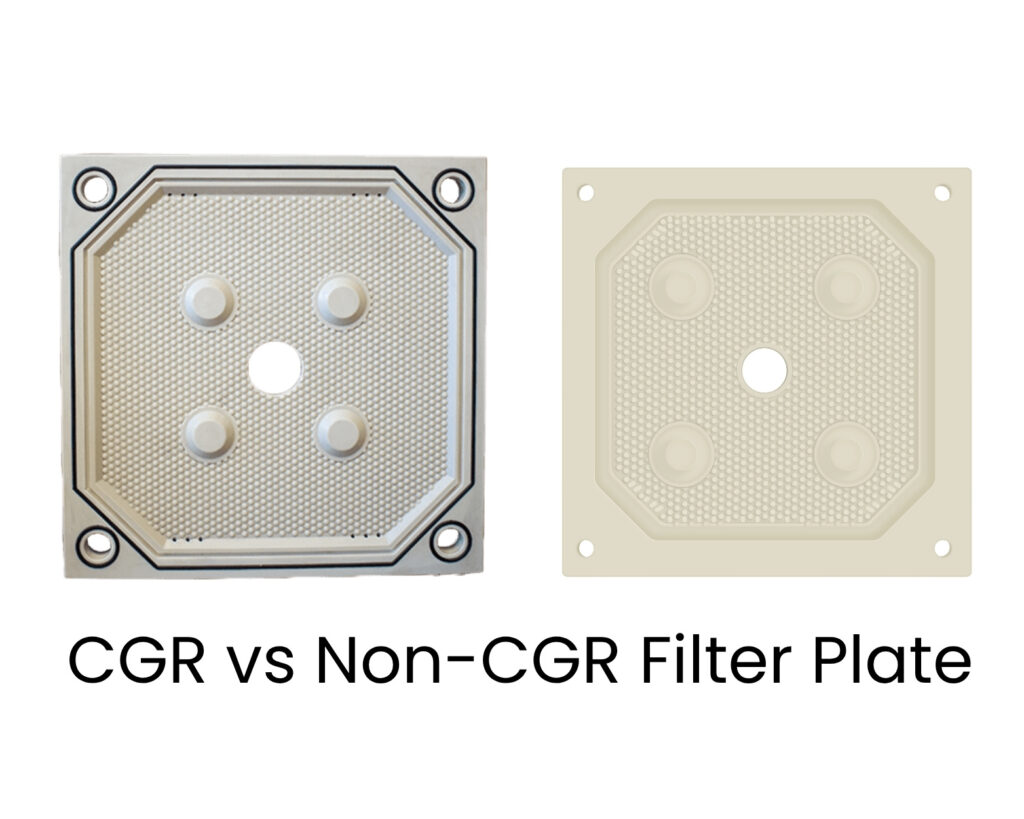
Recessed chamber plates come in gasketed and non-gasketed versions. The difference affects leakage, cloth installation and maintenance.
Gasketed plates use a gasket, often a molded or inserted sealing element along the edge. They are designed to reduce leakage between plates and are commonly chosen when the slurry is corrosive, hazardous or valuable, or where a clean working area matters.
Non-gasketed plates rely on the direct contact of the sealing edges and the cloth. Cloth installation is usually faster, and the initial cost is lower. Depending on the cloth and the slurry, some minor weeping at the edges can occur. A latex strip along the edge of the cloth can reduce wicking.
A quick way to decide:
- If leakage is unacceptable for safety, environmental or housekeeping reasons, choose gasketed.
- If the slurry is benign and you value fast cloth changes and low cost, non-gasketed is often sufficient.
- If you are unsure, consider the cost of cleanup and the hazard level of the slurry, rather than the plate price alone.
When to Use Recessed Chamber Plates (and When a Membrane Plate Is the Better Choice)
Where recessed chamber plates fit best
Recessed chamber plates are a strong choice when:
- The slurry filters reasonably well and does not need extreme cake dryness.
- The process is cost-sensitive and the plate budget is limited.
- A simple, low-maintenance operation is more important than the shortest possible cycle.
- The feed has high solids content, where the even center-fill design is an advantage.
Typical applications include mining and mineral processing, metal finishing, industrial and municipal wastewater, chemical processing, power, lime softening, stone fabrication and ready-mix concrete washout.
When a membrane plate is worth considering
A membrane plate has a flexible diaphragm that can be inflated after filtration. It squeezes the cake mechanically, which removes more moisture and shortens the long tail of the dewatering stage. Consider membrane plates when:
- Disposal, transport or drying costs make every point of cake moisture valuable.
- You need shorter cycle times to increase plant capacity without buying a bigger press.
- The cake is compressible and responds well to squeezing.
A practical middle path
Many plants run a mixed plate pack, alternating recessed chamber plates and membrane plates. This can improve dewatering and cycle time while keeping the plate cost lower than a full membrane pack. Whether it works for your slurry depends on the press design and the feed characteristics, so it should be verified with test data.
Recessed chamber vs. membrane plate at a glance
| Factor | Recessed chamber plate | Membrane plate |
|---|---|---|
| Cake dewatering | Depends on feed pressure and time | Improved by mechanical squeeze |
| Cycle time | Longer tail in dewatering stage | Often shorter overall |
| Plate cost | Lower | Higher |
| Auxiliary needs | Standard feed system | Requires squeeze medium (air or water) and control |
| Complexity | Simple | More components to maintain |
| Best fit | Easily filtered slurries, moderate dryness targets, budget-sensitive projects | Higher dryness targets, throughput-limited plants, expensive disposal |
How to Specify Recessed Chamber Filter Plates: Material, Pressure Rating and Size
A clear specification prevents most of the problems that show up after installation. Prepare the following before requesting a quotation.
Press frame data. Plate size, thickness, feed position, handle or lug type, and the number of plates. Plates must match the existing frame exactly, or the retrofit will fail at installation. Standard sizes range from small laboratory formats up to large industrial plates, and square, rectangular and round shapes are available.
Operating pressure. Common ratings for recessed plates fall in the range of roughly 7 to 16 bar (about 100 to 230 psi), with higher-pressure options available on reinforced designs. Always specify the maximum feed pressure and the closing pressure of your press.
Temperature. Plate material and grade set the temperature limit. Provide the highest slurry temperature the plate will see, including any wash water or cleaning cycle.
Slurry chemistry. State the pH range, the presence of solvents, oxidizers or abrasives, and the particle size and solids concentration. These determine the material, the wear allowance and the gasketing choice.
Cloth and discharge. Confirm the cloth type and whether open or closed filtrate discharge is required.
Duty targets. Give the expected cake dryness, cycle time
If you send this information to a plate manufacturer, a good supplier will be able to confirm the fit, flag any risks and suggest alternatives where the duty calls for it.
Choosing With Confidence
Recessed chamber plates remain the default choice for a reason: they are dependable, economical and well suited to a wide range of slurries. The key is to match the plate to the duty, and to look beyond the unit price to feed design, sealing, pressure rating and frame compatibility.
If you are comparing plate options or planning a retrofit, our team can review your slurry data and press dimensions and suggest a suitable plate configuration. Feel free to get in touch with the details of your application whenever you are ready.
Frequently Asked Questions
What is the difference between a recessed chamber plate and a membrane plate?
A recessed chamber plate forms a fixed-volume chamber and relies on feed pressure and time to build and dewater the cake. A membrane plate adds an inflatable diaphragm that squeezes the cake after filtration, giving a drier cake and often a shorter cycle at a higher plate cost.
How dry can the cake be with recessed chamber plates?
It depends mainly on the slurry, including particle size, compressibility and conditioning, as well as the feed pressure and cycle time. Some slurries reach a fairly dry cake, while others stay wetter. A pilot test or trial with your actual material is the most reliable way to know.
Should I choose gasketed or non-gasketed plates?
Choose gasketed plates when leakage is a safety, environmental or cleanliness issue, or when the filtrate is valuable. Non-gasketed plates suit benign slurries where faster cloth installation and lower cost matter more.
What material are recessed chamber filter plates made of?
Most are made of polypropylene because of its chemical resistance, low weight and strength. More demanding duties may call for reinforced or alternative materials. The right choice depends on temperature, pressure and slurry chemistry.
Can I replace the plates on an older filter press with new recessed chamber plates?
Often yes, provided the new plates match the frame dimensions, feed position, thickness and handle style, and are rated for your operating pressure. Sharing your press drawings or measurements with the manufacturer is the safest way to confirm compatibility.