
Every year, industrial buyers lose thousands of dollars because they order filter plates without fully understanding their slurry characteristics. I’ve seen it too many times — a facility receives the wrong plates, production stalls, and months of profit disappear while they wait for replacements. The good news is that choosing the right filter plate doesn’t have to be a guessing game if you follow the right evaluation process from the start.
To choose the right filter plate, start with your slurry characteristics — including pH, solids content, particle size, abrasiveness, and operating temperature — then select the plate type, material, size, and cavity depth that match your process goals and equipment specifications. Always verify chemical compatibility and pressure ratings before ordering.
Start with Slurry Characteristics
Why do most filter plate selection mistakes happen? Because buyers look at price or dimensions first — and the slurry second. In reality, your slurry is the single most important factor that determines everything else about your filter plate choice.
The key selection factors from your slurry include pH level, solid concentration, particle size distribution, abrasiveness, viscosity, operating temperature, feed pressure, required cake moisture content, washing requirements, and cycle time expectations. Each of these factors narrows down your viable plate material, type, and design options.
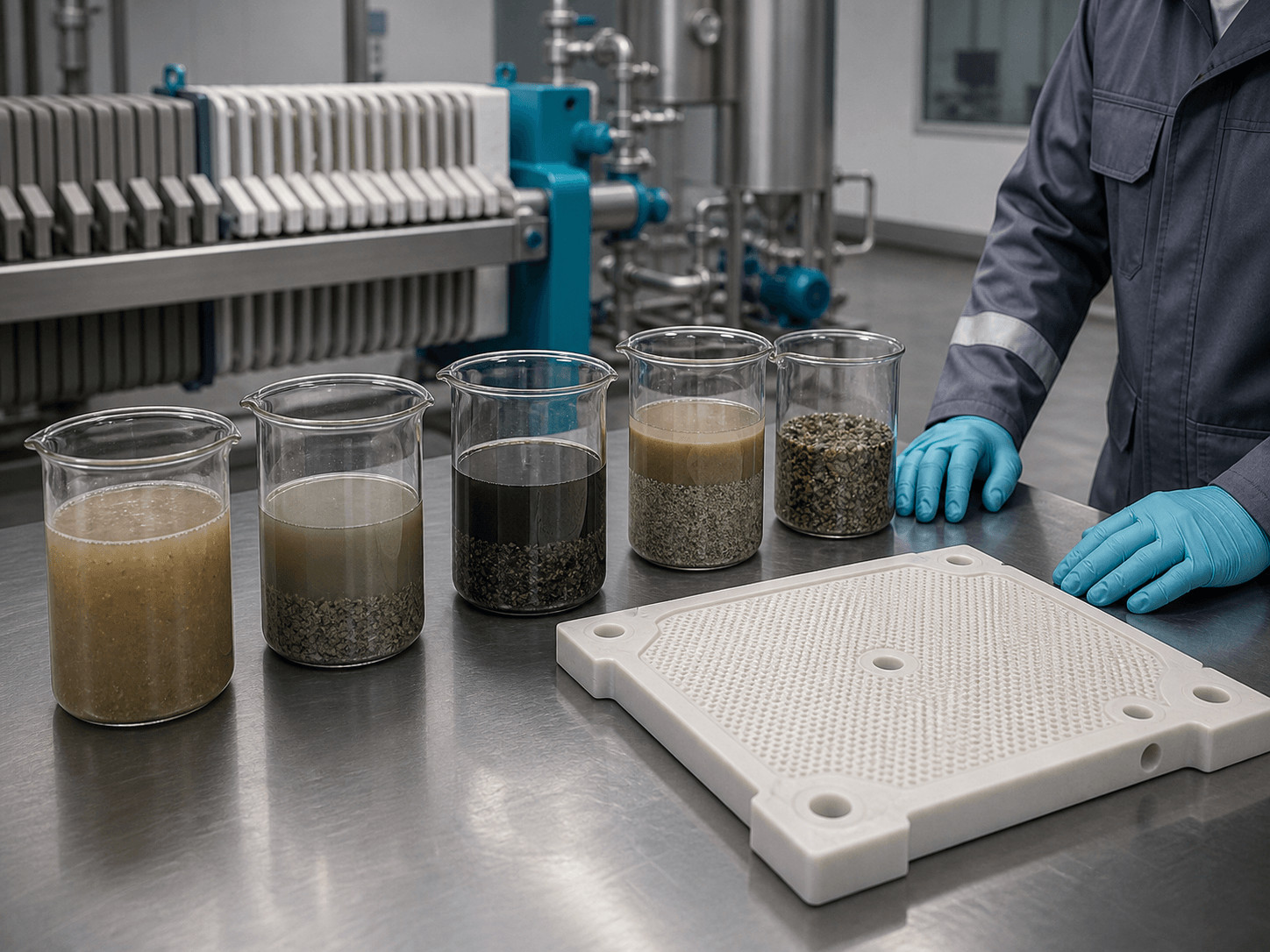
Understanding Slurry Chemistry
Your slurry’s chemical composition dictates which plate material will survive. An acidic slurry with a pH below 3 will rapidly degrade standard polypropylene plates over time. A highly alkaline process above pH 12 can cause similar issues. I remember working with a mining client whose slurry had a pH of 1.5 — their initial PP plates deteriorated within six months, developing micro-cracks that led to sudden failures during operation.
Here’s what you need to document about your slurry chemistry:
- pH range — the minimum and maximum values your slurry reaches during the cycle
- Chemical composition — specific acids, bases, salts, or organic compounds present
- Oxidizing agents — substances like chlorine or peroxides that accelerate material degradation
- Contaminants — any unexpected compounds that might interact with plate materials
Solids Characteristics Matter More Than You Think
The physical properties of your solids directly impact plate wear and filtration efficiency:
- Particle size — Fine particles below 10 microns may require different plate surface textures than coarse particles above 100 microns
- Abrasive content — Materials like silica sand, iron ore concentrates, or metal hydroxides cause accelerated wear on plate surfaces and sealing faces
- Solid concentration — Higher solids content means longer filtration cycles and more mechanical stress on plates
- Cake compressibility — Some sludge forms hard, compact cakes while others remain loose and friable
Temperature and Pressure Requirements
Operating temperature affects both material selection and plate design. Standard polypropylene filter plates handle temperatures up to approximately 80°C. Above that, you need to consider alternatives like PVDF or stainless steel. Meanwhile, operating pressure determines the structural strength your plates must provide — higher pressures demand thicker plates with reinforced designs.
Choose the Right Filter Plate Type
Once you understand your slurry, the next critical decision is which filter plate type best serves your application. Each type offers distinct advantages for different process requirements.
The four main filter plate types are recessed cavity plates for general filtration, membrane squeeze plates for low cake moisture, CGR plates for fast filtration with washability, and plate-and-frame designs for highly abrasive or variable slurries. The right type depends on your moisture target, throughput needs, and cake discharge requirements.
| Filter Plate Type | Best For | Max Moisture Reduction | Typical Pressure Range | Cost Level |
|---|---|---|---|---|
| Recessed Cavity | General filtration | Baseline | 0.6–1.2 MPa | Low |
| Membrane Squeeze | Low moisture cake | 15–30% | 0.6–2.0 MPa | High |
| CGR | Washing applications | Moderate | 0.6–1.2 MPa | Medium |
| Plate-and-Frame | Abrasive or lab use | Minimal | 0.4–0.8 MPa | Low–Medium |
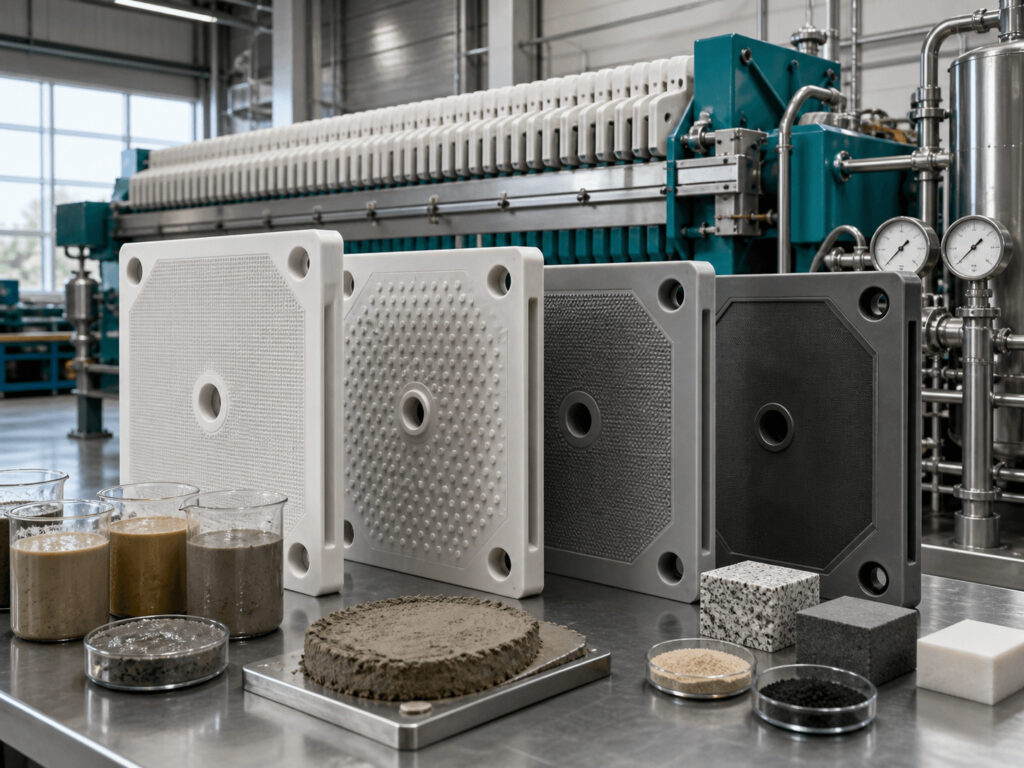
Choose the Right Plate Material
The material your filter plates are made from determines their chemical resistance, thermal stability, and mechanical durability. Choosing the wrong material is the fastest way to experience premature plate failure and unexpected downtime.
Common filter plate materials include polypropylene (PP), polyethylene (PE), stainless steel 304/316, and PVDF. Polypropylene is the most widely used due to its excellent chemical resistance and affordability, while stainless steel handles the highest temperatures and most aggressive chemicals at a premium cost.
| مادة | Temperature Range | Chemical Resistance | Abrasion Resistance | Relative Cost |
|---|---|---|---|---|
| Polypropylene (PP) | −10°C to 80°C | Excellent for most acids and bases | Good | 1× |
| Polyethylene (PE) | −20°C to 80°C | Very Good | Very Good | 1.1× |
| PVDF | −20°C to 140°C | Excellent, including oxidizers | Very Good | 2.5× |
| SS 304/316 | Up to 250°C+ | Excellent across broad range | Excellent | 4–6× |
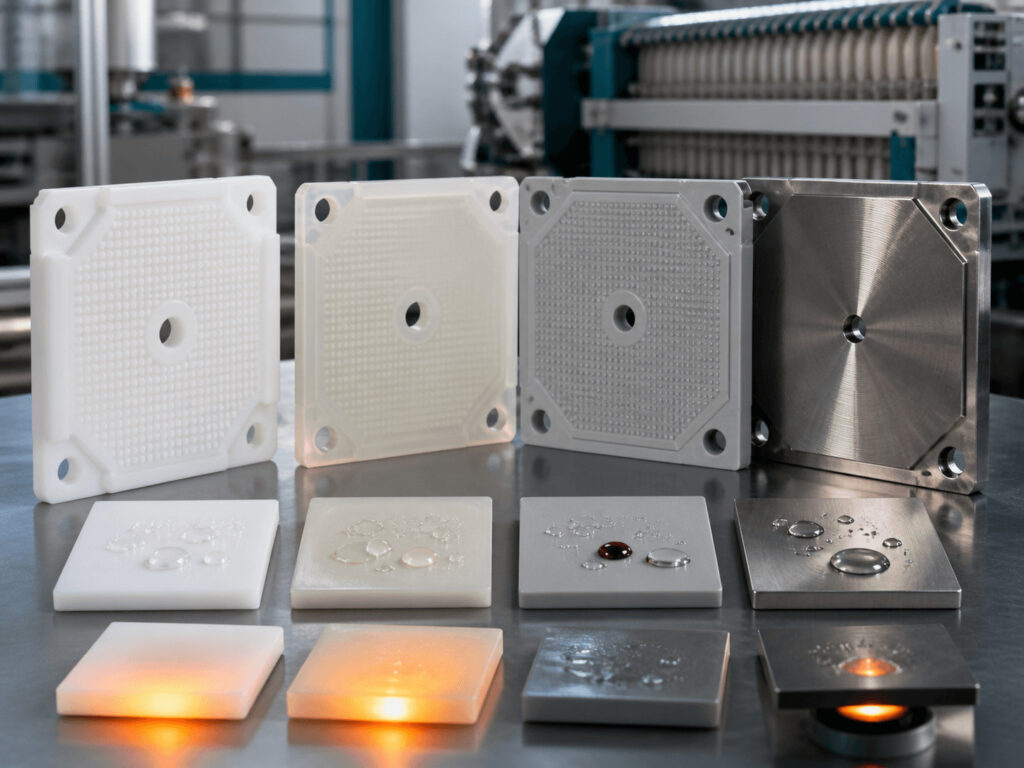
Check Operating Requirements
Your filter press operates within specific pressure and temperature constraints, and your filter plates must be rated to handle those conditions safely throughout their service life. Ignoring these parameters can lead to plate deformation, seal failure, or catastrophic rupture.
Filter plates should be rated for at least 20% above your maximum operating pressure to provide a safety margin. Operating temperature must stay within the material’s rated range, and your target cake moisture directly influences whether you need membrane squeeze capability or standard chamber plates will suffice.
Pressure Rating Considerations
Standard industrial filter plates are typically rated for operating pressures between 0.6 MPa and 1.2 MPa. Membrane squeeze plates often require higher ratings, up to 2.0 MPa, because the squeezing phase adds additional internal pressure to the already-formed cake. When selecting plates, always confirm the manufacturer’s rated pressure and ensure it exceeds your maximum feed pressure by a comfortable margin.
I’ve encountered situations where buyers selected plates rated exactly at their operating pressure. Over time, thermal cycling and mechanical fatigue reduced the actual pressure tolerance, leading to premature failures. A 20% safety margin is not excessive — it’s essential.
Temperature Effects on Plate Performance
Temperature does more than challenge material selection. It affects plate dimensions through thermal expansion and contraction, which can compromise sealing surfaces if the plate and frame materials expand at different rates. In high-temperature applications, specify plates with tight dimensional tolerances and verify that the manufacturer has tested the plate design at your target operating temperature.
Cake Moisture Targets Drive Plate Selection
Your desired cake moisture is perhaps the single most important performance target. If your process requires cake moisture below 20%, membrane squeeze plates are likely necessary. Standard chamber plates typically achieve cake moisture levels between 25% and 40%, depending on slurry characteristics and operating conditions. Understanding your moisture target early in the selection process prevents costly redesigns after installation.
Choose Plate Size and Chamber Depth
Filter plate dimensions and cavity depth directly affect your press’s throughput, cycle time, and maintenance intervals. Getting these specifications wrong means either excessive changeover frequency or insufficient capacity for your production targets.
Filter plate dimensions must match your existing filter press frame or be precisely specified for a new installation. Cavity depth determines cake storage capacity — deeper chambers mean fewer discharge cycles but longer cycle times and potentially harder cake discharge. Standard sizes range from 200 mm to 2000 mm in side length.
Matching Plate Size to Your Press
If you’re replacing plates on an existing filter press, accurate measurement is critical. You need the overall length, width, thickness, and the exact geometry of feed and filtrate ports. Even a 5 mm discrepancy in port alignment can cause leaks and performance loss. At Longone, we provide detailed dimension sheets for every plate model to help ensure perfect compatibility with your existing equipment.
For new installations, work with your engineering team to determine the optimal plate size based on your required hourly or daily throughput, available floor space, and hydraulic system capacity.
Chamber Depth and Cycle Efficiency
Chamber depth is a balancing act. Deeper chambers hold more cake, which means:
- Fewer discharge cycles per shift
- Longer filtration times per cycle
- Potential difficulty discharging thick or sticky cakes
- Increased cleaning time between cycles
Shallower chambers offer the opposite advantages — faster cycles and easier discharge but more frequent maintenance interruptions. The optimal depth depends on your slurry’s solids content, cake characteristics, and your production schedule.
Choose Replacement Filter Plates
Replacing worn or damaged filter plates is one of the most common procurement tasks for filter press operators. However, it requires more attention to detail than simply ordering the same part number, especially if your operating conditions have changed since the original plates were installed.
When selecting replacement filter plates, verify the exact dimensions, port configuration, and material grade of your existing plates. Reassess whether your current operating conditions — especially slurry chemistry, temperature, and pressure — still match the original plate specifications, as process changes may require an upgrade.
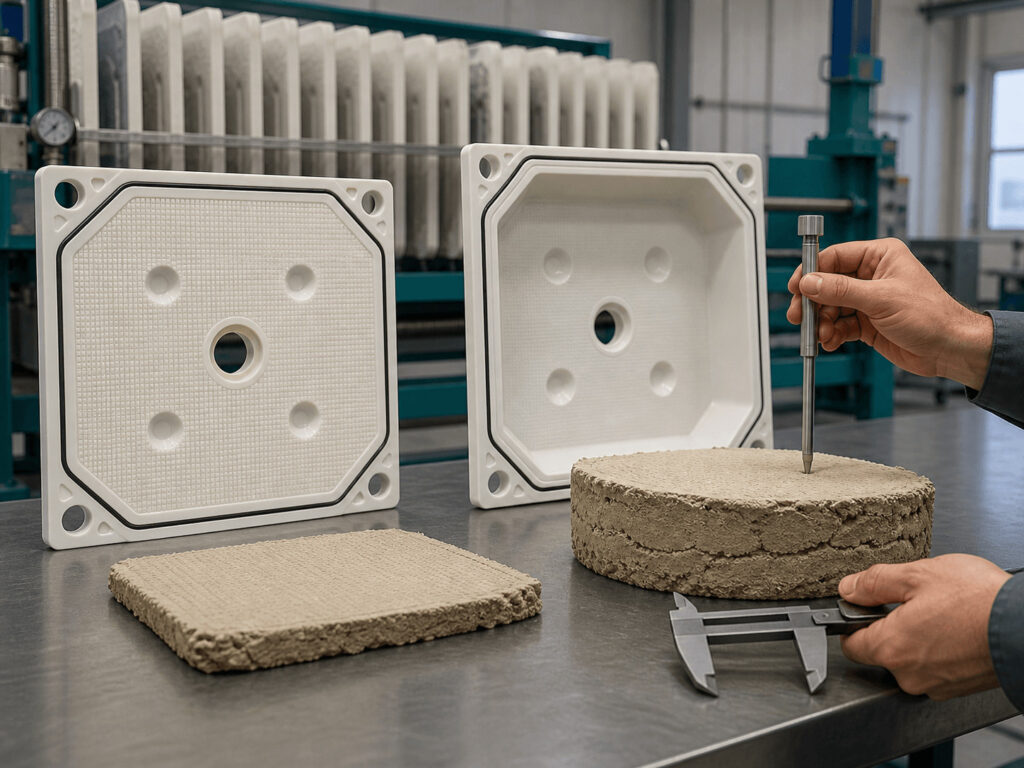
Document Your Current Setup
Before placing a replacement order, take careful measurements of your existing plates. Record the length, width, thickness, corner radius, feed port diameter and position, filtrate port configuration, and the number and placement of corner holes for mounting. Photograph the plates from multiple angles. This documentation prevents ordering errors and serves as a reference if you ever need to reorder.
Reassess Your Operating Conditions
Process changes are common in industrial facilities. Over time, your slurry composition may have shifted, your operating temperature may have increased, or your production targets may have changed. Compare your current conditions against the original plate specifications. If anything has worsened — higher temperature, more aggressive chemistry, higher pressure — discuss the changes with your supplier. You may need to upgrade to a more resistant material or a stronger plate design.
Work With Certified Manufacturers
Always source replacement plates from certified manufacturers who provide material certifications and dimensional guarantees. At Longone, we maintain detailed records of our plate specifications and offer compatibility guidance for most major filter press brands. Properly certified replacement plates from a reputable manufacturer ensure that your press returns to full performance quickly and reliably, with a warranty that protects your investment.
Conclusion
Choosing the right filter plate is not a simple catalog lookup — it’s a systematic evaluation that starts with understanding your slurry and ends with matching every specification to your actual operating conditions. From slurry chemistry and particle characteristics to plate type, material, pressure rating, and cavity depth, every decision point matters. I’ve watched too many facilities waste time and money on plates that fail prematurely because the selection process skipped critical steps.
The investment in proper filter plate selection pays for itself repeatedly through longer service life, lower downtime, and better filtration performance. If you need guidance selecting filter plates for your specific application, our engineering team at Longone is available to review your process conditions and recommend the optimal solution — from standard models to fully customized designs. Reach out and let’s ensure your next filter plate order is the last one you need to worry about for years.