
A filter press can have a strong feed pump, a healthy hydraulic system and a well-planned process, and still produce wet cake, leaking joints and cracked plates. When that happens, the machine is rarely the problem. The plates are.
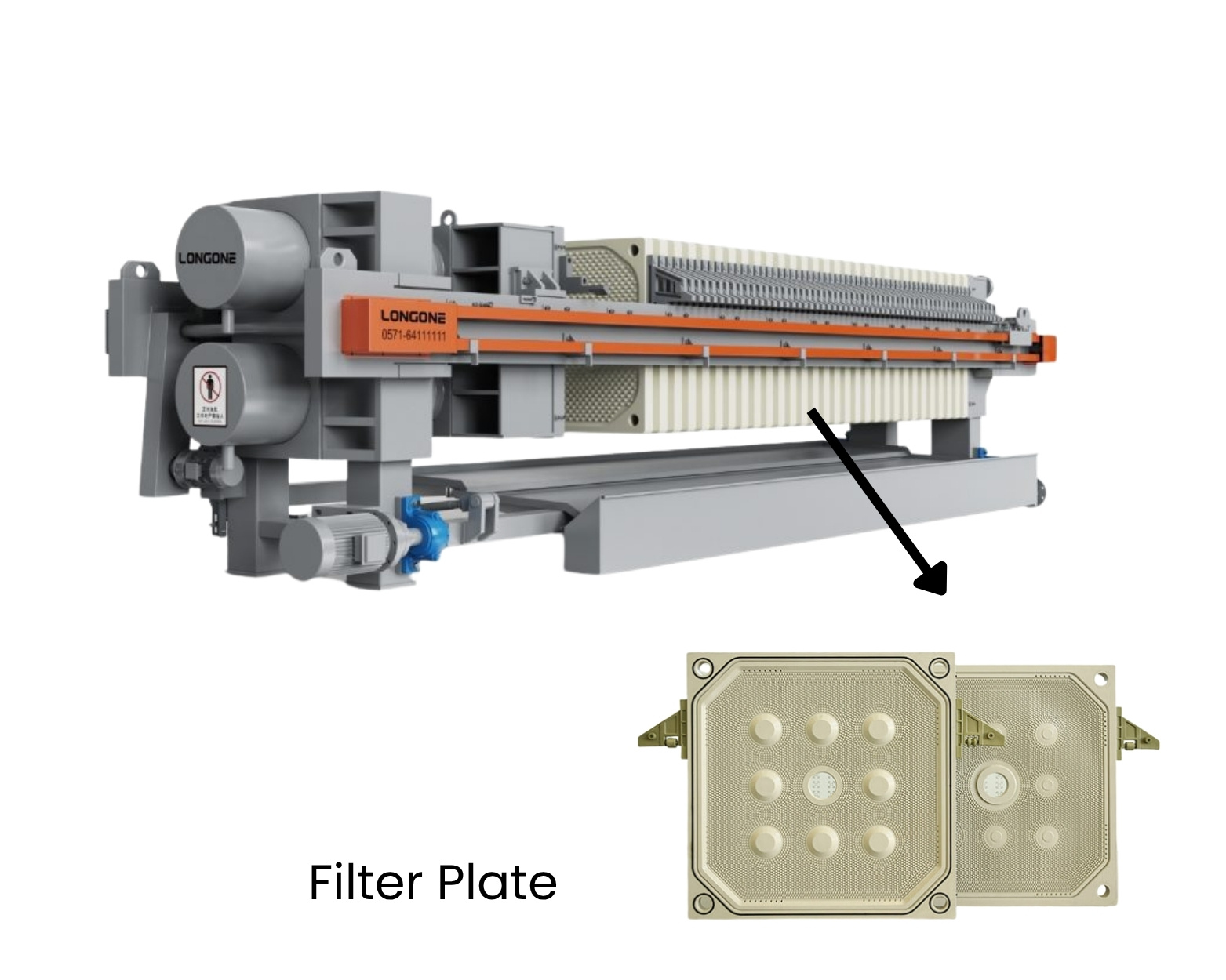
Filter plates are the core component of a filter press. They form the filtration chambers, carry the filter cloth, channel the filtrate out and take the full pressure of every cycle. The plate you choose decides cake dryness, cycle time, sealing reliability and how often you stop the line for replacements.
This guide explains how filter plates for filter presses work, which plate types suit which slurries, how materials and specifications affect performance, and how to build a selection checklist you can send to any manufacturer.
What Are Filter Plates for Filter Presses and How Do They Work
A filter press separates solids from liquid by pumping slurry into a stack of plates held together under hydraulic force. Each pair of neighboring plates creates a chamber. A filter cloth covers the surface of every plate, and the cloth is what actually holds back the solids.
A typical cycle has five stages:
- Closing: The hydraulic cylinder pushes the plate pack together and holds it under pressure.
- Feeding: Slurry is pumped into each chamber through the feed port.
- Filtration: Liquid passes through the cloth and flows along the drainage surface of the plate to the filtrate outlet. Solids stay behind.
- Cake formation: The chambers fill with solids until flow drops and the cake reaches the target dryness. Some plates add a squeezing or washing step here.
- Discharge: The press opens, plates are shifted apart and the cake falls out.
The plate does more than hold the cloth in place. Its drainage surface pattern, feed position, chamber depth, sealing structure and mechanical strength all affect how evenly cake forms, how quickly filtrate leaves and whether the joint stays leak-free at working pressure. A plate that is slightly wrong for the application can quietly cost you capacity on every single cycle.
Chamber, Membrane, CGR and Plate-and-Frame: Which Filter Plate Type Fits Your Slurry
Four plate designs cover most industrial filter presses. They differ in how the chamber is formed, how the joint is sealed and whether the cake can be squeezed after filtration.
Chamber (recessed) filter plates
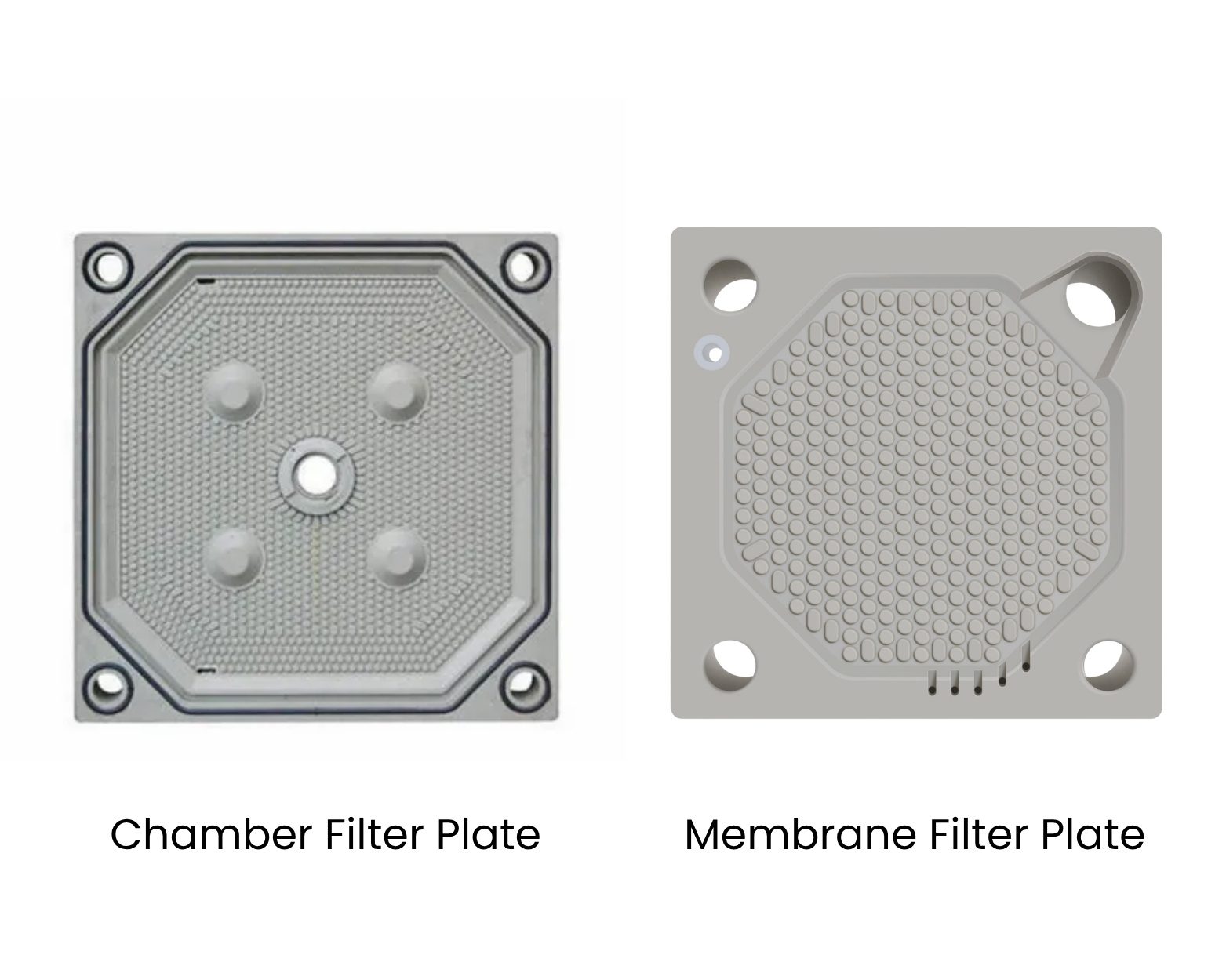
Chamber plates have a recessed surface on both sides. When two plates are pressed together, the recesses form a closed chamber. This is the most widely used design for general sludge dewatering and solid-liquid separation. It has a simple structure, is easy to maintain and works across a wide range of slurries. The cake dryness depends entirely on feed pressure and filtration time, since there is no mechanical squeeze.
Membrane filter plates
A membrane plate has a flexible diaphragm on its surface. After the normal filtration stage, compressed air or water inflates the membrane and squeezes the cake from the side. The result is lower cake moisture and often a shorter overall cycle, because less time is needed to reach the target dryness. Membrane plates cost more than chamber plates, so they make the most sense when disposal cost, drying cost or downstream handling makes dryness valuable.
CGR filter plates
CGR (composite gasketed recessed) plates have a built-in sealing structure along the plate edge. The seal sits in a dedicated groove and creates a tight joint between plates. CGR plates are a practical answer to persistent edge leakage, particularly in applications with fine particles or higher pressure, where a standard joint tends to weep or spit slurry.
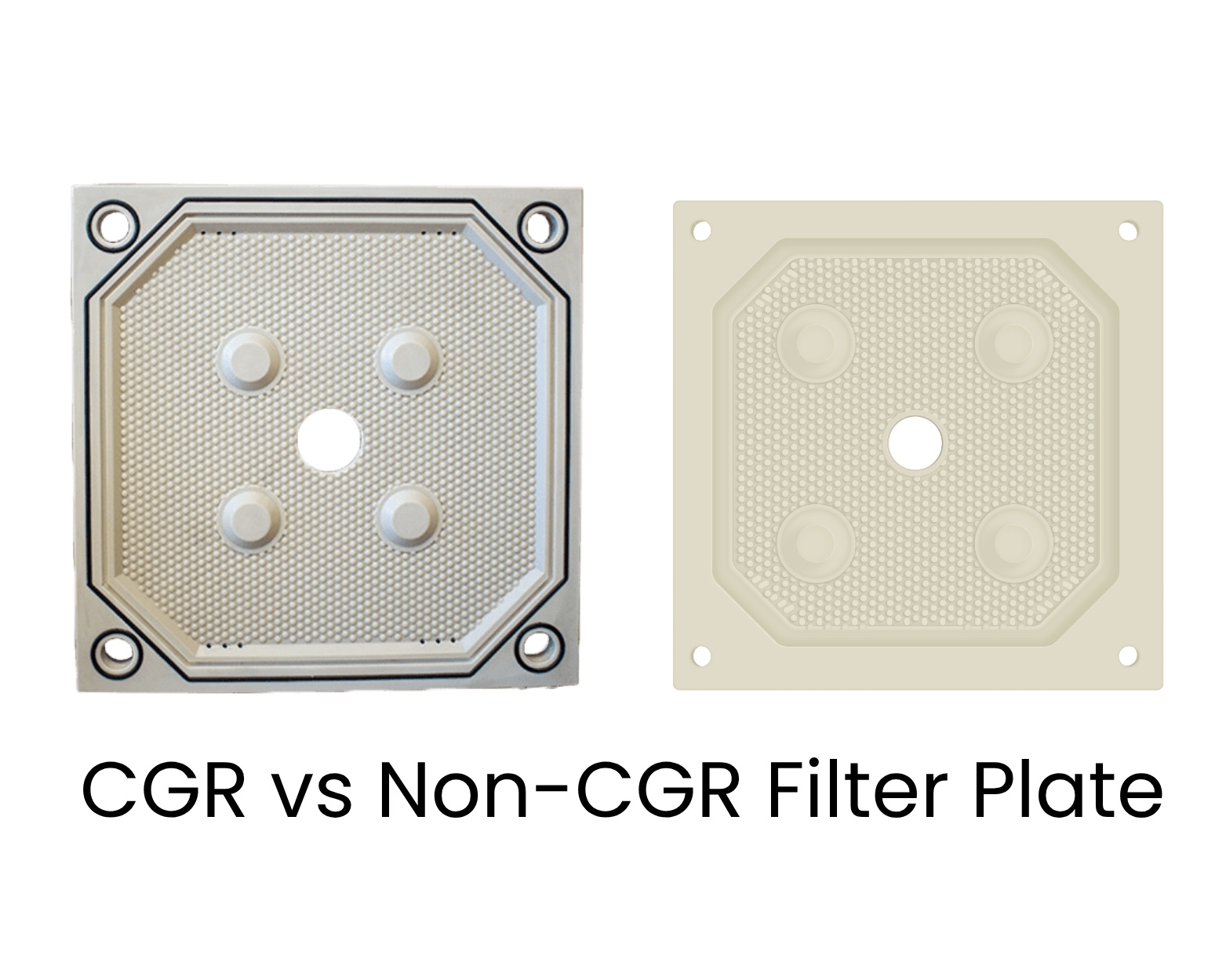
Plate-and-frame filter plates
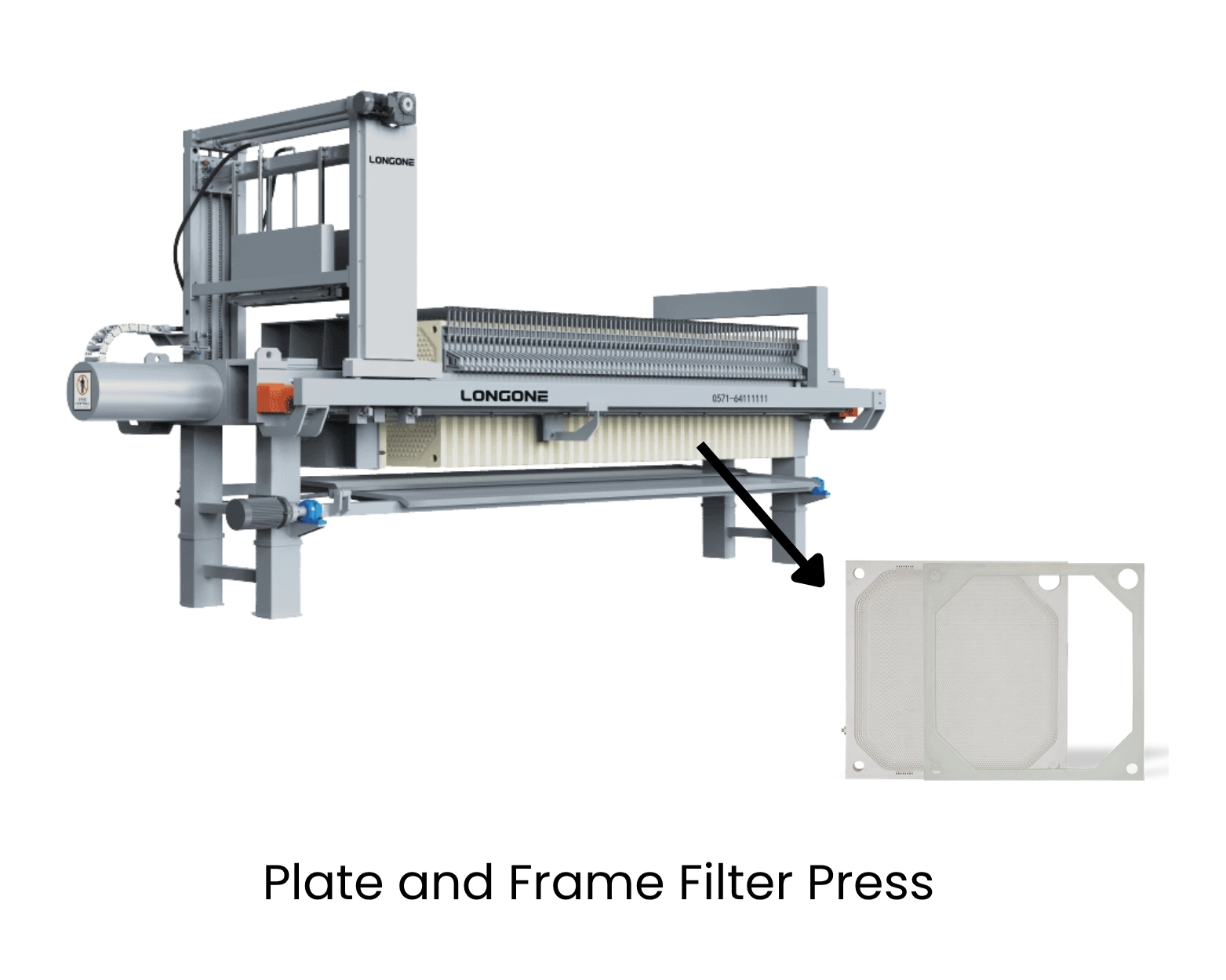
In a plate-and-frame configuration, flat plates alternate with separate frames. The frame thickness sets the cake thickness, so operators can adjust cake depth by changing frames. This design works well for fine, difficult or specialty filtration where flexibility and cake control matter more than automation or speed.
Quick comparison
| Plate type | Best-fit slurry / application | Cake moisture | Typical pressure range | Relative cost |
|---|---|---|---|---|
| Chamber | General sludge, mineral slurries, broad industrial use | Moderate, depends on feed pressure and time | Standard feed pressure | Lowest |
| Membrane | Applications where low cake moisture and shorter cycles justify the investment | Lowest, thanks to the squeeze step | Feed pressure plus squeeze pressure | Highest |
| CGR | Fine particles, edge leakage problems, higher-pressure duty | Moderate, similar to chamber | Standard to higher feed pressure | Medium |
| Plate-and-frame | Fine or specialty filtration needing adjustable cake thickness | Moderate, set by frame depth | Standard feed pressure | Medium |
The right choice depends on your slurry, your target cake dryness and what the dryness is worth to you downstream. If you are replacing plates on an existing press, the press itself usually limits which designs are even possible, so check that before comparing price.
For detailed specifications, see LONGONE’s pages on membrane filter plates, chamber filter plates, CGR filter plates and plate and frame filter plates.
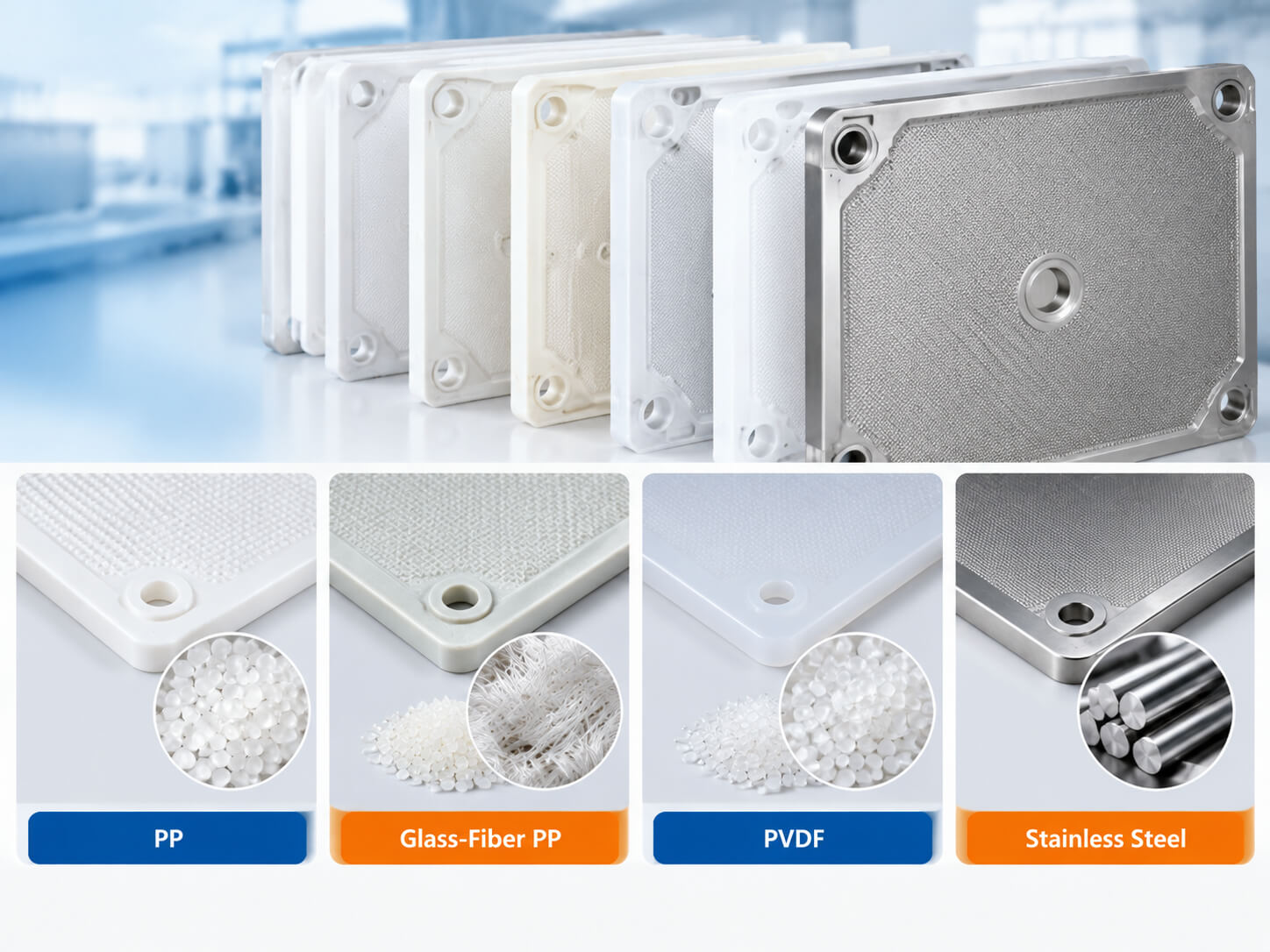
Filter Plate Materials: PP, Glass-Fiber PP, PVDF and Stainless Steel Compared
Material decides how a plate behaves under pressure, heat and chemical attack. Choosing the wrong one is one of the most common reasons plates crack, warp or degrade early.
Polypropylene (PP)
PP is the industry default for good reasons. It is lightweight, chemically resistant to a wide range of acids and alkalis, and cost-effective. It handles typical sludge, mineral and many chemical slurries without difficulty. Its limits show up at higher temperature and pressure, where standard PP can soften or deform over time.
Glass-fiber reinforced PP
Adding glass fiber increases stiffness and strength, which helps the plate resist deformation and cracking under demanding pressure or temperature. It keeps the chemical resistance of PP while extending the working window. It is a common step up when standard PP shows fatigue.
PVDF
PVDF is chosen for aggressive chemicals, solvents and elevated temperatures where PP is no longer reliable. It costs more, so it is reserved for processes where chemical or thermal conditions justify it.
Stainless steel and cast iron
Metal plates serve specialized duties such as very high temperature or specific hygiene and mechanical requirements. They are heavier and more expensive, and they are used where polymer plates cannot meet the conditions.
| Material | Strengths | Typical use |
|---|---|---|
| PP | Light, chemical resistant, economical | Sludge dewatering, mining, general industry |
| Glass-fiber PP | Higher rigidity and strength | Higher pressure or temperature duty |
| PVDF | Strong chemical and heat resistance | Aggressive chemicals, solvents |
| Stainless steel / cast iron | Mechanical strength, temperature tolerance | Specialized or high-temperature processes |
The practical rule: start with PP, and move up only when your actual temperature, pressure or chemistry demands it. Over-specifying material adds cost without adding value, and under-specifying leads to early failure.
Filter Plate Size, Feed Position and Sealing Design: Specs That Decide Compatibility
Even with the right type and material, a plate has to physically fit and seal on your press. These specifications are where most replacement orders go wrong.
Plate size. Filter plates range from small laboratory formats to very large industrial plates. LONGONE produces sizes from 250 × 250 mm up to 2000 × 2000 mm and beyond, and larger sizes are available through our filter press plate sizes range. Size determines filtration area per plate and therefore total press capacity.
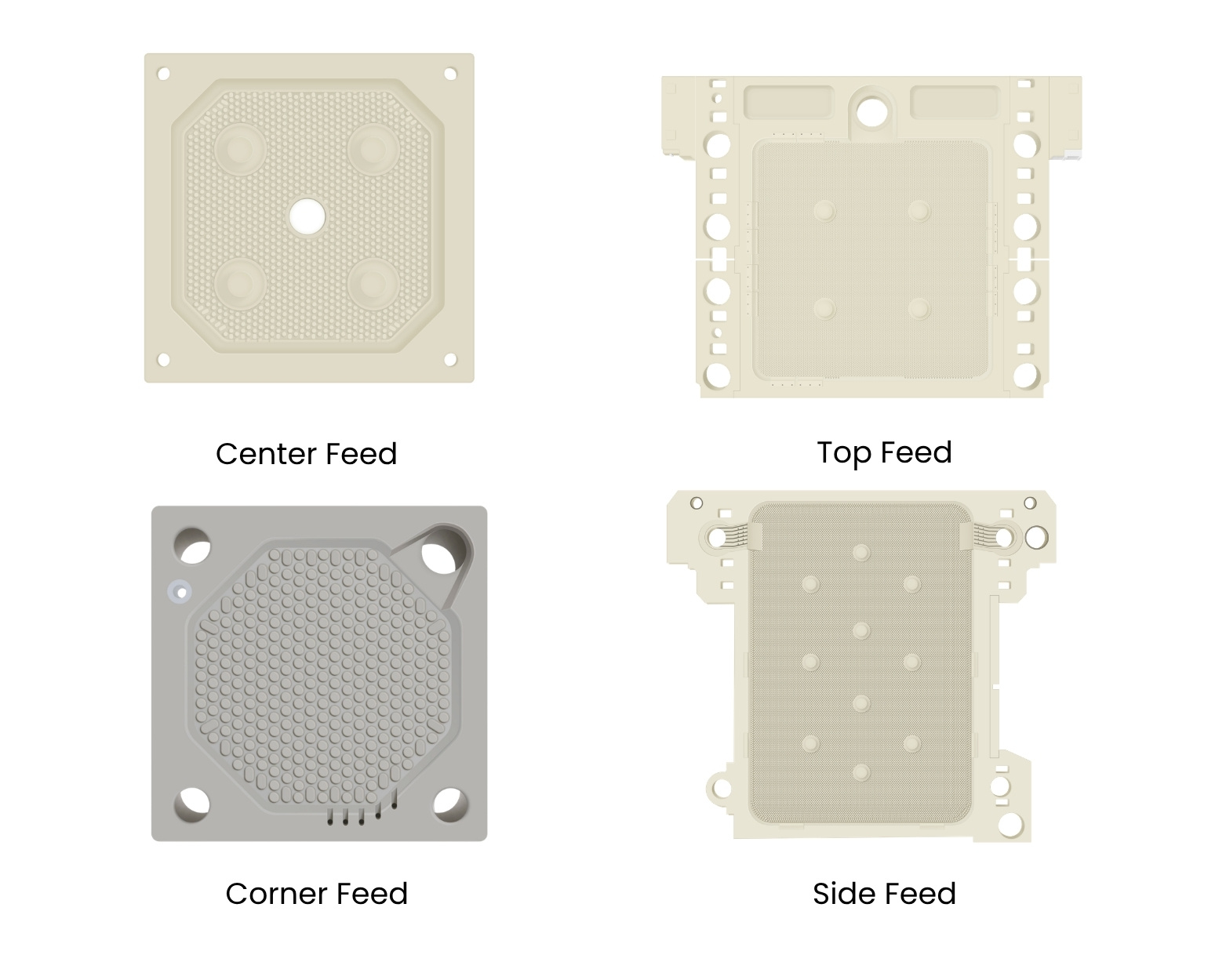
Feed position. Slurry can enter through the center of the plate, from a corner, from the top or from the side. The feed position must match the press design and the plate pack. A mismatch means the plate does not connect to the manifold at all, and fixing it means modifying the press, not the plate.
Sealing design. A joint can be gasketed, non-gasketed or CGR. Gasket materials such as EPDM, NBR, neoprene or Viton are selected according to temperature and chemical exposure. The seal is what keeps slurry inside the chamber, so mismatched gasket material is a frequent cause of leakage.
Chamber depth and cake thickness. Chamber depth sets the volume of solids each cycle can hold. Deeper chambers give more capacity per cycle but need longer filtration and drying times. The depth should match your solids loading.
Drainage surface pattern. Ribs, grooves, pips and grid patterns all channel filtrate differently. The pattern affects flow speed, cloth support and wear.
Handles and lugs. The handle and lug design has to match your existing frame and rails so plates sit and shift correctly in the press.
Small dimensional deviations cause outsized problems. A plate that is slightly off in thickness, handle position or feed hole alignment creates uneven pressure across the pack, leading to leaks and uneven wear. This is why tight manufacturing tolerances matter more than headline specifications.
How to Select Filter Plates for Your Filter Press: A Step-by-Step Checklist
A good selection starts with data, not with a price list. Work through these steps before you request quotes.
Step 1: Define your slurry. Record solids content, particle size, viscosity and whether the slurry is abrasive. These determine plate type and drainage design.
Step 2: Define operating conditions. Note feed pressure, any squeeze pressure, working temperature and pH or chemical content. These determine material and gasket choice.
Step 3: Set the dryness target. Decide what cake moisture you need and what it is worth. If low moisture saves meaningful cost in transport, drying or disposal, membrane plates deserve a serious look.
Step 4: Identify your existing press. For replacement plates, record the press brand, model, plate size, feed position, thickness and the number of plates. Send a drawing or a physical sample if possible.
Step 5: Check sealing and joint design. If you have chronic leakage, ask whether a CGR design or a different gasket would address it before assuming you need a larger change.
Step 6: Compare on total cost, not unit price. A cheaper plate that cracks twice as often is more expensive once downtime, labor and lost production are counted.
Common mistakes include selecting purely on price per piece, ignoring dimensional tolerance, over-specifying materials, and ordering without sending the original plate drawing or sample.
When you contact a manufacturer, the following list gets you an accurate quote fastest:
- Plate size and quantity
- Plate type: chamber, membrane, CGR or plate-and-frame
- Material preference
- Operating pressure, temperature and slurry type
- Existing press brand and model (for replacement orders)
Filter Plate Failure, Maintenance and When to Replace
Plates wear out, but most early failures have identifiable causes. Knowing them lets you fix the process, not just swap the part.
Common failure modes
- Cracking: Often caused by pressure spikes, uneven loading across the pack, or material that is not suited to the temperature.
- Warping or deformation: Typically heat or sustained over-pressure on a material with insufficient rigidity.
- Leakage at the joint: Caused by worn or incorrect gaskets, damaged sealing surfaces, poorly fitted cloth or dimensional mismatch.
- Feed port wear: Abrasive slurry gradually erodes the feed hole, especially at high flow.
- Blocked drainage surfaces: Fine solids or scale build up in the drainage pattern, restricting filtrate flow.
- Membrane damage (membrane plates): Punctures or fatigue in the diaphragm reduce squeeze effectiveness.
Maintenance habits that extend plate life
- Install filter cloth flat and fully seated, with no folds across the sealing surface, because cloth problems often show up as plate leakage.
- Keep sealing surfaces clean at every discharge.
- Avoid sudden pressure surges by ramping feed pressure gradually where the process allows.
- Inspect plates on a schedule, checking for cracks, edge damage and gasket condition.
- Clean drainage surfaces periodically to maintain flow.
- Rotate or replace worn plates in sets so that wear stays even across the pack.
When to replace
Replace a plate when cracks reach the sealing area or feed port, when deformation prevents a leak-free joint, when membrane damage cannot be repaired, or when repeated leakage persists after cloth and gasket have been checked. Replacing a few plates early is usually cheaper than letting one failed plate damage its neighbors or trigger an unplanned shutdown.
Choosing a Filter Plate Partner
The best filter plate is the one that fits your press precisely, matches your slurry and holds up to your real operating conditions. That outcome depends on accurate specifications and consistent manufacturing, not on any single feature.
LONGONE is a China-based manufacturer of filter press plates supplying customers in more than 30 countries. Our plates are designed to fit most major filter press brands, and because we process raw materials in-house through our subsidiary, Longyuan New Materials Co., Ltd., we control quality from raw material to finished plate. If you are comparing options, you are welcome to send your plate size, type, material preference, operating conditions and press model, and our team will review them and respond with a detailed quotation.
Frequently Asked Questions
What are filter press plates made of?
Most filter press plates are made of polypropylene (PP), valued for its chemical resistance and low cost. Glass-fiber reinforced PP adds stiffness for higher pressure or temperature, PVDF handles aggressive chemicals and heat, and stainless steel or cast iron serve specialized high-temperature or mechanical duties.
What is the difference between chamber and membrane filter plates?
Chamber plates form a fixed recessed chamber, so cake dryness depends on feed pressure and filtration time. Membrane plates add an inflatable diaphragm that squeezes the cake after filtration, producing lower moisture content and often shorter cycles, at a higher plate cost.
How do I know which filter plate fits my filter press?
Match the plate size, thickness, feed position, handle and lug design, and sealing structure to your existing press. The most reliable method is to provide the press brand and model together with a drawing or a physical sample of the original plate to the manufacturer.
How long do polypropylene filter plates last?
Service life varies widely with pressure, temperature, slurry abrasiveness, chemistry and maintenance. Plates operated within their rated conditions, with correct cloth installation and gradual pressure ramping, last considerably longer than plates exposed to pressure spikes, overheating or poor sealing.
Can filter plates be customized for older or non-standard presses?
Yes. A manufacturer can produce plates to your size, chamber depth, feed position, material, gasket type, drainage pattern and handle design, working from a drawing or sample. This is a common solution for older presses whose original plates are no longer available.